

Compliance Update | 27 July 2026
2-Minutes-Briefing
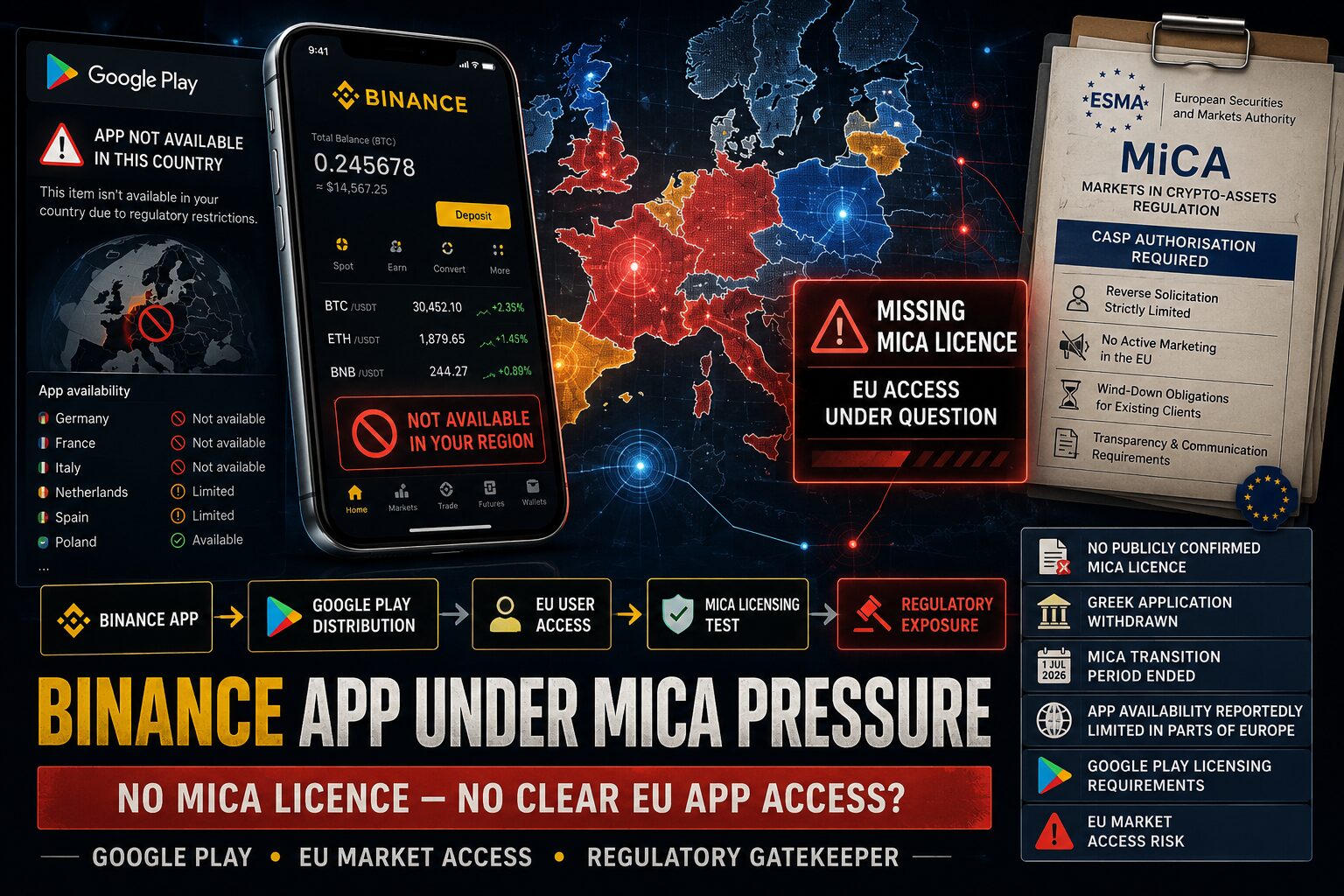
According to reports circulating on X, the Binance Android app is no longer available through the Google Play Store in parts of Europe. One of the sources behind the reports is Erald Ghoos, CEO of OKX Europe and therefore a representative of a direct Binance competitor. Cointelegraph subsequently picked up the claim.
So far, neither Google nor Binance has publicly confirmed in which countries the app may have been removed, whether the restriction is temporary, or which party initiated the measure. The reports should therefore be classified as plausible but not yet fully verified.
From a regulatory perspective, however, a regional removal would be consistent with Google Play’s crypto-app policy. Google requires crypto exchanges targeting EU member states to hold the necessary authorisation as a Crypto-Asset Service Provider (CASP) under the Markets in Crypto-Assets Regulation (MiCA).
Binance currently does not hold a publicly confirmed MiCA authorisation. The company withdrew its Greek MiCA application on 24 June 2026 and announced that it intended to apply in another EU jurisdiction.
Key Compliance Facts
| Issue | Compliance Assessment |
|---|---|
| Binance MiCA status | No currently confirmed EU-wide MiCA authorisation; Greek application withdrawn |
| MiCA transition period | Expired across the EU on 1 July 2026 |
| Google Play policy | EU distribution of crypto-exchange apps requires appropriate MiCA authorisation |
| App availability | Regional disappearance reported, but affected countries and cause remain unconfirmed |
| Permitted activity without authorisation | Generally limited to the orderly wind-down of existing EU customer relationships |
What MiCA Now Requires From Binance
ESMA has set out clear expectations for crypto-asset service providers that are no longer covered by national transitional arrangements and have not obtained MiCA authorisation. Such providers must generally:
- stop onboarding new EU customers;
- cease active marketing and solicitation in the EU;
- restrict services to the orderly closing or transfer of existing positions;
- maintain custody only where necessary for an organised withdrawal process; and
- provide customers with transparent information about deadlines, transfers and account closure procedures.
ESMA has also made clear that non-EU providers may not actively target EU customers without authorisation.
The so-called reverse-solicitation exemption applies only where the service is provided at the customer’s genuinely exclusive initiative. It cannot be used as a general business model or as a substitute for MiCA authorisation.
Why a Google Play Removal Would Matter
Google treats the inclusion of a country in the Play Console as an active decision to make an app discoverable and available in that market. Where an app developer cannot demonstrate the required regulatory status, the relevant country may have to be removed from the app’s regional distribution settings. For crypto exchanges targeting EU users, Google expressly refers to MiCA authorisation requirements.
The Google Play Store is therefore becoming a form of private regulatory gatekeeper.
A regional removal would not constitute a formal enforcement action by a financial regulator. It could nevertheless represent an immediate operational consequence of Binance’s lack of MiCA authorisation.
The regulatory sequence would be straightforward:
No MiCA authorisation → no lawful active EU onboarding → no compliant EU app distribution → regional delisting or geoblocking.
Implications for Binance
Binance must be able to identify EU users reliably and restrict access to services that would amount to active crypto-asset service provision within the EU. This includes, in particular:
- new customer registration;
- EU-based KYC onboarding;
- deposits and trading activation;
- Earn, staking or similar products;
- targeted marketing; and
- localised app distribution.
A fragmented country-by-country approach would raise additional concerns. MiCA has applied as a harmonised EU authorisation regime since 1 July 2026.
If the Binance app, website or onboarding process remains fully accessible to customers in some EU states while users in other member states are blocked, regulators may examine whether Binance is genuinely winding down its EU business or continuing to provide services without authorisation.
Implications for Existing EU Customers
The disappearance of an app from an app store does not automatically mean that customer funds are frozen or lost. Existing customers should generally continue to have access to mechanisms allowing them to:
- close open positions;
- withdraw crypto-assets;
- transfer assets to another provider; or
- move funds to a self-custody wallet.
However, customers using an unauthorised provider do not benefit from the full MiCA framework governing custody, governance, complaints handling, conflicts of interest and the protection of client assets.
EU customers should therefore verify the provider’s authorisation status and assess whether their assets should be transferred to a MiCA-authorised CASP or to a self-hosted wallet.
The APK Download Risk
Binance has previously directed users in regions without Google Play availability to download the Android application directly as an APK file. For EU users, this raises both compliance and cybersecurity concerns. Sideloading an application outside the official app store increases the risk of:
- fake Binance applications;
- manipulated installation files;
- malware;
- phishing attacks; and
- compromised software updates.
An alternative download route also does not resolve the underlying regulatory question. The fact that an app can technically be installed does not mean that the associated crypto services may legally be offered to an EU customer.
FinTelegram Compliance Assessment
Status: RED — Unauthorised EU Market Access Risk
The reported regional removal of the Binance app has not yet been officially confirmed as a regulatory measure. Nevertheless, the reports are consistent with:
- the expiry of the MiCA transitional period;
- Binance’s lack of a publicly confirmed MiCA licence;
- Google Play’s licensing rules for crypto-exchange applications; and
- ESMA’s expectations for unauthorised providers leaving the EU market.
The decisive compliance issue is not merely whether the app can still be downloaded.
The relevant question is whether Binance continues, after 1 July 2026, to:
- onboard new EU customers;
- accept EU identification documents;
- activate trading or Earn products;
- allow new deposits;
- distribute its app in EU markets; or
- actively target EU residents.
Technical accessibility must not be confused with regulatory permission. If Binance continues to offer normal services to EU customers without MiCA authorisation, coordinated action by national regulators and ESMA should be expected.