


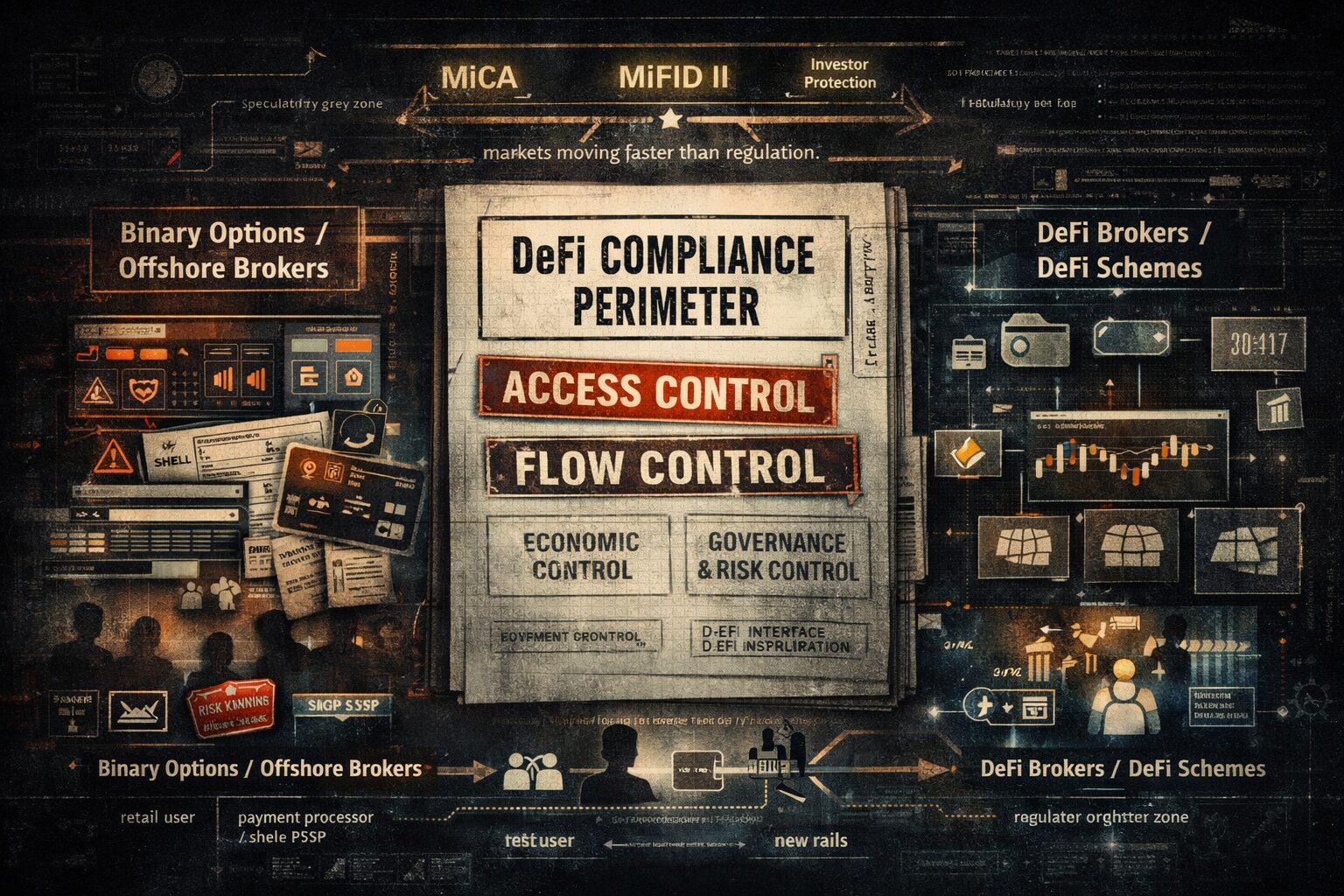
FinTelegram has now published its DeFi Compliance Perimeter as a permanent evergreen framework page. The reason is straightforward: we increasingly see DeFi brokers, DeFi investment schemes, and their supporting rails as the next major perimeter problem in digital finance. In phenomenological terms, this looks familiar. What binary options once represented for the convergence of gambling, speculative retail trading, and weakly supervised distribution, DeFi brokers and DeFi schemes may now represent for crypto-native markets.
The labels have changed, the rails are more complex, and the structures are more technical. But the investor-protection logic is strikingly similar. FinTelegram’s published framework therefore focuses on the practical questions of Access Control, Flow Control, economic control, and governance control to assess when a DeFi-labeled model begins to look less like “pure DeFi” and more like a controlled, commercially organized financial service.
Key Findings
- FinTelegram has published the DeFi Compliance Perimeter as a living evergreen framework on its website.
- The framework’s core thesis is that the decisive question is no longer whether a project calls itself “DeFi,” but when it becomes a controlled, commercially organized financial service.
- FinTelegram identifies Access Control and Flow Control as the first decisive indicators that a supposedly decentralized model may in fact sit inside the practical compliance perimeter.
- The framework also stresses that MiCA does not automatically exempt services merely because part of the activity is decentralized, and that MiFID II may also apply where crypto-assets or structures qualify as financial instruments.
- FinTelegram sees a strong phenomenological parallel between the historic binary-options segment and today’s DeFi broker and DeFi investment-scheme segment: fast-growing retail speculation, fragmented accountability, aggressive onboarding, and markets evolving faster than perimeter enforcement.
- The first practical applications of this framework were FinTelegram’s recent reviews of Hyperliquid and AXIOM, both of which raised questions about DeFi branding, leveraged retail access, and embedded funding rails.
Compliance Analysis
Why FinTelegram Has Created A DeFi Compliance Perimeter
FinTelegram has now formally published its DeFi Compliance Perimeter because the DeFi segment is no longer a niche innovation story. It is becoming an investor-protection and perimeter-enforcement story. The framework page states the core thesis clearly: the decisive question is not whether a project uses the word “DeFi,” but when a DeFi-labeled scheme becomes a controlled and commercially organized service. That is the point at which existing regulatory logic — under MiCA, MiFID II, AML/CFT, and broader conduct standards — may begin to apply in substance, even where market participants continue to market the model as decentralized.
Why We View DeFi Phenomenologically Like Binary Options
FinTelegram does not argue that DeFi brokers are legally identical to binary options. The point is different and more important: the pattern looks familiar.
Binary options emerged from a grey zone between gambling logic and financial speculation. For years, the sector industrialized retail losses through gamified trading interfaces, weakly supervised operators, aggressive marketing, payment intermediaries, and fragmented cross-border structures before regulators fully defined the perimeter. FinTelegram’s DeFi framework explicitly uses that history as a warning. Its published text notes that the binary-options era shows how long markets can operate in a grey zone before regulators fully define the perimeter, and it uses that history to explain why earlier scrutiny matters for investor protection.
In phenomenological terms, the DeFi segment shows similar traits:
- speculative retail exposure,
- friction-reduced onboarding,
- complex but commercially orchestrated rails,
- fragmented accountability,
- and narratives that initially outrun supervisory interpretation.
That is why FinTelegram views the DeFi segment not merely as crypto infrastructure, but as a potential successor to earlier high-risk retail trading ecosystems.
The New Broker Problem: Same Game, New Rails
The biggest difference between the old binary-options world and the new DeFi world is not necessarily the retail psychology. It is the architecture.
Where offshore brokers once relied on card acquirers, shell PSPs, introducing agents, and jurisdictional arbitrage, DeFi brokers and DeFi investment schemes increasingly rely on:
- wallet-native onboarding,
- on/off-ramp partners,
- routing layers,
- embedded trading access,
- execution venues,
- yield mechanisms,
- and “interface-only” or “non-custodial” defenses.
FinTelegram’s published framework argues that these structures should not be judged by labels alone. Instead, they should be assessed through four control layers: Access Control, Flow Control, Economic Control, and Governance & Risk Control. That is the practical lens FinTelegram will now use for systematic DeFi coverage.
The logic is simple. Once identifiable actors control the front end, the client relationship, the funding route, the wallet logic, fee capture, or the emergency powers of a supposedly decentralized system, the claim of being fully outside the perimeter begins to weaken.
Hyperliquid And AXIOM Were Only The Beginning
FinTelegram’s earlier reporting on Hyperliquid and AXIOM already foreshadowed this shift. Those reviews were early case studies in what FinTelegram now describes more systematically through its DeFi Compliance Perimeter. Hyperliquid raised the question of whether a DeFi-labeled derivatives venue with broad retail accessibility and limited visible perimeter controls should really be treated as a credibly permissionless protocol. AXIOM then added another layer by showing how a branded front end can package leveraged DeFi trading, wallet integration, and buy-crypto rails into a more broker-like retail journey.
Together, these cases made one thing clear: DeFi brokers and DeFi investment schemes deserve the same kind of structured scrutiny that FinTelegram once applied to binary options, offshore brokers, and their payment enablers.
Why Investor Protection Requires A Public Framework
One of the strongest parts of the published framework is its investor-protection logic. The page states that the lesson from binary options was not only that the products were risky, but that markets can scale retail harm faster than regulation can define the perimeter. That is precisely why FinTelegram is treating DeFi brokers, DeFi investment schemes, and their supporting rails as a developing investor-protection story rather than merely a technical crypto story.
This is also why the framework is being published as a living framework. FinTelegram explicitly says it will evolve as new cases, legal interpretations, regulatory actions, and expert feedback emerge. That openness is deliberate. The perimeter is still moving, the segment is still changing, and many compliance professionals are still working through how MiCA, MiFID II, AML/CFT, and conduct rules intersect in these hybrid models.
FinTelegram’s Strategy Going Forward
Going forward, FinTelegram will use the DeFi Compliance Perimeter as the anchor for a more systematic review strategy. That means future coverage will increasingly focus on:
- DeFi brokers offering leverage, perpetuals access, or broker-like trading functionality;
- DeFi investment schemes built around staking, vaults, yield, or “earn” narratives;
- on/off-ramp and wallet rails that move users from fiat into high-risk speculative environments;
- and perimeter watch cases where “DeFi” branding appears to mask concentrated operational control.
In this sense, the DeFi Compliance Perimeter is more than a framework page. It is also FinTelegram’s editorial roadmap for the next phase of compliance reporting.
Summary Compliance Statement
FinTelegram has published the DeFi Compliance Perimeter because the DeFi segment increasingly resembles a new perimeter challenge in investor protection. From our perspective, this segment should be approached phenomenologically in much the same way the binary-options segment once had to be approached: as a fast-growing retail-risk environment where commercial innovation and distribution speed can outpace perimeter enforcement. The new rails are more technical, the language is more sophisticated, and the structures are more fragmented. But the underlying compliance question is familiar: who controls access, who controls the flow, who monetizes the journey, and who bears responsibility when retail users are harmed? FinTelegram’s answer is to make that question visible through a public, living framework and to apply it systematically across DeFi brokers, DeFi investment schemes, and their supporting rails.
Call To Insiders, Traders, And Whistleblowers
If you are a trader, insider, builder, compliance officer, former employee, investor, payment provider, or infrastructure partner with relevant information about DeFi brokers, DeFi investment schemes, or their supporting rails, contact FinTelegram confidentially via Whistle42.
We are particularly interested in:
- internal compliance assessments,
- rail and wallet-routing architecture,
- on/off-ramp integration,
- target-market and geo-blocking practices,
- admin-key and governance concentration,
- retail-investor complaints,
- and evidence showing how supposedly decentralized systems are commercially orchestrated in practice.
Together, we can help make this developing segment more transparent, more understandable, and harder to game in the interest of investor protection.