


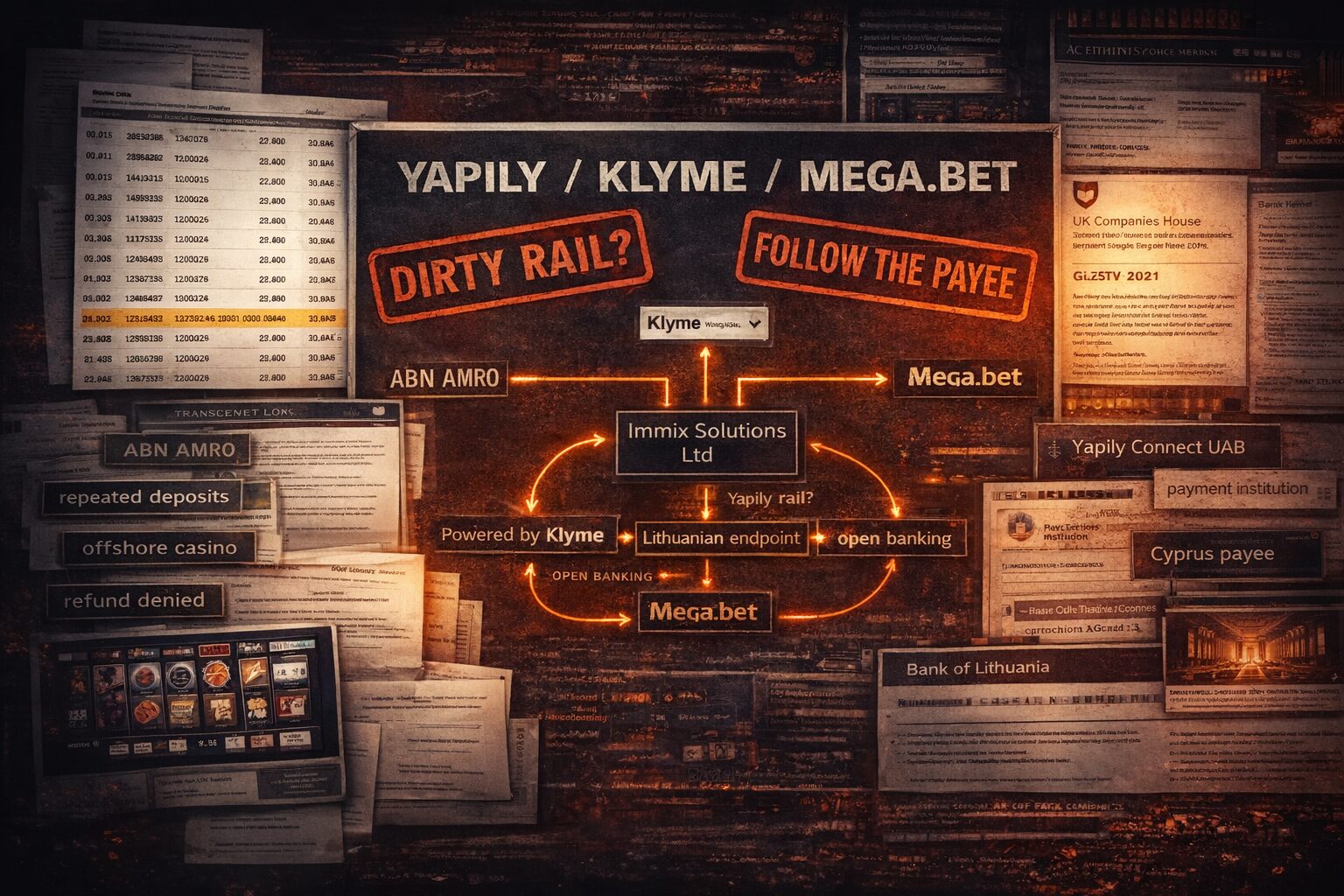
A new whistleblower submission reviewed by FinTelegram adds fresh fuel to the Yapily-Klyme case. The material includes a deposit ledger, complaint emails, and a payment-flow screen capture showing Mega.bet using a Klyme-branded “Pay by Bank” rail with Immix Solutions Ltd named as payee. The emerging picture is ugly: a player’s money appears to have moved through a layered structure involving a UK technology intermediary, a Cyprus payment-agent-style entity, and a Lithuanian beneficiary account, while Yapily remains the obvious regulated open-banking name in the background. Yapily openly markets pay-by-bank solutions to the iGaming industry, and the Bank of Lithuania confirms its Lithuanian entity holds a payment institution licence.
Key Findings
- A new whistleblower package reviewed by FinTelegram shows repeated deposits from a Dutch ABN AMRO account to IBAN LT53 5030 1200 0000 0804, indicating a recurring collection account rather than a one-off payment event.
- A still from the player’s own payment video shows Mega.bet displaying “Pay by Bank” powered by Klyme and naming Immix Solutions Ltd as the payee.
- In the correspondence provided by the player, Klyme allegedly admits the merchant relationship existed, that transactions ran during the relevant period, and that the merchant was later terminated.
- Klyme reportedly first gave the player a wrong termination date and later corrected it to 7 April 2025, a discrepancy that raises further questions about merchant oversight and complaint handling.
- Yapily Connect UAB is listed by the Bank of Lithuania as a licensed payment institution.
- Yapily openly promotes open-banking products for iGaming operators and PSPs, including pay-by-bank deposit flows.
- Immix Solutions Ltd publicly presents itself as a Cyprus-based payment-services business offering settlement, escrow, and payment processing.
Compliance Analysis
The first FinTelegram report on the Yapily leaks exposed a disturbing theme: instead of treating an offshore-casino complaint as a red-flag merchant-risk issue, Yapily’s compliance handling appeared to focus on the complaining user. According to that report, an internal email instructed partner Klyme to blacklist the whistleblower rather than confront the illegal-gambling problem head-on.
Now comes the follow-up evidence. And it makes the whole thing look worse.
The new whistleblower package contains exactly the kind of material that matters in rail investigations: transaction data, complaint correspondence, and front-end payment proof. The player’s deposit ledger shows repeated payments from her Dutch bank account to LT53 5030 1200 0000 0804 across late 2024 and March 2025. That is not what an isolated accidental consumer payment looks like. It looks like a working deposit rail.
The payment screenshot is the real grenade.
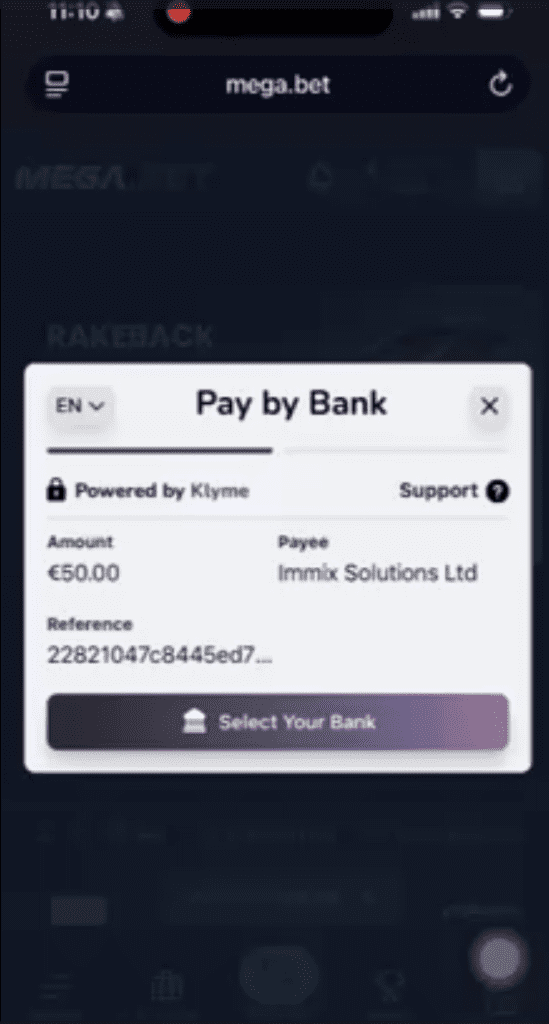
It shows Mega.bet running a “Pay by Bank” screen powered by Klyme, with Immix Solutions Ltd listed as the payee. That single image blows a hole in any attempt to treat Klyme as a distant, irrelevant bystander. If Klyme’s brand appears in the payment journey and a Cyprus payments outfit appears as payee, then this was not some abstract software relationship. This was a visible and operational payment chain.
And then there is Immix Solutions Ltd.
The whistleblower herself did not even highlight Immix in her email. But the screenshot did. Publicly available material at immix.pro presents Immix Solutions as a Cyprus-based payments business offering settlement, escrow, and payment processing services. In plain English: the kind of entity you would expect to find sitting inside a layered, hard-to-read collection structure.
So what do we appear to have here?
A player deposits into an offshore-style casino environment. The customer-facing rail is branded Klyme. The payee shown is Immix Solutions Ltd in Cyprus. The beneficiary trail points to a Lithuanian account. And hanging above all of this is Yapily, a regulated open-banking player that openly courts the iGaming sector and promotes pay-by-bank solutions precisely for that market.
That does not prove that Yapily personally touched every euro in this exact chain. It does prove something more uncomfortable: the whistleblower’s basic story is commercially and structurally plausible.
Yapily cannot pretend that iGaming use of its rails is some bizarre edge case. The company itself says it helps iGaming operators and PSPs “win more operators,” streamline onboarding, support top-ups, and deploy open-banking payment flows in gambling environments.
The Lithuanian angle matters too. The Bank of Lithuania publicly lists Yapily Connect UAB as a licensed payment institution. The central bank also previously announced the licensing of Yapily’s Lithuanian vehicle, explaining that the business intended to offer open-banking payment services in Lithuania after Brexit.
That is why the regulatory optics here are so bad.
When a regulated open-banking player actively markets iGaming solutions, and when whistleblower evidence then points to offshore-casino deposit flows routed through a Klyme-branded widget, a Cyprus payee, and a Lithuanian account, this stops being a whiny player dispute. It becomes a merchant-control and rail-governance problem.
Klyme’s reported emails add another ugly wrinkle. In the correspondence provided by the whistleblower, Klyme allegedly said the merchant had been onboarded under its infrastructure, later breached terms, and was terminated. Klyme also reportedly first gave the wrong termination date and later corrected it to 7 April 2025. If that correspondence is authentic, then Klyme has already conceded the critical point: there was a merchant relationship, there was oversight, and there was later intervention. That makes the “we are only a technology provider” line sound less like a defense and more like a shield.
To be clear, FinTelegram is not saying Klyme or Yapily automatically owe the player a refund. That is the weakest part of the whistleblower’s legal argument. Payment rails are not automatically refund guarantors. But that is also not the real story.
The real story is this:
A player complaint appears to have exposed an offshore-gambling deposit rail that ran through branded open-banking plumbing, a Cyprus payee, and a Lithuanian banking endpoint — and the firms in the chain seem far more comfortable disclaiming responsibility than explaining the structure.
That is the scandal.
Why This Follow-Up Matters
This case reinforces the pattern already exposed in the earlier Yapily report: when offshore-gambling complaints hit the payment chain, the response appears to drift toward damage control, distancing, and user management, instead of direct answers about merchant onboarding, downstream controls, geo-risk, and beneficiary routing.
The new evidence also introduces a far more explosive angle: Immix Solutions Ltd. If a Cyprus payment-services business is appearing as payee inside a Klyme-powered Mega.bet deposit flow, then investigators need to know exactly what role it played. Collection merchant? Settlement agent? Payment agent? Shadow PSP layer? That is where the next round of scrutiny belongs.
Summary Table
Entities
| Entity | Type | Role in Case | Key Data | Status / FinTelegram View |
|---|---|---|---|---|
| Yapily / Yapily Connect www.yapily.com | Open-banking / payment institution group | Alleged regulated payment rail in the background of casino deposits | Player says Yapily processed transactions and appears in GDPR data | Commercially plausible in iGaming context; direct role in each payment not yet fully evidenced from current attachments alone |
| Klyme Ltd https://klyme.io | UK technology / payment-flow intermediary | Customer-facing “Pay by Bank” layer shown in Mega.bet payment flow | “Powered by Klyme” visible in uploaded screenshot | Strongly implicated in front-end payment journey; exact contractual role still needs clarification |
| Shane Adam Williams | Director of Klyme | Main named Klyme contact in player correspondence | Allegedly sent/approved responses stating Klyme was only a technology provider | Relevant decision-maker in complaint handling |
| Mega.bet | Offshore-style casino / sportsbook | Casino directly evidenced in screenshot | Appears in uploaded payment-flow still | Strongly evidenced in current file |
| Luckytwice | Casino mentioned by player | Additional casino referenced in complaint | Mentioned in email chain only | Needs independent evidence before strong publication claim |
| Immix Solutions Ltd | Cyprus-based payment-services entity | Payee shown in Klyme-powered Mega.bet payment flow | Visible as “Payee: Immix Solutions Ltd” in uploaded screenshot | Important new rail entity; likely payment agent / settlement / collection function, exact role still open |
| Immix.pro | Website / operating front | Public-facing site for Immix Solutions | Presents settlement, escrow, and payment processing services | Supports plausibility of payments role |
| LT53 5030 1200 0000 0804 | Lithuanian beneficiary IBAN | Repeated beneficiary account in player transaction ledger | Appears across multiple deposits | Central rail endpoint in current evidence |
| AB Mano bankas | Lithuanian bank | Likely bank of beneficiary IBAN | Bank code 50300 corresponds to Mano bankas | Useful rail-mapping anchor; account holder still unknown |
| Chillstock | Name allegedly linked to beneficiary account | Possible merchant / collection / network name | Mentioned by player | Not independently verified in current file |
| Kasha Global Holding LTD | Name allegedly linked to beneficiary account | Possible related entity | Mentioned by player | Not independently verified in current file |
Questions That Now Need Answers
Questions for Yapily
- Did Yapily Connect Ltd or Yapily Connect UAB provide payment-initiation or related infrastructure for flows connected to Mega.bet, Luckytwice, or linked merchants?
- What controls does Yapily apply when its infrastructure is used by PSPs or intermediaries serving offshore-gambling operators?
- Why did the earlier whistleblower case result in a blacklisting controversy instead of a fully transparent merchant-risk explanation?
Questions for Klyme
- Did Klyme onboard the merchant behind the Mega.bet flow shown in the whistleblower material?
- Why did Klyme reportedly misstate the merchant termination date before correcting it?
- What exactly was Klyme’s role in the payment stack: gateway, orchestration layer, merchant-of-record support, or something else?
- What is Klyme’s relationship, if any, with Immix Solutions Ltd?
Questions for Immix Solutions Ltd
- Why did Immix Solutions Ltd appear as payee in a Klyme-powered Mega.bet payment flow?
- Was Immix acting as payment agent, settlement intermediary, collection merchant, or another role?
- Which gambling or high-risk merchants was Immix servicing during the relevant period?
Conclusion
The new whistleblower submission does not close the case. It opens it wider.
The combination of a Klyme-branded Mega.bet pay-by-bank flow, Immix Solutions Ltd as payee, a Lithuanian beneficiary account, and Klyme’s reported admission of a later-terminated merchant relationship turns this from a player grievance into a serious open-banking compliance story. And because Yapily openly promotes iGaming payment solutions while operating through regulated entities, the pressure now shifts to one simple question:
Who knew what about this merchant flow, and why was the whistleblower treated like the problem?
If you worked at Yapily, Klyme, Immix Solutions, or any PSP or banking partner involved in offshore-gambling flows, FinTelegram and Whistle42 want to hear from you. We are particularly interested in merchant onboarding files, KYB/KYC records, beneficiary-account documentation, internal escalations, geo-fencing decisions, and complaints-handling logs.