



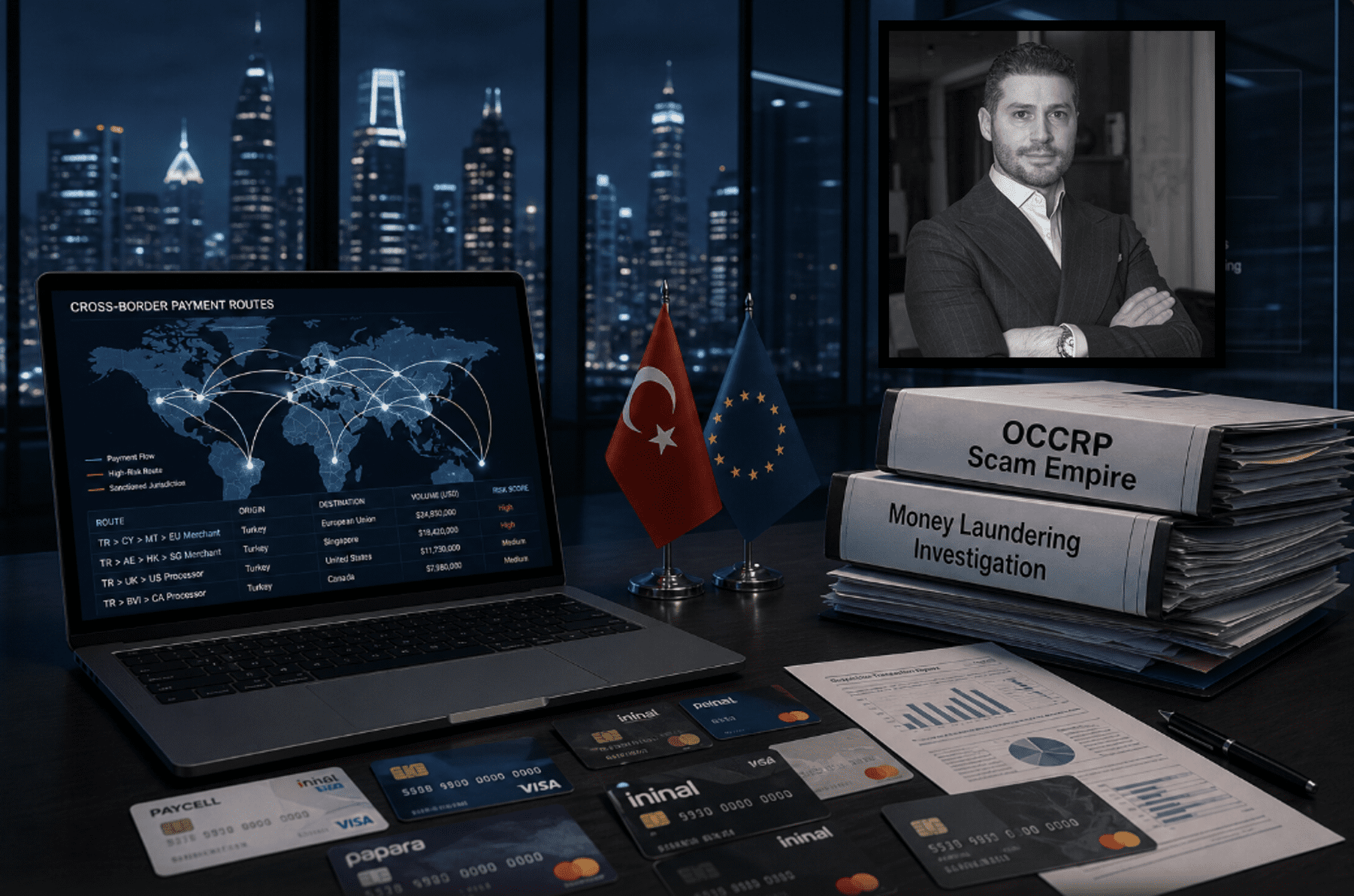
Turkish authorities have opened a money‑laundering investigation into companies owned by Cypriot‑Norwegian fintech entrepreneur Ozan Özerk, whose network includes payment and banking institutions previously tied to a global online fraud “Scam Empire” exposed by OCCRP. While Özerk tirelessly markets himself as a cross‑border payments visionary and compliance advocate, FinTelegram’s long‑running coverage and the latest OCCRP findings raise a sharper question: Is this public persona a reputational smokescreen for a payment architecture repeatedly surfacing in high‑risk, scam‑adjacent flows?
All individuals and entities mentioned are presumed innocent until proven guilty; investigations described here are ongoing, and some parties deny or contest the allegations.
Key findings
- Turkish prosecutors are investigating individuals and companies linked to Ozan Elektronik Para A.Ş. and Aveon Global Sigorta A.Ş., both majority‑owned by Ozan Özerk, on suspicion that they were used to inject criminal assets—primarily from illegal betting—into the financial system.
- Authorities have seized assets in the tens of millions of Turkish lira and arrested multiple executives, while appointing a trustee to take control of Ozan Elektronik Para A.Ş., signaling serious supervisory concern.
- OCCRP’s “Scam Empire” project showed that other Özerk‑owned entities, including Malta‑linked OpenPayd and Lithuania‑based European Merchant Bank (EMBank), processed payments connected to a massive online investment fraud scheme that defrauded at least 32,000 victims of about 275 million dollars.
- FinTelegram has for years flagged OpenPayd, LQDFX, EuroTrader, and related ventures in the Özerk environment as high‑risk rails for offshore brokers, scam operators, and aggressive investment schemes, well before mainstream investigative outlets joined the dots.
- OpenPayd has already been held liable by Malta’s Financial Arbiter for its role in an investor case where an elderly victim was manipulated into losses processed via OpenPayd’s virtual IBAN infrastructure.
- Parallel to these regulatory and investigative developments, Özerk has cultivated an intensive self‑branding strategy: a polished LinkedIn presence, a personal profile on OpenPayd’s site, and frequent articles on fintech, MiCA, DeFi, and cross‑border payments that position him as a compliance‑savvy innovator.
- In search results, Özerk increasingly appears not as the owner of entities named in fraud and laundering probes, but as a commentator on how to prevent exactly those abuses, a classic reputation‑management and search‑engine strategy.
Quick reference table: Ozan Özerk ecosystem
| Element | Details |
|---|---|
| Principal | Ozan Özerk (also: Ozan Ozerk), Cypriot‑Norwegian fintech entrepreneur and former medical doctor; founder or owner of multiple regulated fintechs across UK, EU, and Turkey. |
| Key regulated entities | OpenPayd (Banking‑as‑a‑Service / embedded finance, Malta‑linked), European Merchant Bank / EMBank (Lithuania), Ozan Elektronik Para A.Ş. (Turkish EMI), Aveon Global Sigorta A.Ş. (Turkish insurance firm). |
| Investigative focus | Turkish money‑laundering probe targeting Ozan Elektronik Para A.Ş. and Aveon Global Sigorta A.Ş. for allegedly introducing criminal proceeds, primarily from illegal betting and other suspect activities, into the financial system. |
| Enforcement / supervisory actions | Asset seizures worth roughly 72 million TRY and earlier seizures of about 9.6 million USD; detention orders for multiple employees; arrests of executives; court‑appointed trustee at Ozan Elektronik Para A.Ş.; liability finding against OpenPayd by Malta’s Financial Arbiter. |
| Scam‑related exposure | OCCRP “Scam Empire” data linking OpenPayd and EMBank to payments later associated with online investment scams that defrauded at least 32,000 victims of about 275 million USD. |
| High‑risk broker ties | LQDFX, an offshore broker founded by Özerk, repeatedly red‑listed by FinTelegram and warned about by regulators, facilitated via high‑risk PSPs including crypto processor Confirmo and voucher processor PayRedeem. |
| Reputation narrative | Self‑presentation as global fintech innovator, cross‑border payments expert, and compliance‑aware MD, amplified via LinkedIn posts, cross‑border payment market analyses, and articles on rails‑agnostic international payments and DLT. |
| Risk themes | High‑risk merchant exposure, offshore brokerage, illegal betting flows, AML/CTF weaknesses, regulatory arbitrage, and reputation‑washing through content marketing and thought‑leadership. |
Analysis of the OCCRP/Turkey investigations
The OCCRP report marks a formal escalation from journalistic suspicion to prosecutorial action inside Turkey’s financial system. Turkish prosecutors allege that Ozan Elektronik Para A.Ş. was used to bring criminal assets, “primarily derived from illegal betting activities,” into the financial system, while Aveon Global Sigorta A.Ş. allegedly disguised illicit funds as insurance premiums. Even if Özerk himself has not been formally named as a suspect, the appointment of a trustee and the magnitude of asset seizures indicate that authorities view the corporate structures as systemically compromised risk channels rather than isolated incidents.
The Turkish probe follows but is formally separate from OCCRP’s “Scam Empire” investigation, which showed how scam operators used payment institutions—including Özerk‑owned OpenPayd and EMBank—to channel funds from thousands of victims into sham investment platforms. OCCRP explicitly notes there is no proof that these institutions knew the funds were fraudulent, but in a risk‑based AML framework, repeated appearance in high‑risk flows is a pattern demanding remediation, not a coincidence to be explained away. Taken together, the OCCRP data and Turkish actions reveal a corporate network that has become a recurring conduit between unregulated online schemes and the regulated financial perimeter.
From a compliance perspective, Turkey’s investigation is significant because it targets licensed firms—not only offshore shells—and uses traditional AML tools (asset freezes, trustees, arrests) against entities that marketed themselves as modern, tech‑driven fintechs. This challenges the assumption that a licence and a glossy fintech narrative suffice to neutralize concerns about underlying merchant profiles and transaction flows.
FinTelegram’s earlier warnings and patterns in the Ozan ecosystem

FinTelegram has documented Ozan‑linked structures for years: from LQDFX and EuroTrader to OpenPayd’s BaaS platform and the Lithuanian EMBank. Long before OCCRP’s “Scam Empire” publication, FinTelegram reports highlighted how these entities formed an expanding payment and brokerage stack servicing high‑risk online trading, gambling, and crypto business—including red‑listed offshore brokers and unlicensed schemes.
A few recurring patterns stand out:
- Offshore brokerage plus regulated wrapper: LQDFX, founded by Özerk and operating from offshore jurisdictions, sat alongside EuroTrader, which obtained CySEC and later FCA licensing, giving the overall group a veneer of regulatory legitimacy while still serving speculative and high‑risk flows.
- High‑risk payment processors as rails: PSPs such as Confirmo, PayRedeem, Koinal, Bitpace and others appear in the orbit of Ozan‑linked ventures, offering card, voucher, and crypto rails that are attractive to gambling, betting, and aggressive “investment” offers.
- Gift card and voucher layer: Giftbull and similar gift‑card operations tied to Ozan’s environment through directors and holding structures add a pseudo‑cash layer capable of moving value into and out of regulated accounts.
- Partnerships with major brokers and platforms: Partnerships like eToro’s use of OpenPayd’s virtual IBAN infrastructure demonstrate how deeply embedded these rails have become in mainstream fintech ecosystems, not just in obscure boiler‑room circles.
Seen against this background, the Turkish money‑laundering investigations look less like a local aberration and more like the first state‑level test of a corporate network that has long operated in the grey zone between mainstream fintech and high‑risk, occasionally fraudulent, online business models.
Read our reports on Ozan Ozerk here.
Reputation engineering and search‑engine strategy
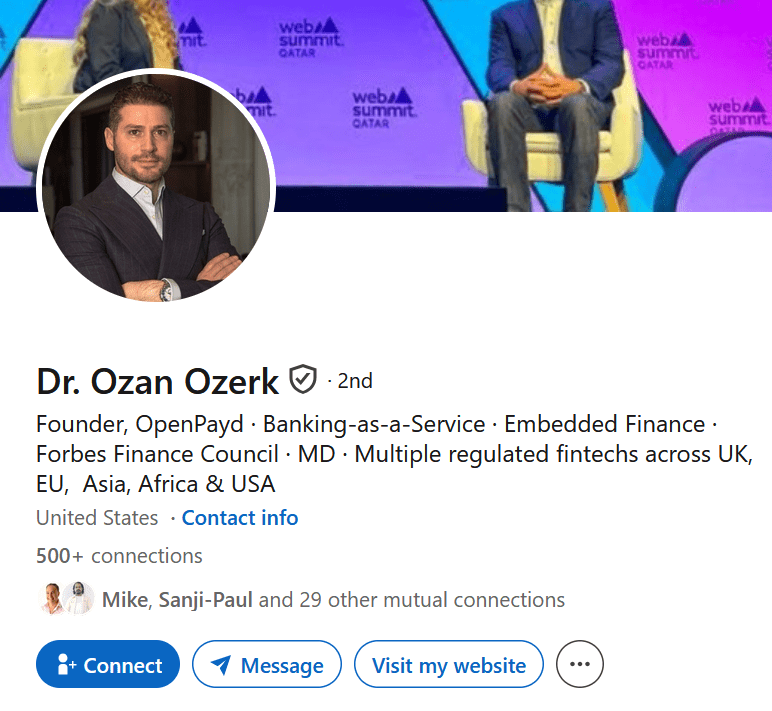
Parallel to the structural risk profile runs a highly curated reputation machine. Özerk’s LinkedIn profile, personal pages and corporate biographies present him as a serial fintech founder, embedded finance pioneer, and member of elite finance councils, with heavy emphasis on regulatory evolution, DeFi, MiCA, CBDCs, and instant payments. This is reinforced by frequent essays and market snapshots on cross‑border payments, rails‑agnostic future architectures, and blockchain‑enabled efficiency, often couched in the language of compliance, transparency, and financial inclusion.
The recent LinkedIn article on the “snapshot of the cross‑border payments market in 2025” is a case in point. It details market‑size figures, structural frictions, AML/KYC constraints, and the promise of DLT to reduce costs and enhance transparency—precisely the issues at stake in the OCCRP and Turkish narratives, but presented as neutral thought‑leadership rather than as contextualized by the controversies around his own entities. Likewise, his article on the “rails‑agnostic future of international payments” frames him as an architect of safer, more efficient payment rails while investigative reporting documents how some of those rails have been used in large‑scale fraud and suspect flows.
From a reputation‑management and SEO standpoint, this content strategy has obvious functions:
- It floods search results for “Ozan Özerk” and “cross‑border payments” with polished, high‑authority content, pushing critical coverage and investigative reports further down in ranking.
- It reframes the narrative from “owner of entities named in fraud and laundering probes” to “expert explaining how to fix exactly those problems,” a textbook credibility‑preemption tactic.
- It supplies conference organizers and media with ready‑made positioning, reinforcing the expert persona and insulating him from reputational damage in mainstream fintech circles.
In short, in search results and professional networks, Özerk increasingly appears not as the owner of entities named in fraud and laundering investigations, but as a commentator on how to prevent the very abuses his companies are associated with. For a compliance‑literate audience, that inversion is precisely why independent investigative work and whistleblower input remain essential.
Compliance and risk implications
For regulators and financial institutions, the Ozan ecosystem illustrates how a single beneficial owner can span banks, payment institutions, e‑money issuers, insurance firms, offshore brokers, and crypto PSPs across multiple jurisdictions. When that web repeatedly touches fraud‑exposed flows and alleged illegal betting proceeds, supervision must shift from siloed entity‑level monitoring to group‑wide and ownership‑level risk assessment.
Key implications include:
- Group‑wide AML assessment: Supervisors should treat OpenPayd, EMBank, Ozan Elektronik Para, Aveon Global Sigorta, and associated PSPs as a consolidated risk cluster, irrespective of formal separations or branding differences.
- Enhanced scrutiny of BaaS and embedded finance: Banking‑as‑a‑Service and virtual IBAN models like OpenPayd’s warrant deeper due diligence, as they grant high‑risk merchants quasi‑banking capabilities with limited transparency for downstream banks and regulators.
- Reputation vs. reality: Public thought‑leadership on compliance and cross‑border payments must be critically cross‑checked against SAR data, whistleblower submissions, enforcement actions, and investigative reporting rather than accepted at face value.
- Fit‑and‑proper considerations: Where the same UBO repeatedly surfaces around high‑risk schemes and enforcement actions, fit‑and‑proper tests for holding stakes and management roles in regulated entities become a central line of defence.
For correspondent banks and payment partners, the presence of Özerk‑linked institutions in transaction chains should trigger enhanced due diligence: deeper merchant reviews, scrutiny of past complaints, exposure analysis to jurisdictions with lax gambling controls, and mapping of any overlaps with “Scam Empire”‑type operations.
Call to players, insiders, and whistleblowers
FinTelegram will continue to follow the OCCRP‑triggered investigations and the broader evolution of the Ozan payment empire across Malta, Lithuania, Turkey, and other hubs. The combination of high‑risk merchants, complex cross‑border payment stacks, and aggressive self‑promotion demands ongoing scrutiny and independent intelligence gathering.
Players, former employees, compliance officers, PSP partners, and other insiders who have information about:
- payment flows through OpenPayd, EMBank, Ozan Elektronik Para, Aveon Global Sigorta, or associated PSPs linked to scams, illegal betting, or unlicensed brokers;
- internal pressure to on‑board or retain high‑risk merchants despite clear red flags;
- structures used to route or disguise cross‑border flows involving Ozan‑linked entities;
are invited to share their information—confidentially and securely—via FinTelegram’s whistleblower platform Whistle42.
Any concrete documentation (contracts, internal emails and chats, payment instructions, account statements, merchant lists, risk reviews, or screenshots) helps to map the true extent of the ecosystem and supports regulators and victims in holding the right actors accountable.