



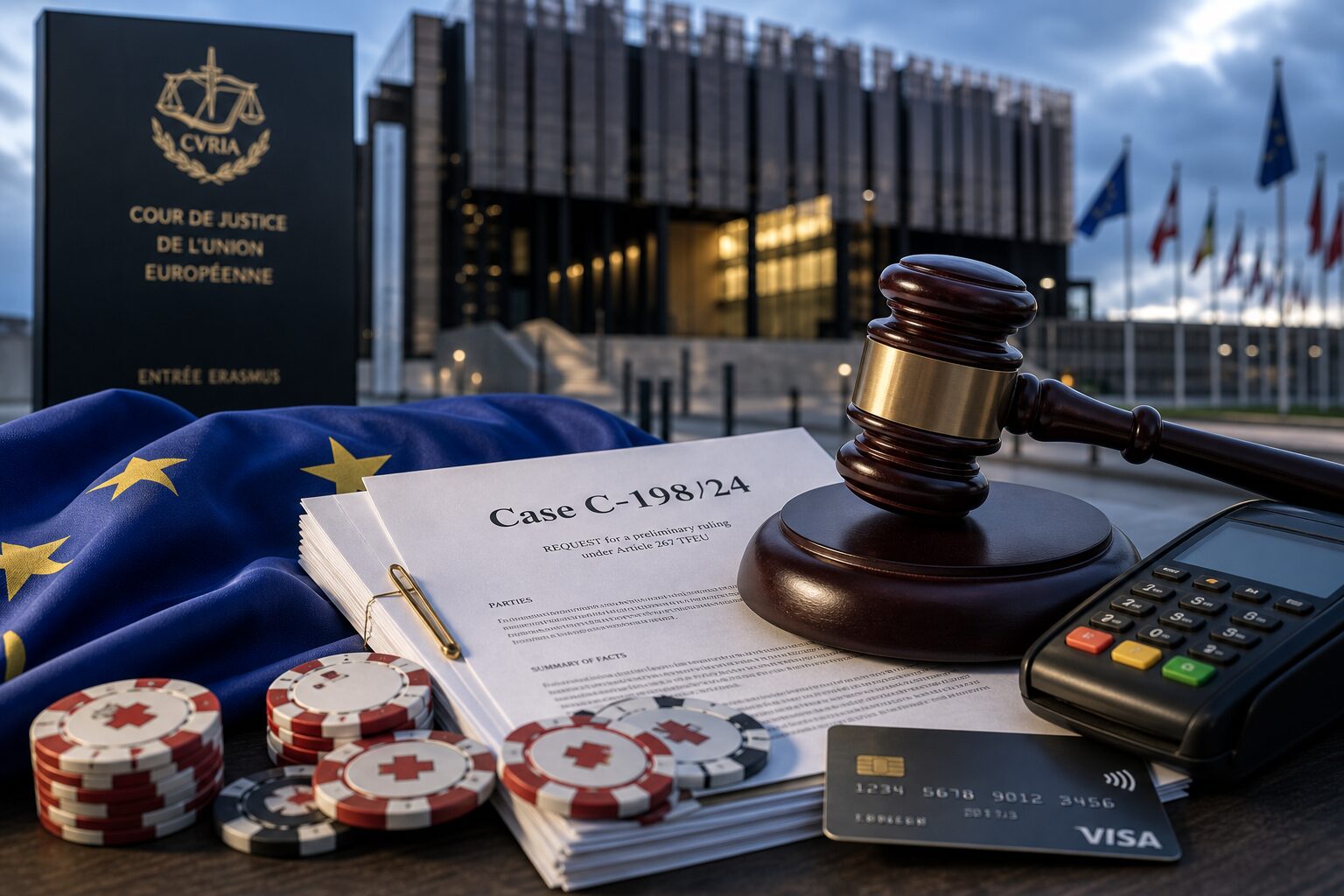
A forthcoming Court of Justice ruling in Case C-198/24, TQ v. Mr Green Limited, could become a defining moment for cross-border player restitution in Europe. The case sits at the intersection of illegal gambling, asset-freezing under the European Account Preservation Order regime, and Malta’s attempt to shield locally licensed operators from foreign judgments through Article 56A of its Gaming Act.
Key findings
- Case C-198/24 concerns an Austrian player’s attempt to enforce final Austrian refund judgments against Malta-licensed operator Mr Green Limited through a European Account Preservation Order (EAPO).
- Austrian courts had already declared the gambling relationship unlawful and the refund judgments were final and enforceable by at least 13 April 2022, yet the claim remained unpaid.
- The referring Vienna court asked the CJEU to clarify when cross-border account-freezing is justified under the EAPO Regulation, particularly where an operator may have shifted assets after enforcement pressure.
- The case gained wider significance because the player identified accounts not only in Malta but also in Sweden, Luxembourg and Ireland, underscoring the pan-European payment footprint of gambling groups.
- Advocate General Emiliou delivered his opinion on 30 October 2025, and the CJEU calendar indicates delivery of judgment in Mr Green on 21 May 2026 before the Fourth Chamber.
- The dispute is unfolding against the background of Malta’s Article 56A, a provision the European Commission has challenged because it may obstruct the cross-border enforcement of judgments against Malta-licensed gambling operators.
Quick overview
| Item | Details |
|---|---|
| Case number | C-198/24, TQ v. Mr Green Limited. |
| Opinion | Opinion of Advocate General |
| Court | Court of Justice of the European Union, Fourth Chamber; judgment listed for 21 May 2026 in the judicial calendar. |
| Core issue | Whether an EAPO can be used to preserve assets of a Malta-licensed online gambling operator facing enforcement of an Austrian refund judgment. |
| Claimant | TQ, an Austrian player seeking repayment of gambling losses awarded by Austrian courts. |
| Respondent | Mr Green Limited, a Malta-licensed online gambling operator. |
| Relevant legislation | EAPO Regulation; Malta Gaming Act Article 56A / Act XXI of 2023; EU judicial cooperation principles. |
| Known accounts named in the EAPO request | Malta, Sweden, Luxembourg, and Ireland. |
| Broader significance | The ruling may affect player restitution, enforcement strategy, and risk exposure for gambling operators and their payment facilitators across the EU. |
Analysis of the case
The legal importance of Mr Green does not lie only in the player’s underlying refund claim. The central issue before the CJEU is whether a successful claimant can use the EAPO framework to freeze funds across borders when there is evidence that an online gambling operator may dissipate, relocate, or reorganize assets to frustrate enforcement.
The facts described in the referral are especially significant for compliance analysis. According to the summary of the case, the player argued that Mr Green had moved assets by terminating its relationship with Austrian third-party debtor Dimoco Europe GmbH after enforcement had been authorized, and warned that funds could similarly be transferred from other jurisdictions to Malta. That framing turns the case into more than a civil enforcement dispute; it becomes a test of whether payment and treasury arrangements can be used to hinder execution of final court judgments.
The case also exposes the structural tension between Malta’s point-of-supply licensing model and the regulatory claims of other EU states. Malta’s defenders argue that Article 56A merely codifies public-policy limits on recognition of foreign judgments, while critics, including the European Commission, see it as a legal shield that weakens mutual trust and cross-border judicial cooperation. Even where the CJEU does not directly rule on Article 56A’s compatibility with EU law in this case, its interpretation of the EAPO regime may sharply limit the practical effectiveness of Malta’s defensive legislation.
For FinTelegram’s readership, the most important point is this: if a gambling operator can continue to benefit from EU payment infrastructure while refusing to satisfy final judgments in favor of players, then payment routing, merchant acquiring, e-money relationships, and treasury concentration structures become compliance red flags. The Mr Green proceedings suggest that courts are increasingly willing to examine these operational facts, not just the formal licensing narrative presented by operators and regulators.
Implications for the gambling industry
A ruling favorable to the player would likely strengthen recovery strategies against operators that target consumers in jurisdictions where they lack the required local authorization. It could encourage more claimants and litigation funders to pursue cross-border preservation measures early, especially when account locations and payment flows can be mapped across several EU member states.
Malta-licensed operators would face a more acute enforcement risk outside Malta, particularly if they rely on the assumption that domestic public-policy defenses will neutralize foreign judgments. In practice, that could increase pressure to settle player claims, review market-access strategies, and ring-fence exposure in jurisdictions where the legality of operations is disputed.
The sector may also see a compliance spillover. Boards, MLROs, and legal teams could be forced to treat repeated non-payment of court-ordered player refunds as a governance and conduct issue rather than a routine litigation cost, especially where cross-border asset movement appears timed around enforcement events.
Implications for payment facilitators
Payment processors, e-money institutions, acquiring banks, and intermediary merchants should read Mr Green as a warning that transaction chains matter. Where a gambling operator is accused of operating illegally in one member state while using a multi-jurisdictional payment stack, facilitators may face heightened scrutiny over whether their services enable the continuation of unlawful offers or frustrate the enforcement of player claims.
The reference to Dimoco Europe GmbH in the Austrian proceedings is particularly relevant because it highlights the role of third-party payment counterparties in the enforcement narrative. Once courts and regulators begin to connect unpaid judgments with shifting payment relationships or account structures, facilitators may have to justify their onboarding, monitoring, reserve, and termination decisions in far greater detail.
For compliance teams, the message is clear: high-risk gambling merchants should be subject to closer jurisdictional screening, beneficial-ownership analysis, website and market-access reviews, and monitoring for litigation-related asset movements. Payment facilitators that ignore these signals may not only face reputational damage but also attract questions from banking partners, regulators, and law-enforcement agencies.
Share Information
Players, insiders, payment professionals, and former service providers with information about illegal online casinos, hidden processing chains, merchant entities, or judgment-evasion structures should submit material through FinTelegram’s whistleblower platform, Whistle42. Information on acquiring banks, PSPs, EMI partners, front merchants, affiliate funnels, and payout channels is particularly relevant for ongoing investigations into unlawful gambling operations and their facilitators.