


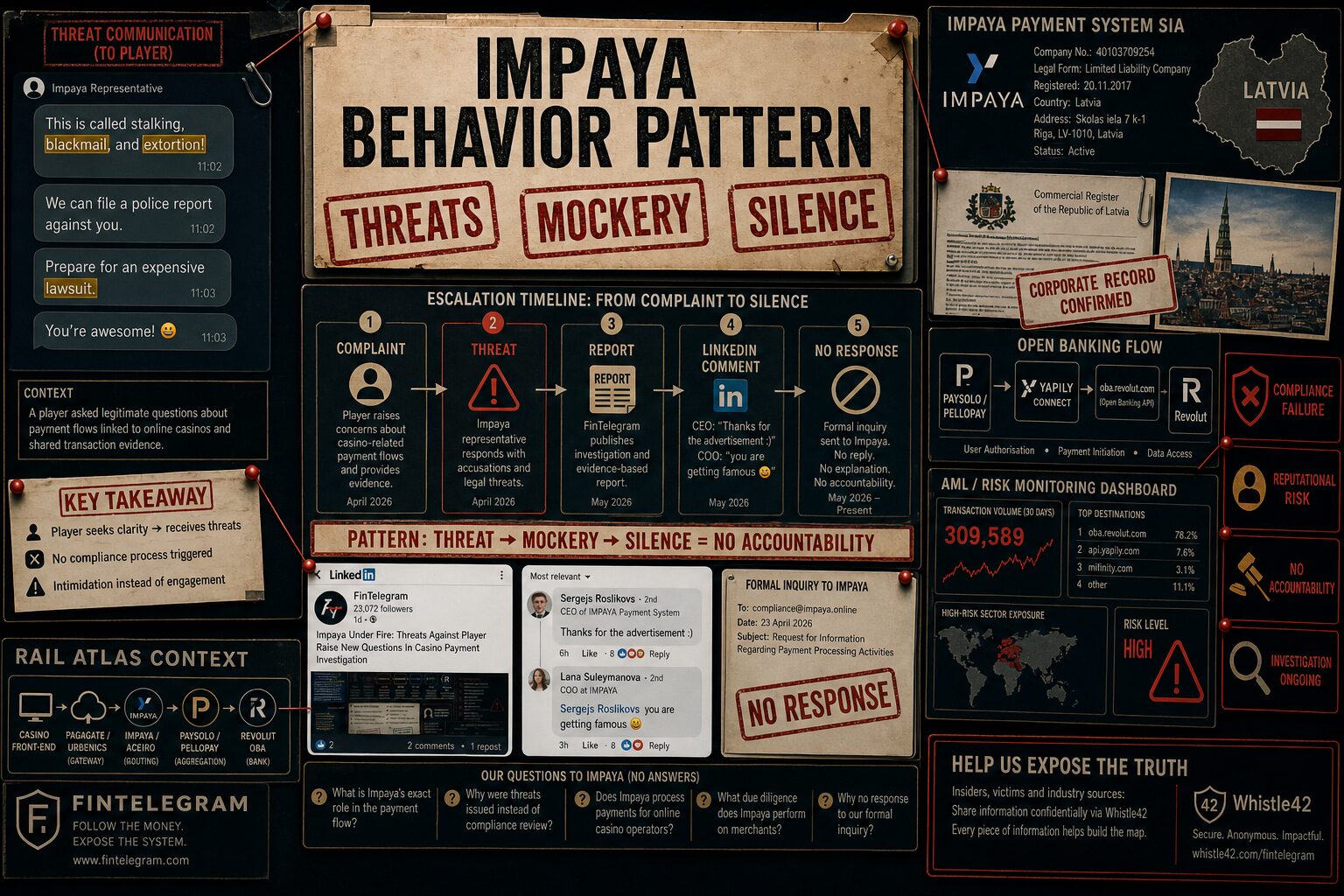
FinTelegram’s Rail Atlas investigation into casino payment flows has taken a new turn. What began with alleged threats against a player has evolved into a pattern: intimidation, followed by silence, and accompanied by public mockery. With no response to formal inquiries but sarcastic engagement on LinkedIn, Impaya’s handling of the situation raises serious questions about compliance culture, accountability, and its role in high-risk payment infrastructures.
Key Findings
- Phase 1 — Threats: A player raising concerns about casino-related payment flows was allegedly accused of “blackmail,” “extortion,” and “stalking,” and threatened with legal action
- Phase 2 — Exposure: FinTelegram published an evidence-based report on the incident and the broader payment ecosystem
- Phase 3 — Mockery: Sergejs Roslikovs responded publicly with “Thanks for the advertisement :)”, reinforced by Lana Suleymanova (“you are getting famous 😄”)
- Phase 4 — Silence: No response has been received to FinTelegram’s formal compliance inquiry
- Systemic context: Impaya appears in a multi-layer payment structure linked to offshore casino operations
Read our reports on Impaya here.
The Pattern: Threat → Exposure → Mockery → Silence
This is no longer a single incident. It is a sequence.
1. Threats (Private Channel)
A player contacts Impaya with:
- transaction evidence
- structured questions
- attempts to resolve the issue
The reported response:
- criminal accusations
- lawsuit threats
- sarcastic tone
👉 No compliance engagement
2. Exposure (Public Reporting)
FinTelegram publishes:
- documented communication
- payment-flow analysis
- compliance questions
👉 Evidence enters public domain
3. Mockery (Public Reaction)
Instead of addressing the issues:
- CEO comment: “Thanks for the advertisement :)”
- COO reinforcement with emoji
👉 No denial. No clarification. No investigation.
4. Silence (Formal Channel)
- Formal inquiry sent to Impaya
- Detailed questions provided
- Opportunity to respond offered
👉 No response
Why This Pattern Matters
For regulated or payment-facing entities, this pattern is a red flag.
A. Complaint Handling Failure
Expected:
- acknowledge complaint
- escalate internally
- respond neutrally
Observed:
- intimidation
- dismissal
- no follow-up
B. Compliance Culture Signal
Public behavior often reflects internal culture.
👉 When leadership responds with sarcasm instead of substance:
- compliance may not be prioritized
- risk awareness may be weak
- escalation processes may be missing
C. Strategic Silence
Silence after exposure is not neutral. It can indicate:
- avoidance of formal statements
- unwillingness to commit to a position
- reliance on ambiguity
Rail Atlas Context: The System Behind The Behavior
Impaya is not an isolated actor. It appears in a broader multi-layer payment ecosystem:
Casino front-end
→ Anonymous gateways (Pagagate / Urbenics)
→ Impaya / Aceiro (routing layer)
→ Paysolo / Pellopay (aggregation)
→ Yapily Connect (Open Banking)
→ Revolut OBA
This structure is characterized by:
- multi-hop routing
- merchant opacity
- distributed responsibility
👉 In such systems, behavior becomes critical: If each layer deflects responsibility, no layer remains accountable.
Behavior As A Risk Indicator
FinTelegram’s position: In complex payment ecosystems, behavior is as important as infrastructure. The Impaya case suggests:
- complaints are not treated as compliance triggers
- scrutiny is met with resistance
- transparency is limited
The Chargeback Problem
The player was reportedly advised to “do a chargeback.” However:
- Open Banking payments typically do not support chargebacks
- This limits consumer remedies
- It shifts responsibility to payment providers
👉 If providers do not engage: the consumer is left without recourse
Evidence & Confidence Table
| Element | Role | Evidence | Confidence | Key Question |
|---|---|---|---|---|
| Player complaint | Trigger | Screenshots + video | Confirmed | Why no compliance escalation? |
| Impaya response | Threat communication | Documented messages | Corroborated | Does Impaya stand by this? |
| CEO / COO comments | Public reaction | Confirmed | Why mock instead of respond? | |
| Formal inquiry | Opportunity to respond | FinTelegram record | Confirmed | Why silence? |
| Payment role | Routing layer | Rail Atlas findings | Indicated | What is Impaya’s exact function? |
Open Questions To Impaya
- Does Impaya confirm sending the messages attributed to it?
- Why was a compliance complaint treated as a legal threat scenario?
- Why has Impaya not responded to FinTelegram’s formal inquiry?
- What is Impaya’s role in payment flows involving casino operators?
- How are complaints escalated internally?
- Does Impaya consider its LinkedIn response appropriate for a financial-services context?
Conclusion
The Impaya case has evolved.
It now represents:
- a payment-flow question
- a compliance question
- a behavior question
The pattern is clear:
- threats when questioned
- silence when challenged
- mockery when exposed
👉 In a regulated financial environment, that combination is not trivial.
It is a signal.
Whistle42 Call — Help Us Map The Pattern
FinTelegram calls on:
- Impaya insiders
- payment partners
- compliance officers
- affected players
to share information via Whistle42.