


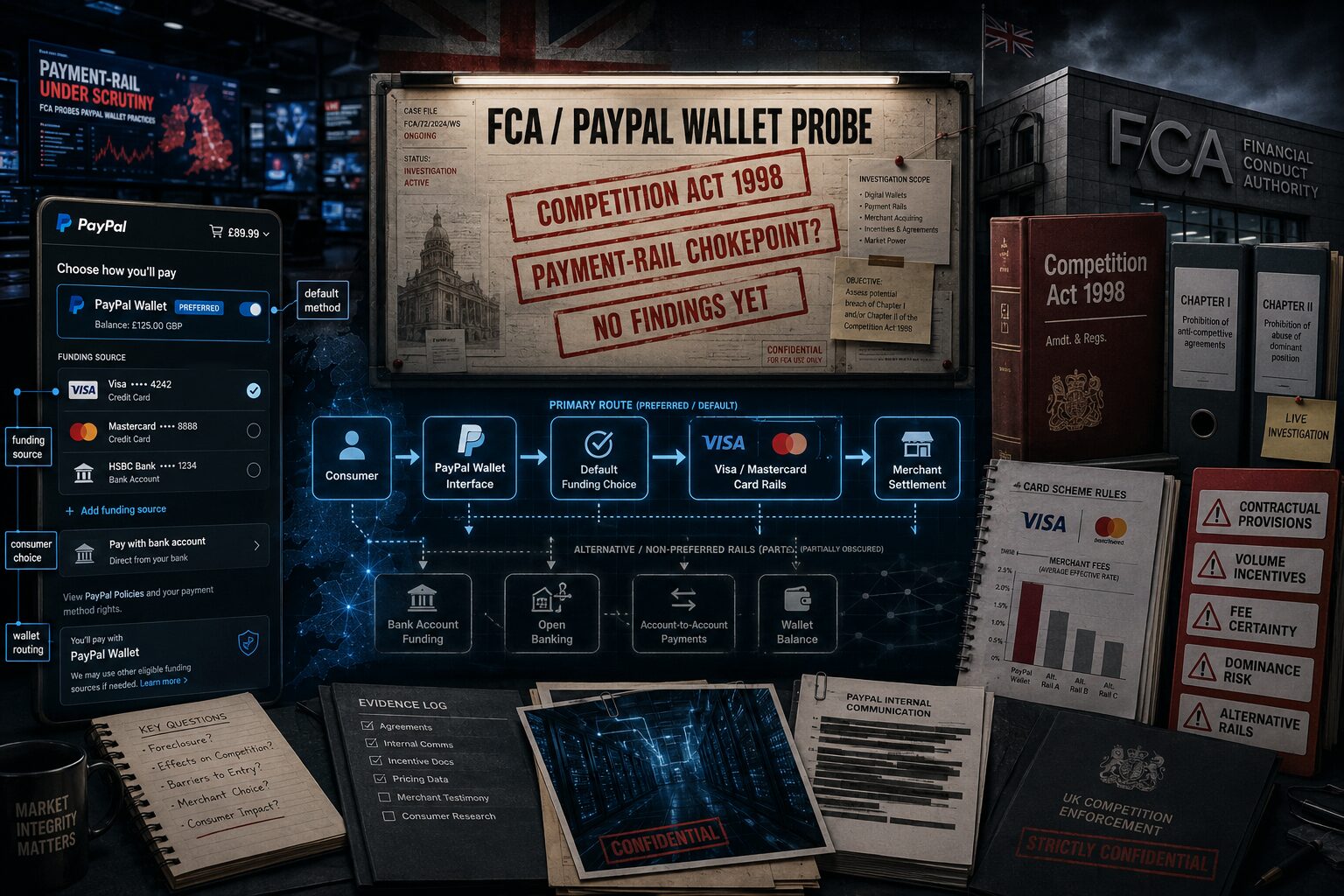
The UK Financial Conduct Authority (FCA) has opened Competition Act 1998 investigations into PayPal, Mastercard and Visa over suspected anti-competitive conduct linked to the funding and usage of PayPal’s digital wallet. This is not an AML case, not a consumer-fraud case, and not yet a finding of wrongdoing. It is something potentially more structural: a competition-law probe into how the hidden contractual and economic architecture behind a major digital wallet may influence which payment rails consumers are nudged to use.
The FCA confirmed that it is investigating Mastercard, PayPal and Visa under Chapter I of the Competition Act 1998, and Mastercard and Visa under Chapter II, while stressing that it has reached no conclusions and made no findings that competition law has been breached. The regulator says it is still gathering evidence and may or may not issue a statement of objections later in the process.
For FinTelegram, the significance is clear: this is a payments-chokepoint investigation. The FCA appears to be looking beneath the familiar PayPal checkout interface into the contractual arrangements, volume incentives, wallet-default logic, and card-scheme economics that may determine whether consumers use card rails, bank-account funding, stored wallet balances, or alternative account-to-account payment methods.
Key Findings
- Confirmed FCA investigation. The FCA announced on 6 May 2026 that it is investigating Mastercard, PayPal and Visa under the UK Competition Act 1998 in relation to suspected anti-competitive conduct connected to the funding and usage of PayPal’s digital wallet.
- Different legal tracks. All three companies are under investigation under Chapter I, which concerns anti-competitive agreements, concerted practices or decisions. Mastercard and Visa are also under investigation under Chapter II, which concerns abuse of a dominant position.
- No findings yet. The FCA expressly states that it has not concluded that competition law has been breached. The case is still in the evidence-gathering stage, and not every Competition Act investigation results in a statement of objections.
- PayPal disclosed the matter first. PayPal’s Q1 2026 Form 10-Q disclosed that, in March 2026, it received notices of investigations and related information requests from the FCA concerning provisions in PayPal’s contractual agreements with Visa and Mastercard relating to funding and use of the PayPal digital wallet. PayPal said it is cooperating.
- The contractual background matters. Public PayPal-Visa partnership materials from 2016 show terms under which Visa cards would be presented as clear and equal payment options in PayPal flows, users could set Visa as a preferred payment method, PayPal would not encourage Visa cardholders to link bank accounts via ACH, and PayPal would receive certain economic incentives, including incentives for increased Visa volume and longer-term Visa fee certainty. These historic terms are not proof of illegality, but they show why wallet funding and usage provisions may now be competition-sensitive.
- Digital wallets are now systemically important payment interfaces. The FCA and Payment Systems Regulator previously noted that the share of UK card transactions using a digital wallet increased from 8% in 2019 to 29% in 2023, showing that wallets are no longer a niche checkout convenience but a major interface layer in retail payments.
The FinTelegram Analysis: The Wallet Is the Interface, But the Rail Is the Business
Consumers see a PayPal button. Regulators see a routing layer.
That distinction is crucial. A digital wallet is not merely a convenient front-end. It is a decision engine. It determines how payment instruments are displayed, which options are made frictionless, which rails are set as defaults, which funding methods are promoted or deprioritised, and which economic incentives flow between wallets, card schemes, banks and merchants.
The FCA’s reference to the “funding and usage” of PayPal’s digital wallet therefore goes to the heart of modern payment competition. The issue is not simply whether consumers can technically choose between cards, bank accounts or wallet balances. The sharper question is whether contractual arrangements and commercial incentives influence the architecture of choice itself.
In plain terms: does the wallet neutrally present payment options, or does it steer users toward rails favoured by the dominant schemes?
Why Chapter I and Chapter II Matter
The FCA’s legal split is important.
Under Chapter I, the regulator is examining whether agreements or arrangements between undertakings may prevent, restrict or distort competition in the UK. This captures the horizontal and vertical contractual dimension: what PayPal agreed with Visa and Mastercard, how those agreements shaped wallet behaviour, and whether such provisions affected competition between payment methods.
Under Chapter II, the FCA is looking only at Mastercard and Visa. This provision concerns abuse of a dominant position. That does not mean the FCA has concluded that either scheme abused dominance. But it does suggest that the regulator may be examining whether the card schemes’ market power, combined with wallet-related contractual arrangements, could have restricted alternative payment rails or entrenched scheme-card usage inside PayPal.
This distinction gives the case its real weight. It is not just about PayPal. It is about the interaction between a dominant consumer-facing wallet and the dominant global card-scheme infrastructure behind it.
The Historic PayPal-Visa Model: Consumer Choice or Rail Steering?
PayPal’s 2016 Visa partnership was publicly framed as improving consumer choice and expanding digital-payment adoption. The agreement included several commercially significant elements: Visa cards would be presented as clear and equal payment options, consumers could set Visa cards as their preferred payment method, PayPal would not encourage Visa cardholders to link bank accounts via ACH, and PayPal would receive economic incentives including volume incentives and fee certainty.
From a business perspective, this was understandable. PayPal needed better card-scheme relationships, broader point-of-sale acceptance, tokenisation capabilities and issuer cooperation. Visa and Mastercard wanted to prevent PayPal from becoming a bank-account-funded alternative that bypassed card rails.
From a competition perspective, however, the same arrangements raise obvious questions. If a wallet receives incentives tied to card volume, and if it agrees not to encourage bank-account linking for certain users, then the regulator may ask whether lower-cost or non-card rails were disadvantaged before the consumer even reached the checkout decision.
That is the chokepoint: not the transaction itself, but the pre-transaction architecture.
The Hidden Economics of Wallet Funding
Digital-wallet funding is not neutral. Each funding source carries different economics.
- Card-funded PayPal payments generate scheme fees, issuer economics, acquiring economics and merchant costs.
- Bank-account-funded payments may bypass some of those card economics. Stored wallet balances can create another layer of value capture.
- Account-to-account or open-banking payments may introduce new competitors and reduce dependence on card rails.
The regulatory concern, therefore, is not that PayPal offers card payments. It is that contractual and economic incentives may shape whether consumers are nudged toward card-funded payments even when alternatives exist or could develop.
This is especially relevant because the FCA and PSR previously identified digital wallets as both an opportunity for innovation and a potential competition concern. Their feedback statement noted that digital wallets could support non-card forms of payment as they become available, but also recorded stakeholder concerns that card schemes’ position in UK retail payments could become entrenched unless consumers can access alternative forms of payment inside wallets.
The Bigger Picture: Wallets as Payment-Rail Gatekeepers
The FCA probe fits a wider regulatory shift. Payment regulators are increasingly looking beyond the visible merchant checkout page and into the layers that determine transaction routing:
- User-interface design: Which funding source appears first? Which one is default? Which one has the least friction?
- Commercial incentives: Does the wallet receive payments, volume rebates or fee certainty that favour one rail over another?
- Technical dependency: Does tokenisation, contactless access or in-store acceptance depend on card-scheme infrastructure?
- Alternative-rail suppression: Are bank-account, open-banking or account-to-account payment options made less visible, less convenient or commercially unattractive?
- Market power: Do the dominant card schemes use their position to preserve scheme-card volumes inside wallets that might otherwise become competitors?
This is exactly where FinTelegram’s rail-analysis lens applies. In illegal gambling and high-risk broker investigations, FinTelegram frequently follows payment rails to identify the real operators, intermediaries, acquiring relationships and risk chokepoints. Here, the FCA is applying a different legal framework, but the analytical logic is similar: follow the rails, not just the brand interface.
What the Companies Say
According to media coverage based on the FCA announcement and company responses, all three companies said they are cooperating with the regulator. Mastercard confirmed it had received an information notice from the FCA requesting details of its contractual relationship with PayPal; Visa said it had been informed of an inquiry into contractual provisions regarding the PayPal digital wallet; and PayPal declined further comment because the investigation is pending.
The cooperation statements are standard and should not be overread. The important point is that the FCA’s investigation is live, document-driven and focused on contractual provisions.
Compliance Note
The FCA has not concluded that PayPal, Mastercard or Visa breached UK competition law. The investigation is ongoing and remains at the evidence-gathering stage. This report reflects FinTelegram’s analysis of the FCA announcement, PayPal’s public SEC disclosure, historic public PayPal-card-scheme partnership materials, and related regulatory context.
Whistleblower Request
FinTelegram invites payment-industry insiders, merchants, PSP employees, open-banking providers, former PayPal staff, and card-scheme professionals to share documents, contractual insights, interface screenshots or merchant-pricing evidence relating to digital-wallet funding, default payment settings, rail incentives, or payment-method steering.
Information can be submitted securely via Whistle42.com.