



Coinbase recently laid off 14% of its workforce, pivoting aggressively toward an “AI-native” business model. This structural shift is echoing throughout the cyberfinance and fintech sectors as major players replace traditional roles with automated systems. As artificial intelligence fundamentally alters corporate structures, it raises critical questions about the future of financial regulatory compliance and systemic risk.
Key Findings:
- Major Downsizing at Coinbase: In early May 2026, Coinbase cut approximately 700 roles (14% of its global workforce) to transition into an “AI-driven operating model,” actively targeting 50% AI-written code.
- A Broad Cyberfinance Trend: This is not an isolated event. Major players like Block (which cut 40% of its workforce earlier this year), PayPal, Gemini, and Crypto.com have all executed massive layoffs to replace back-office, support, and middle-management roles with AI.
- Radical Restructuring: Crypto and fintech firms are flattening hierarchies. Coinbase is reducing its management depth to just five layers below the C-suite and introducing “one-person teams” augmented by AI to handle product, design, and engineering.
- Compliance Transformation: AI is absorbing critical compliance functions, such as transaction monitoring, anti-money laundering (AML), and fraud detection. While this reduces operational costs, it creates new vulnerabilities surrounding “black-box” auditability, data privacy, and systemic regulatory risks.
Analysis: The Paradigm Shift to AI-Native Operations
Coinbase’s Structural Overhaul
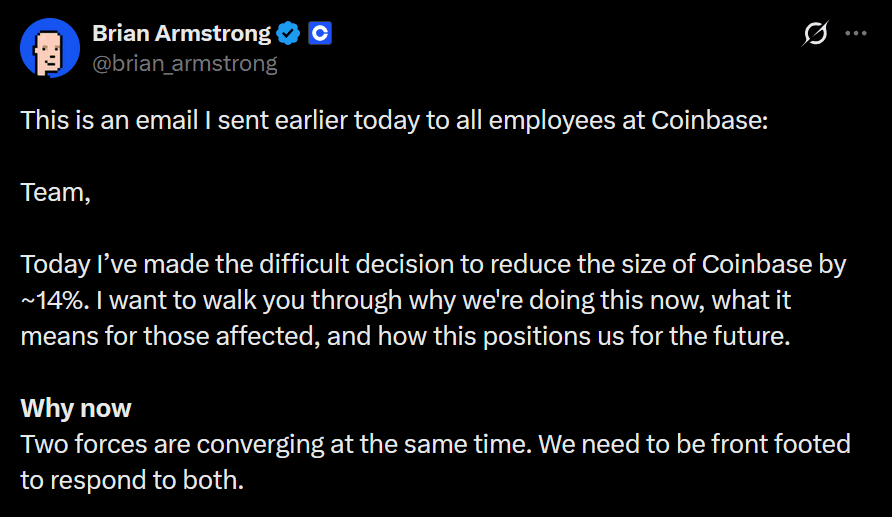
On May 5, 2026, Coinbase CEO Brian Armstrong declared on X that artificial intelligence is “materially changing how work is executed.” In laying off 14% of its staff, the US-based crypto exchange is not simply reacting to market volatility; it is executing a structural redesign.
According to Armstrong’s public communications to employees, Coinbase is moving toward small, autonomous “AI-native pods.” The corporate hierarchy is being heavily flattened, requiring remaining managers to adopt a “player-coach” model as active individual contributors. Furthermore, the company is enforcing the adoption of AI tools like GitHub Copilot and Cursor, moving toward a framework where one person—heavily augmented by AI—can accomplish the work of entire departments.
A Sector-Wide Trend in Cyberfinance
The corporate restructuring driven by AI extends far beyond Coinbase, revealing a stark reality for the cyberfinance and fintech industries: human capital is increasingly being viewed as a bottleneck.
- Block: In February 2026, CEO Jack Dorsey announced the fintech giant would slash 40% of its workforce (roughly 4,000 roles), explicitly citing advancements in AI tools that can replace middle management.
- PayPal: CEO Enrique Lores has signaled plans to trim 20% of the company’s workforce over the next two to three years, setting up new AI transformation groups to replace traditional roles in customer support, fraud detection, and back-office functions.
- Crypto Exchanges: The broader digital asset space is mirroring this contraction. Recent months have seen Gemini slash 30% of its staff, Algorand cut 25%, and Crypto.com reduce its headcount by 12%, all pointing to AI-driven efficiency gains as a primary factor.
Consequences for Cyberfinance Compliance
As human personnel are aggressively phased out, the responsibility for regulatory compliance in cyberfinance is being handed over to algorithmic systems. This has profound consequences for how crypto exchanges and fintech platforms manage risk:
- Automated AML and Fraud Detection: Machine learning and Large Language Models (LLMs) are highly adept at identifying complex behavioral anomalies and scanning vast transaction networks faster than human analysts. AI can reduce false positives in transaction monitoring, making compliance workflows theoretically more efficient.
- The “Black Box” Dilemma: The biggest regulatory threat in an AI-native compliance model is explainability. Financial regulators require transparent audit trails. If an AI system incorrectly flags a legitimate transaction, or worse, fails to detect a sophisticated crypto-laundering chain, companies must be able to explain why the model made its decision. Without Explainable AI (XAI) frameworks, companies run the risk of failing regulatory audits.
- Systemic Vulnerabilities: When multiple financial institutions rely on similar foundational AI models to monitor compliance, a single algorithmic bias or blind spot could create a systemic failure, allowing organized cybercrime rings to exploit universal regulatory gaps undetected.
Conclusion
The wave of AI-driven layoffs in the spring of 2026 marks a permanent turning point for the cyberfinance industry. Companies like Coinbase, Block, and PayPal are proving that AI is no longer a supplementary tool, but a direct replacement for human labor. While this “leaner, faster” approach promises to lower overhead costs and boost short-term margins, the mass delegation of critical compliance and fraud-detection operations to artificial intelligence introduces unprecedented regulatory risks. Navigating the convergence of AI and cyberfinance will require strict new oversight to ensure these automated systems do not compromise the integrity of global financial markets.
Call to Action
Are you an insider at Coinbase, Block, PayPal, or another cyberfinance company undergoing an AI-driven restructuring? Do you have insights into how these automated systems are handling (or mishandling) AML, KYC, and regulatory compliance? We want to hear from you.
Please report any potential issues, systemic risks, or internal documents regarding AI in the CyberFinance segment to FinTelegram safely and anonymously via our whistleblower platform: Whistle42. Your identity will be fully protected.