



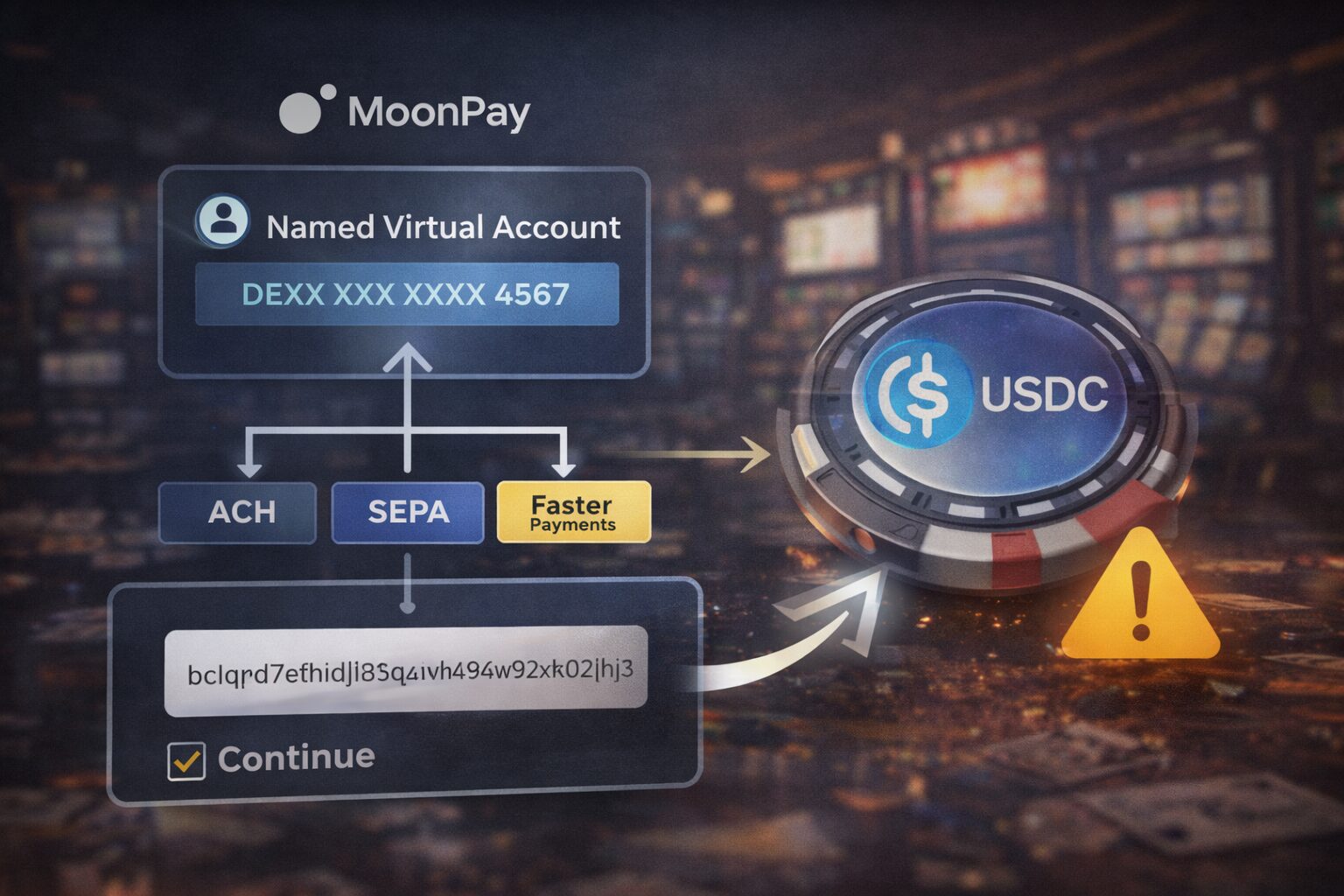
U.S. crypto payment processor MoonPay has announced a “Stablecoin Stack” built around Iron-powered virtual accounts and stablecoin orchestration—promising that what used to take multiple banks and PSPs can now be implemented via one integration. In the context of FinTelegram’s Rail Atlas (where MoonPay repeatedly appears as an embedded on-ramp in offshore “no-KYC” casinos), this move could materially reshape deposit rails by making bank-to-stablecoin funding (ACH/SEPA/Faster Payments) simpler to embed—and harder to detect when merchant controls fail.
Key Facts
- MoonPay markets Virtual Accounts (powered by Iron) that allow partners to issue named USD/EUR/GBP accounts and “convert to stablecoins,” while MoonPay handles payments, compliance and fraud.
- These virtual accounts can be topped up via ACH, SEPA, and Faster Payments.
- Iron describes APIs for Virtual Accounts (auto-settle incoming fiat into stablecoins), On/Off-ramp, and Payments (send stablecoins into third-party bank accounts “as a fiat transfer”).
- MoonPay also launched an enterprise stablecoin business, integrating with M0 for issuance/management of “fully reserved digital dollars,” framing MoonPay as covering “issuance, ramps, swaps, and payments.”
- Media coverage of the “Stablecoin Stack” emphasizes single-integration banking access + on-chain settlement as the value proposition.
Read our MoonPay reports here.
Short Analysis
What changes for casino rails:
In Rail Atlas terms, casinos currently rely heavily on the “Buy Crypto” pattern—an indirect FIAT deposit rail that routes players to an on-ramp (MoonPay, or Changelly→Banxa) before funds land as crypto. MoonPay’s stack adds a more bank-native option: named virtual accounts that accept ACH/SEPA/Faster Payments and can be converted into stablecoins “in minutes,” all behind a single API.
If a high-risk merchant is onboarded (or misclassified) into this infrastructure, the “Buy Crypto” flow can evolve into “Buy Stablecoins / Pay-by-Bank”—reducing card friction and potentially increasing conversion rates, especially in Europe where SEPA-based funding is culturally normal.
Does it make life easier for illegal operators?
Technically, yes: fewer integrations, more payment options, and faster stablecoin settlement can lower implementation costs for any merchant.
Compliance-wise, it shouldn’t—if MoonPay/Iron enforce robust KYB, gambling-merchant controls, geo-blocking, and ongoing monitoring. But Rail Atlas experience shows that offshore operators often seek weak links: affiliates, intermediaries, shell merchants-of-record, or jurisdictional mismatches. The more powerful the “stablecoin rails,” the higher the systemic impact of any KYB failure.
Regulatory & Supervision Impact
Direct connections to ACH/SEPA/Faster Payments move the chokepoint closer to the regulated banking perimeter—potentially improving traceability and SAR/STR pathways.
At the same time, the “Payments” capability Iron describes—stablecoins paid out into bank accounts “as a fiat transfer”—raises classic laundering and merchant-obfuscation questions for supervisors: who is the true merchant, what is the underlying activity (gambling), and are descriptors, MCC-equivalents, and beneficiary controls accurate?
Call for Information
Have you seen MoonPay virtual accounts, “pay-by-bank” stablecoin funding, or new stablecoin checkout flows embedded in offshore casinos/sportsbooks (especially in the EU/UK)? Send screenshots, descriptors, merchant names, and routing domains (redacting sensitive data) via Whistle42.com—we’re mapping the next generation of “stablecoin rails” in the Rail Atlas.