




A regulatory notification reviewed by FinTelegram asks Estonia’s Finantsinspektsioon to examine whether live merchant crypto payments processed through Dream Finance OÜ remain compatible with the post-1 July 2026 MiCA regime. The case could become an early test of where client protection ends — and prohibited business-as-usual begins.
FinTelegram has reviewed a regulatory notification concerning the continued availability of CryptoProcessing by Coinspaid at Estonian electronics retailer Arvutitark after the MiCA transitional deadline. Dream Finance OÜ admits its CASP application remains pending and says activities have been restricted. Yet Arvutitark publicly continues to instruct shoppers to use “CoinsPaid crypto payment,” with payments processed by Dream Finance OÜ. The central question is now for Estonia’s supervisor: wind-down support or continued unauthorised merchant processing?
Key Facts
| Issue | Current Position |
|---|---|
| MiCA deadline | Estonia’s transitional regime ended on 1 July 2026. |
| Dream Finance OÜ CASP status | Application pending; no final authorisation decision disclosed. |
| Dream Finance position | No new clients, accounts or agreements; no expansion of existing services; restricted activity pending regulator decision. |
| Arvutitark checkout | Publicly offers “CoinsPaid crypto payment” and redirects customers to CryptoProcessing. |
| Processor attribution | Arvutitark states that payments are processed by Dream Finance OÜ. |
| Merchant relationship | CryptoProcessing publicly promoted its partnership with Arvutitark before the MiCA deadline. |
| Regulatory issue | Whether continuing ordinary customer payments for an existing merchant is legitimate wind-down activity or prohibited business-as-usual. |
The Notification to Estonia’s Supervisor
FinTelegram has reviewed a copy of a notification dated 2 July 2026 submitted to Estonia’s Finantsinspektsioon. FinTelegram is not identifying the sender of the notification. The submission asks the Estonian financial supervisor to investigate what it describes as suspected continued provision of crypto-asset services through Dream Finance OÜ / CoinsPaid / CryptoProcessing after the end of Estonia’s MiCA transitional period.
At the centre of the notification is Arvutitark OÜ, an Estonian electronics retailer operating arvutitark.ee. According to the notification, an observed payment flow indicated that Arvutitark customers could still initiate crypto payments through CryptoProcessing by Coinspaid after the 1 July 2026 regulatory deadline.
The notification asks Finantsinspektsioon to determine, among other things:
- whether Dream Finance OÜ, CoinsPaid or CryptoProcessing currently hold a MiCA CASP authorisation in Estonia or elsewhere in the EEA;
- whether a pending CASP applicant may continue processing crypto payments for existing merchants;
- whether the Arvutitark payment flow is compatible with restrictions imposed on unauthorised CASPs;
- whether other EU-based merchants continue to receive services;
- whether any wind-down arrangement permits live payment processing;
- and what supervisory measures may follow if ongoing processing is confirmed.
These are questions. They are not findings of illegality.
The Public Evidence: Arvutitark Still Advertises Crypto Payments
The compliance issue is unusually concrete because the merchant itself publicly describes the payment flow. Arvutitark’s website currently maintains a dedicated guide titled “How to pay with crypto?”
The instructions tell customers to:
- add products to the shopping cart;
- select “CoinsPaid crypto payment”;
- place the order;
- proceed to the CryptoProcessing payment environment;
- select a cryptocurrency;
- receive a wallet address and QR code;
- transfer the required crypto amount.
Most importantly, the merchant states that the payments are processed by Dream Finance OÜ through the CryptoProcessing by Coinspaid solution.
This is not an obscure historical reference buried in an archived page. It is a customer-facing payment instruction explaining how a shopper can make a crypto payment.
That makes the MiCA question difficult to dismiss as merely theoretical.
The Public Invoice Screenshot
In a separate public development, former Dream Finance executive Frédéric Hubin published a LinkedIn post sharply attacking CryptoProcessing’s post-MiCA position.
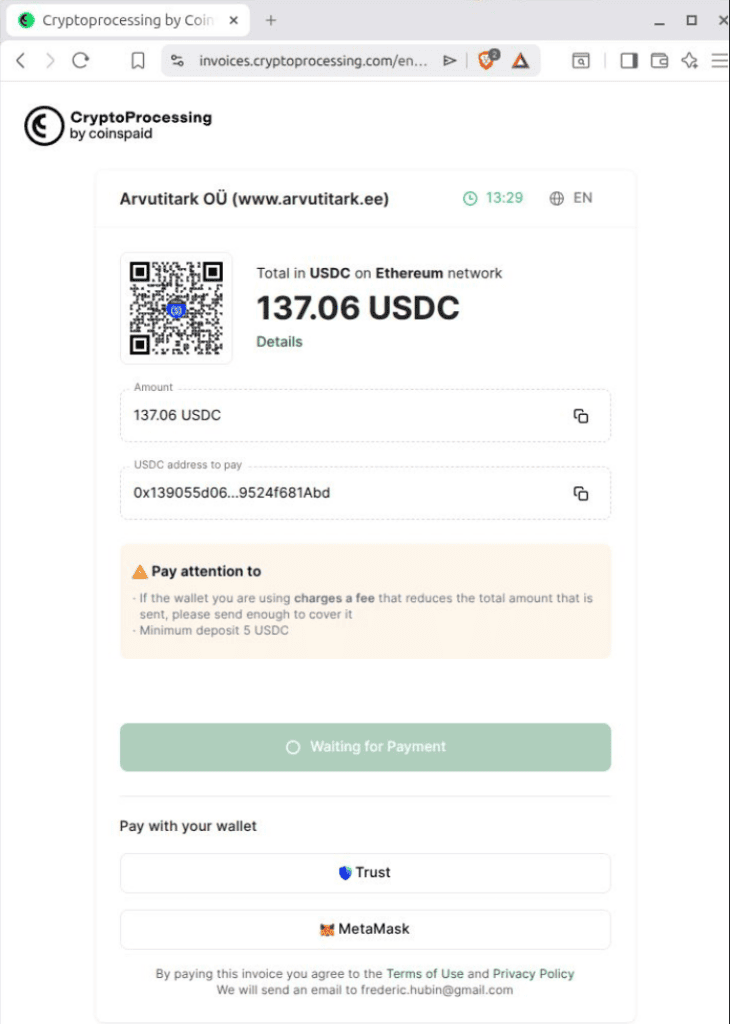
His post includes a screenshot appearing to show a live CryptoProcessing by Coinspaid invoice page for Arvutitark OÜ, hosted on the CryptoProcessing invoice infrastructure. The screenshot displays:
- Arvutitark OÜ as merchant;
- a USDC amount;
- a wallet address;
- a QR code;
- a payment timer;
- and a “Waiting for Payment” status.
Hubin described CryptoProcessing as a “rogue actor in the EEA” and publicly called on Estonian and European authorities to act. The underlying public question is legitimate because the screenshot appears consistent with Arvutitark’s own published description of its crypto-payment flow.
Dream Finance Admits It Has No Final MiCA Decision
The timing is critical. On 30 June 2026, CryptoProcessing by Coinspaid published an update concerning Dream Finance OÜ’s MiCA application. The company stated that:
- Dream Finance OÜ had applied for CASP authorisation in Estonia;
- the application remained under review;
- no licensing decision had been issued;
- the company had restricted its active activities pending the outcome.
According to Dream Finance’s own position, it does not:
- onboard new clients;
- open new accounts;
- enter into new client agreements;
- expand the scope of services provided to existing clients;
- or actively market regulated services.
At the same time, CryptoProcessing states that it continues to support existing clients under its wind-down / continuity planning.
This creates the central compliance issue.
The Regulatory Line After 1 July
Estonia’s Finantsinspektsioon publicly warned the market before the deadline that the old virtual-currency licence era would end on 1 July 2026. After that date, crypto-asset services in Estonia generally require a MiCA authorisation issued by Finantsinspektsioon or another competent EEA authority.
The Estonian supervisor has also stated that applicants still awaiting a decision must limit their activities. ESMA’s EU-wide position is even more explicit. Its April 2026 statement said that after 1 July an entity providing crypto-asset services to EU clients without a MiCA licence must cease offering such services. Unauthorised CASPs were expected to have implemented credible wind-down plans, while national authorities were urged to act against unauthorised services and prevent unauthorised providers from continuing business-as-usual.
That makes Arvutitark an important test case.
The Hard Question: Wind-Down or Business as Usual?
The strongest defence available to Dream Finance appears obvious: Arvutitark was already an existing merchant before 1 July 2026.
Indeed, CryptoProcessing publicly promoted its partnership with the Estonian electronics retailer in 2025. Therefore, this is not necessarily a case of a new merchant being onboarded after the deadline. But that does not end the analysis. The real question is whether an existing merchant may continue allowing ordinary retail customers to initiate new crypto payments through an unauthorised CASP simply because the merchant contract predates the deadline.
There is an important difference between:
- safeguarding existing customer assets;
- permitting withdrawals;
- transferring assets to an authorised provider;
- closing accounts;
- terminating relationships;
and:
- continuing to process new commercial purchase transactions for a live merchant.
From a compliance perspective, the latter looks much closer to ongoing merchant processing than to passive wind-down. That is an assessment, not a legal finding. Finantsinspektsioon must determine where the line falls.
A Potential Contradiction in Dream Finance’s Own Position
Dream Finance says it does not expand the scope of services to existing clients. Yet Arvutitark publicly instructs ordinary customers how to make crypto payments through the CoinsPaid / CryptoProcessing environment. If live payments continue to be generated, processed and settled after 1 July, regulators may need to establish:
- what exact CASP services Dream Finance OÜ performs;
- whether custody is involved;
- whether exchange into fiat or stablecoins occurs;
- whether transfers are executed on behalf of clients;
- who controls the payment address;
- who settles the merchant;
- whether the transaction falls within a regulator-approved wind-down plan.
Without those facts, it would be premature to declare the activity unlawful. But it would be equally premature to treat a pending licence application as if it were a licence.
The Hubin–Dream Finance Conflict
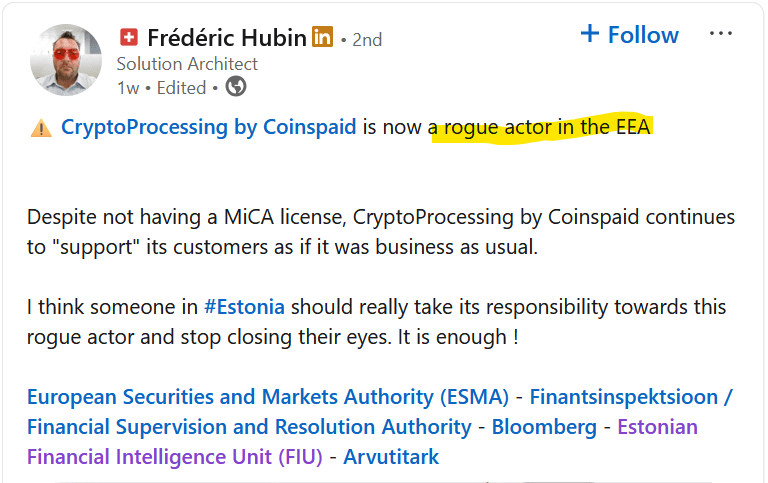
The case also lands in the middle of a bitter and increasingly public conflict between Frédéric Hubin, a former Dream Finance executive, and the CoinsPaid leadership. Hubin has repeatedly criticised Dream Finance and CoinsPaid publicly and now describes CryptoProcessing as a “rogue actor” in the EEA.
CoinsPaid, for its part, has publicly accused Hubin of participating in a coordinated smear campaign and has made serious allegations concerning his past conduct. CEO Max Krupyshev has also published personal accusations against the former executive.
FinTelegram does not adopt either side’s allegations as established fact. But the confrontation matters. Hubin is not a detached commentator. He is a former insider engaged in a highly adversarial dispute with his former group. That requires caution when assessing his statements.
At the same time, an adversarial source is not automatically an unreliable source — particularly where independently accessible public material appears to support the underlying technical question.
In this case, the Arvutitark payment instructions, the CryptoProcessing invoice screenshot, Dream Finance’s own pending-licence disclosure, and the official post-1 July regulatory statements create a factual compliance issue independent of personal animosity.
FinTelegram Assessment
The Arvutitark case may become an important early test of MiCA enforcement in Estonia. The issue is not whether Dream Finance OÜ has submitted an application. It has. The issue is not whether Arvutitark was already a client before 1 July. It apparently was.
The issue is whether live merchant crypto-payment processing may continue after the transitional deadline while the processor remains unauthorised, merely because the merchant relationship predates the deadline.
FinTelegram’s preliminary assessment is that there is a material tension between:
- Dream Finance’s claim that it operates only under restricted activity and wind-down / continuity arrangements; and
- a public merchant flow that appears to permit normal customers to initiate new retail crypto payments.
That tension deserves an explicit supervisory answer.
Questions for Dream Finance / CoinsPaid / CryptoProcessing
FinTelegram invites Dream Finance OÜ, CoinsPaid and CryptoProcessing to clarify:
- Does Dream Finance OÜ currently process live crypto payments for Arvutitark customers?
- Which exact legal entity receives and processes the crypto transaction?
- Which MiCA-defined crypto-asset services are performed in the flow?
- Does Dream Finance OÜ custody assets at any stage?
- Does it exchange crypto assets into fiat or other crypto assets?
- Does it execute or transfer crypto assets on behalf of customers or the merchant?
- Was the continuation of this merchant flow disclosed to Finantsinspektsioon?
- Does a formal wind-down or restricted-activity plan expressly permit such transactions?
- How many existing EU merchants continue to accept new customer payments through the infrastructure?
- What distinguishes current processing from ordinary business-as-usual activity?
Questions for Arvutitark
FinTelegram also invites Arvutitark OÜ to clarify:
- whether the CoinsPaid / CryptoProcessing option remains fully operational;
- whether customers have successfully completed crypto payments after 1 July 2026;
- which entity settles Arvutitark;
- whether the merchant was informed of Dream Finance OÜ’s pending MiCA status;
- and whether any restrictions were introduced after the end of the transitional period.
Right of Reply
FinTelegram invites Dream Finance OÜ, Dream Finance UAB, CoinsPaid, CryptoProcessing, Max Krupyshev, Arvutitark OÜ, Finantsinspektsioon, and other relevant parties to provide factual clarification.
Any response will be reviewed in accordance with FinTelegram’s editorial standards.
Call for Information
FinTelegram invites merchants, customers, current and former employees, compliance officers, PSPs, banks, regulators and technical insiders to provide information concerning post-1 July 2026 processing through Dream Finance OÜ / CoinsPaid / CryptoProcessing.
We are particularly interested in:
- successful payment receipts dated after 1 July 2026;
- CryptoProcessing invoice URLs;
- screenshots of active merchant checkouts;
- wallet addresses;
- blockchain transaction hashes;
- merchant settlement records;
- service agreements;
- wind-down communications;
- regulatory correspondence;
- lists of EU merchants still processing live crypto payments;
- internal instructions concerning post-MiCA continuity.
Information can be submitted securely via Whistle42.com.
Anonymous submissions are welcome. Verifiable documents and transaction evidence are particularly valuable.
The question is simple: after MiCA Day One, is this orderly wind-down — or still business as usual?