


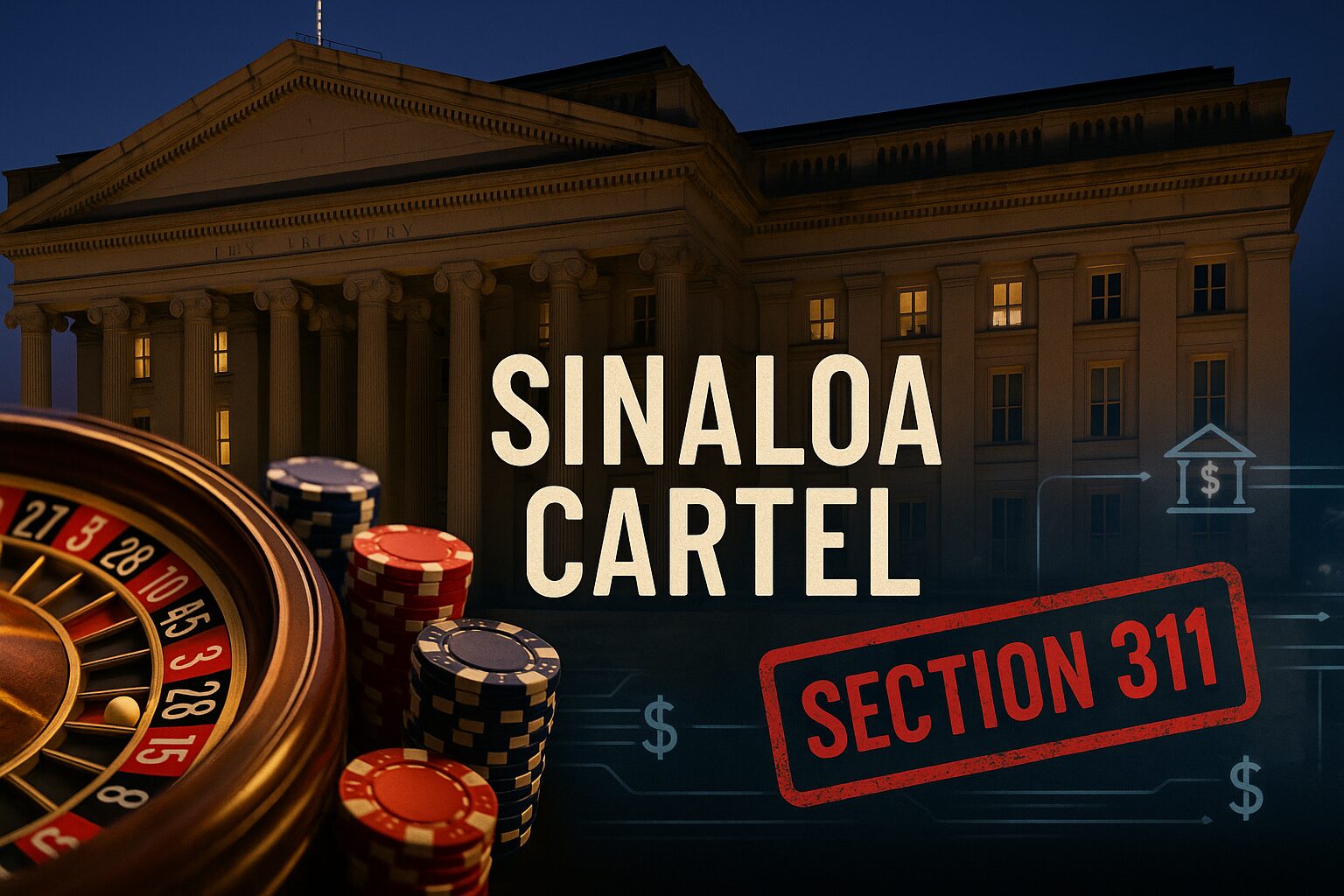
The U.S. Treasury’s Financial Crimes Enforcement Network (FinCEN) has moved against a network of ten Mexico-based casinos it claims are controlled by a criminal group laundering funds for the Sinaloa Cartel. Using its Section 311 powers, FinCEN proposes to cut these gambling venues off from the U.S. financial system via correspondent-banking restrictions.
Key Facts
- Action: FinCEN issues a finding and Notice of Proposed Rulemaking (NPRM) under Section 311 of the USA PATRIOT Act (Source: FinCEN.gov).
- Scope: Transactions involving 10 named Mexican gambling establishments (Emine, Mirage, Midas, Palermo, Skampa casinos) are deemed a class of transactions of primary money laundering concern.
- Measure: Proposed “Special Measure 5” – prohibiting U.S. covered financial institutions from maintaining correspondent accounts used to process transactions involving these casinos.
- Context: Parallel OFAC sanctions on the Hysa Organized Crime Group and 27 related entities, coordinated with the Mexican government, which has frozen accounts of multiple betting houses (Source: U.S. Department of the Treasury).
- Reporting: No new SAR obligation, but institutions are asked to flag relevant SARs with the label “FIN-311-Gambling-Establishments.”
Short Analysis
FinCEN’s move is a textbook example of how the U.S. now weaponises the infrastructure of global finance against organised crime. Rather than only sanctioning individuals or companies, the bureau designates a class of transactions—here, payments involving ten identified casinos—as inherently high-risk and seeks to choke them off at the level of U.S. correspondent banking.
The finding asserts that these casinos have for years funneled illicit payments to senior Sinaloa Cartel figures and even received instructions on how to defeat AML screening. FinCEN.gov+1 Combined with OFAC’s blocking sanctions on the Hysa network and Mexico’s own asset freezes, this is a triangular enforcement model: (1) sanctions, (2) Section 311 de-risking of the banking perimeter, and (3) domestic actions by partner FIUs. For compliance officers, this is another signal that gambling—especially cross-border casino flows—sits firmly in the “cartel finance” red zone.
Operationally, FinCEN’s approach is also procedural: there is an NPRM with a 30-day comment period before the rule becomes final, but institutions are expected to react now—updating screening lists, reviewing correspondent relationships and nested accounts, and recalibrating SAR narratives using the prescribed keyword tag. At the same time, FinCEN prominently advertises its whistleblower program, signalling that banks, staff and intermediaries who see violations of the eventual special measure can monetise inside knowledge if it leads to penalties above USD 1 million.
For global banks, this is not just a Mexico story. Any institution maintaining U.S. dollar correspondent accounts must ensure those accounts are not used—directly or indirectly—to clear payments for the listed casinos or their banking partners. Failure to do so risks not only enforcement under the Bank Secrecy Act but also reputational damage for “facilitating cartel finance” in a sector that FinCEN has now publicly labelled a primary money-laundering concern.
Call for Information
FinTelegram is monitoring cross-border gambling, cartel finance, and bank exposure to Mexican casinos. Insiders at financial institutions, payment providers, casino operators, or regulators who have information on these or similar laundering structures are invited to submit documents and tips—securely and, if desired, anonymously—via Whistle42.com.