



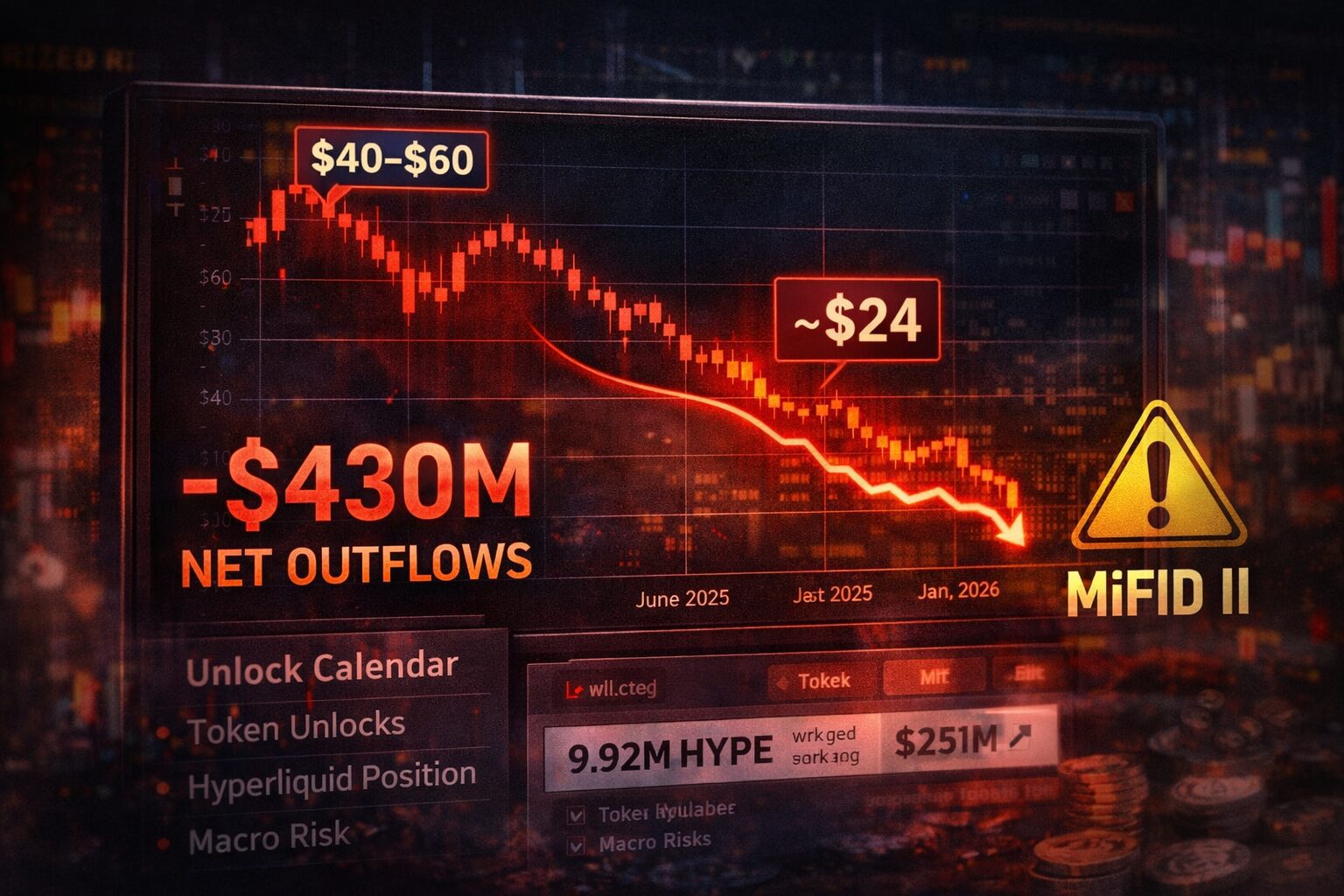
Hyperliquid‘s utility token HYPE is no longer trading anywhere near the “>$40 in June 2025” regime that many holders still anchor to. Using widely-cited price points, HYPE traded around $41.50 on June 10, 2025 (after breaking $40) and is now around $24.5–$24.6 on January 2, 2026. That’s roughly a -40.6% drawdown from the June 2025 “$40+” zone—and a much larger ~58.8% drawdown from the Sep 18, 2025 ATH (~$59.30) (Source: CoinGecko).
The uncomfortable takeaway: even with Hyperliquid’s “poster-child” status for this cycle’s perps-DEX narrative and a high-profile stablecoin partner (Circle), HYPE still trades like a high-beta exchange token—reflexive to (1) market regime, (2) platform flows/volumes, and (3) supply shocks (Sources: FinTelegram, Circle).
Price Snapshot: June 2025 vs. Jan 2, 2026
Reference point (June 10, 2025): HYPE hits ~$41.50 after breaking $40. On Jan 2, 2026: HYPE day stats show open ~$24.28 / close ~$24.64 (with live aggregates ~$24.5) (Source: CoinMarketCap).
Performance (approx.):
- $41.50 → $24.64 = -$16.86 (~-40.6%) (Source: CCN.com).
- ATH ~$59.30 (Sep 18, 2025) → $24.6 ≈ -58.8% (Source: CoinGecko).
Also worth correcting the framing: HYPE’s lifecycle clearly predates June 2025 (CoinGecko shows an ATL in Nov 2024), so June was not a “genesis listing” moment—it was a cycle acceleration moment.
Why is HYPE so far below the June 2025 “$40+” zone?
1) Macro regime risk: the market started pricing a risk-off / bear transition
A growing set of analysts has argued that Bitcoin demand dynamics are weakening and the market may already be shifting into a bear-cycle posture—exactly the environment where leverage-heavy venues and their tokens tend to de-rate fastest (Source: Binance). If BTC is the tide, HYPE is the small boat: it doesn’t need “bad news” to fall—it only needs the tape to turn.
2) Hyperliquid-specific stress: $430M weekly net outflows hit the narrative
FinTelegram’s report (Dec 21, 2025) frames the >$430M weekly net outflow as a visible stress test for Hyperliquid’s “perps-DEX poster child” status, especially with intensifying competition and a risk-off macro backdrop (Source: FinTelegram).
Outflows matter because they’re not just sentiment—they can translate into lower collateral, lower activity, and weaker fee generation, which is fatal for any token story that implicitly depends on “venue flywheel” economics.
3) Competition is no longer theoretical: perps-DEX market share is being contested
Hyperliquid has been described as the dominant perps-DEX by volume (e.g., one market update cited ~79% share among decentralized perps at one point in 2025), but late-2025 reporting increasingly highlights rivals closing the gap (or temporarily overtaking in certain windows).
Translation: traders are less ideological than narratives suggest. If incentives, UX, or perceived safety improve elsewhere, flow migrates.
4) Tokenomics overhang: large unlocks create supply shocks at the worst possible time
Late 2025 saw a very large unlock event highlighted in market coverage: 9.92M HYPE (reported around $251M value) unlocking into circulation—exactly the kind of supply event that can pressure price in thin/risk-off conditions. Even if some recipients stake or hold, markets tend to price the sellable float, not the best-case behavior.
5) “Strong partners” don’t immunize the token—sometimes they raise the bar
Yes: Circle has deepened integration with Hyperliquid (native USDC/CCTP on HyperEVM, “network utility” messaging) and public reporting indicates Circle also became a HYPE stakeholder (Sources: Circle, Circle). But ask the harder question: does this reduce risk, or does it raise expectations (compliance, controls, governance maturity)? In a tightening regulatory climate, the market can assign a bigger risk discount to venues that are “too visible to ignore.”
The constellation around HYPE: dominance + reflexivity + regulatory perimeter
HYPE increasingly trades like a reflexive proxy for:
- Perps volumes / fee intensity (the “exchange token” dynamic),
- Net flows (collateral in/out),
- Competitive positioning (DEX-perps wars),
- Regulatory risk premium (especially where access is perceived as permissive).
FinTelegram has already put the regulatory question on the table: perps access without meaningful geo/KYC friction pushes the venue toward a derivatives-perimeter problem (e.g., MiFID II exposure in the EU framing) (Source: Fintelegram).
Investor Hypothesis: What’s the most likely path from here?
Base-case (most likely): Hyperliquid survives, but HYPE remains a high-beta, regime-sensitive token that can stay suppressed as long as (a) the broader cycle is risk-off, (b) outflows/competition remain visible, and (c) unlock narratives keep resurfacing.
Bear-case: If the bear-market thesis hardens and regulators begin to seriously target offshore/permissionless perps distribution, HYPE could face a longer “exchange-token winter” where each rally is sold into.
Actionable Takeaways (non-advice)
- Treat HYPE less like “a tech token” and more like a leveraged bet on onchain perps activity.
- Watch three signals: net flows, competitive share, and unlock calendar—they often lead price.
- Assume the Circle integration is a strategic positive, but not a near-term price floor.
Reference: FinTelegram prior coverage
This update builds on FinTelegram’s December 21, 2025, report on the $430M weekly outflow and the broader “double whammy” (bear regime + regulation risk) framing.
Read the Hyperliquid reports here.
Call for Information
Are you a market maker, integrator, or trader with insight into Hyperliquid’s real collateral movements, incentive spend, jurisdictional controls, or any enforcement outreach? Share documents and screenshots securely via Whistle42.com. We protect sources.