

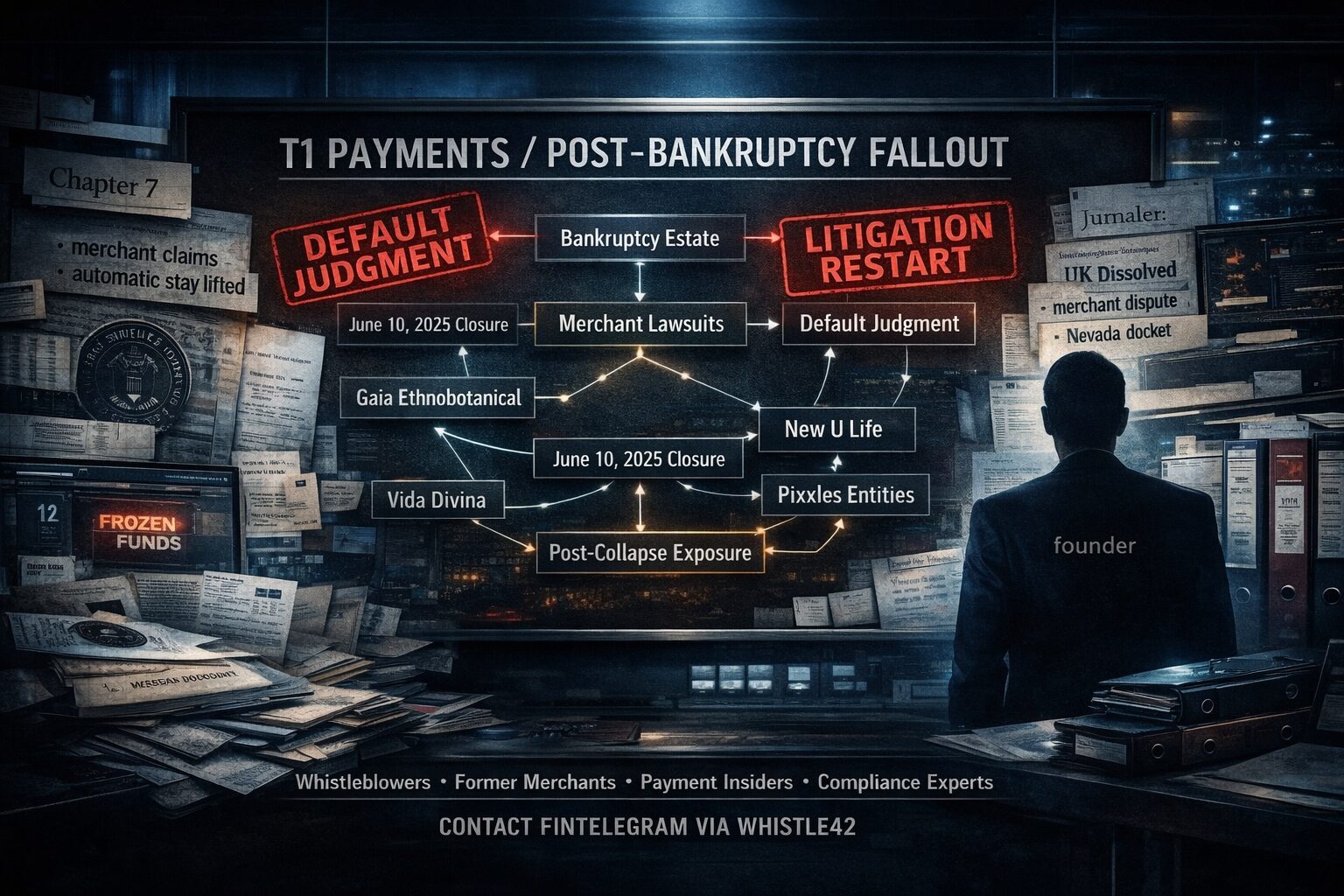
The latest public record around U.S. high-risk processor T1 Payments and its founder and former CEO Donald Kasdon points not to a comeback, but to a deepening post-collapse aftermath. Court records show that T1’s Chapter 7 bankruptcy was treated as closed by June 10, 2025, that stayed merchant cases began moving again, and that one related action ended in a March 30, 2026 default judgment against T1. At the same time, Kasdon remains tied to the still-active New U Life litigation in Nevada.
Key Findings
- T1’s Chapter 7 bankruptcy was treated as closed by June 10, 2025, removing the automatic-stay protection that had frozen at least some civil litigation.
- In Gaia Ethnobotanical v. T1 Payments, the court lifted the stay in July 2025 and later directed the plaintiff to move for default judgment after T1 failed to respond.
- In a related merchant action, default judgment was entered on March 30, 2026 in favor of Vida Divina, LLC and Gaia Ethnobotanical, LLC against T1 Payments, LLC for failure to comply with court orders.
- In T1 Payments v. New U Life, Donald Kasdon remained exposed as litigation continued into 2026; the court extended summary-judgment reply deadlines to February 24, 2026.
- A September 29, 2024 Nevada order denied motions to dismiss and allowed amended civil theft and federal RICO claims in the New U Life case to proceed.
- The UK company T1 Payments Limited was dissolved by compulsory strike-off on June 6, 2023, reinforcing the broader unwind picture.
- Kasdon still has a visible public profile in payments media; American Banker’s author page currently identifies him as founder of T1 Payments and shows a recent byline dated April 6.
The Post-Bankruptcy Report

The latest developments around T1 Payments and Donald Kasdon suggest that the real story is now playing out not in processor growth or licensing announcements, but in the slow legal aftershocks of collapse.
The key turning point was the end of bankruptcy protection. In July 2025, the Nevada federal court in Gaia Ethnobotanical v. T1 Payments expressly noted that T1’s Chapter 7 case had closed on June 10, 2025 and lifted the automatic stay because the bankruptcy code’s stay no longer applied.
That mattered because it reopened a path for merchant plaintiffs. In the Gaia matter, the case moved from procedural suspension to pressure on a now-unshielded defendant. By February 25, 2026, the court noted that T1 had failed to respond to the amended complaint, that default had already been entered, and ordered the plaintiff to move for default judgment by March 11, 2026 or explain why it would not.
The most concrete fresh blow came shortly afterward. A court judgment dated March 30, 2026 shows default judgment entered in favor of Vida Divina, LLC and Gaia Ethnobotanical, LLC against T1 Payments, LLC for failure to comply with court orders. That is one of the strongest recent indicators that T1 is not defending itself in a normal operating-company posture.
At the same time, Donald Kasdon remains relevant because the long-running T1 Payments v. New U Life Corporation litigation is still alive. A March 27, 2025 discovery order shows litigation continuing with Kasdon and related parties still in the case structure, while a February 11, 2026 order extended reply deadlines on competing summary-judgment motions to February 24, 2026. In other words, the flagship dispute involving Kasdon had not burned out by early 2026.
The procedural history of that case is also significant. A Nevada order from September 29, 2024 denied dismissal motions and allowed amended claims, including civil theft and federal RICO, to move forward. That does not establish liability, but it confirms that the court found the amended allegations sufficient to survive that stage of challenge. For a processor group already damaged by bankruptcy, that is a serious litigation signal.
There is also a bankruptcy-to-litigation crossover worth noting. The March 27, 2025 New U Life order references an April 4, 2024 Asset Purchase Agreement under which the Chapter 7 trustee and Kasdon agreed to the purchase of certain estate claims for $36,000. That detail suggests the post-bankruptcy landscape is not merely passive liquidation, but active positioning around claims and litigation exposure.
Outside the U.S. dockets, the UK company record points in the same direction. T1 Payments Limited shows a Final Gazette dissolved via compulsory strike-off on June 6, 2023. That does not resolve the U.S. litigation picture, but it reinforces the impression of structural disintegration rather than international operating continuity.
Kasdon himself remains publicly visible. American Banker’s current author page still identifies him as founder of T1 Payments and lists a byline dated April 6. That indicates ongoing presence in industry commentary, but there is no comparable public evidence in the sources reviewed that T1 itself has re-emerged as a functioning, scaled payment processor.
How the Payvision–T1 Structure Allegedly Worked
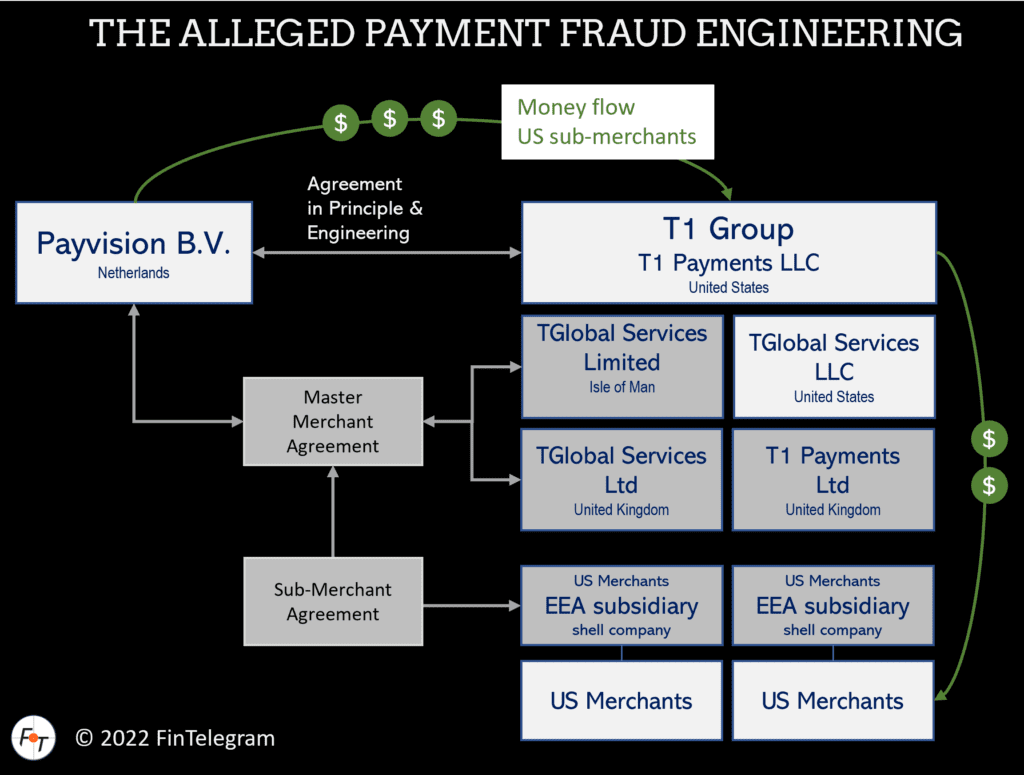
According to investigative reporting and allegations in U.S. complaints, Payvision and T1 Payments allegedly operated a structure that allowed high-risk U.S. merchant transaction flows to be routed through European corporate vehicles linked to Donald Kasdon rather than being presented directly as U.S. high-risk business.
The alleged model was straightforward in concept. T1 Payments sourced or managed the underlying high-risk U.S. merchants, while Payvision provided the European processing layer. To bridge that gap, entities such as T1 Payments Limited in the UK and TGlobal Services Limited in the Isle of Man were allegedly inserted into the chain as formal counterparties or merchant-facing entities. On paper, this created the appearance of non-U.S. merchant business. In substance, according to the allegations, the payment flows remained tied to U.S.-related high-risk activity.
Read more on the Payvision – T1 Payments partnership.
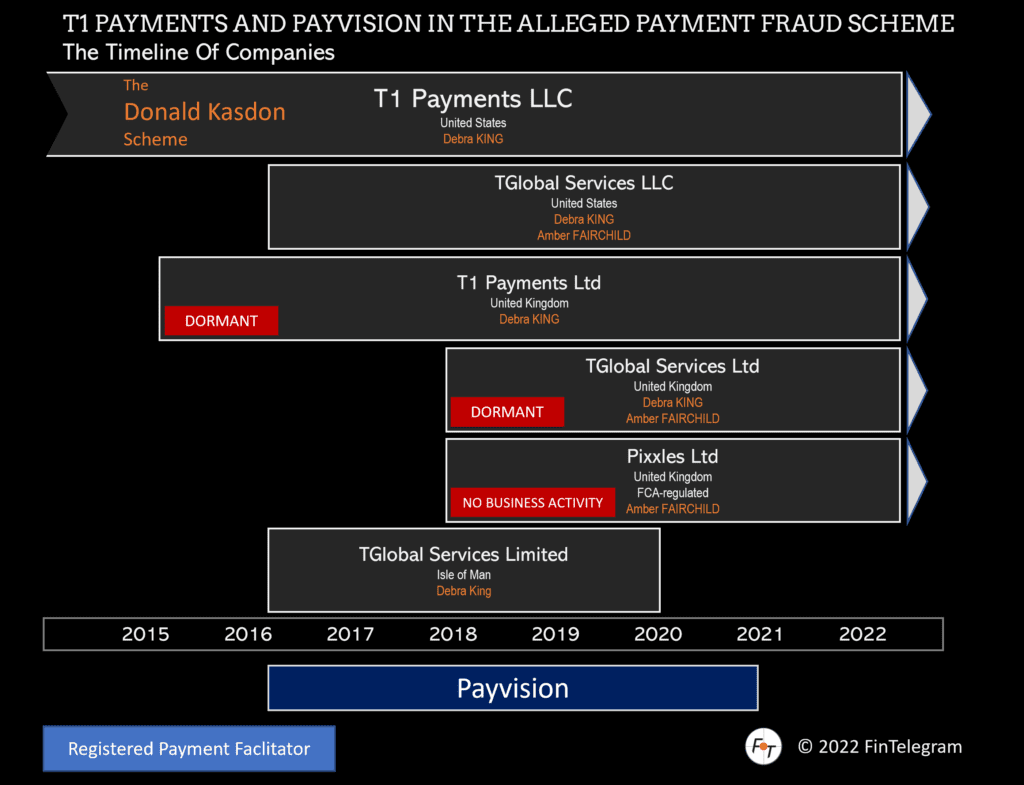
From a compliance perspective, the significance of such an arrangement is obvious. If a processor formally onboards a European entity but the real economic activity, merchant control, or risk exposure sits elsewhere, then the corporate wrapper may serve to obscure the true merchant identity, the actual jurisdictional nexus, and the real risk profile of the business being processed. That, in turn, can weaken onboarding controls, distort due-diligence outcomes, and reduce the visibility of red-flag merchant sectors.
FinTelegram’s interest in this alleged structure is therefore not merely historical. It goes directly to a recurring compliance question in cross-border acquiring: whether offshore or European entities were used as processing fronts for merchants that might otherwise have triggered stricter scrutiny, enhanced monitoring, or outright rejection.
FinTelegram takeaway:
If the allegations are correct, the Payvision–T1 setup was not just a commercial partnership. It was a risk-transformation mechanism: high-risk U.S. merchant activity allegedly entered the acquiring chain under the cover of European entities, making the processing profile appear cleaner than the underlying business reality.
Chronology
- June 6, 2023 — T1 Payments Limited in the UK dissolved via compulsory strike-off.
- October 5, 2023 — Nevada bankruptcy opinion notes that Donald Kasdon paid debtor’s counsel in the Chapter 7 proceeding.
- September 29, 2024 — In New U Life, motions to dismiss denied; amended civil theft and RICO claims allowed to proceed.
- March 27, 2025 — Discovery scheduling order entered in New U Life; order references Kasdon’s purchase of certain estate claims for $36,000.
- June 10, 2025 — T1 bankruptcy treated as closed in later court filings.
- July 23, 2025 — Automatic stay lifted in Gaia Ethnobotanical v. T1 Payments.
- February 11, 2026 — Summary-judgment reply deadline in New U Life extended to February 24, 2026.
- February 25, 2026 — Court orders Gaia to move for default judgment.
- March 30, 2026 — Default judgment entered in related Vida Divina / Gaia action against T1.
Whistle42 Closing CTA
Whistleblowers, former merchants, payment insiders, and compliance professionals with information on T1 Payments, Donald Kasdon, Payvision, related entities, or similar high-risk processor structures are invited to contact FinTelegram via Whistle42. Confidential submissions help expose the rail operators, corporate vehicles, and processing arrangements that continue to shape the cyberfinance risk landscape.