



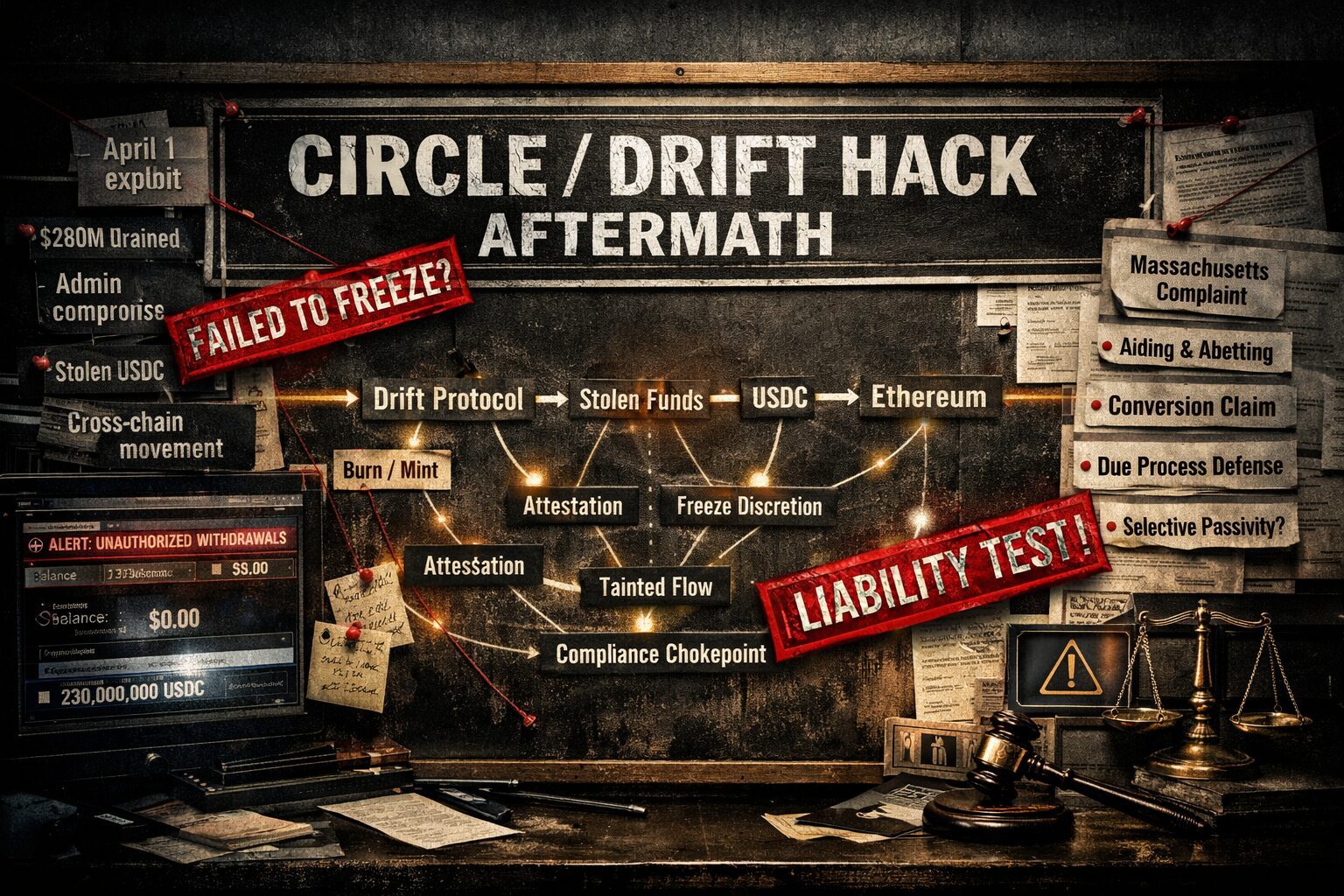
The roughly $280 million Drift Protocol exploit is rapidly turning into a defining compliance test for the stablecoin sector. A proposed class action accuses the US stablecoin issuer Circle of standing by while attackers allegedly moved more than $230 million in stolen USDC through Circle-linked infrastructure instead of freezing the assets. The case strikes at the core of Circle’s regulatory narrative: if USDC is marketed as a controlled, compliance-friendly digital dollar, why was that control not used when it mattered most?
Key Findings
- This is not just a DeFi hack story anymore. The Drift exploit has become a legal and compliance test of whether a centralized stablecoin issuer can escape responsibility when stolen assets move through infrastructure it controls or materially influences (Source: law360.com)
- Circle is being attacked at its weakest point: the gap between compliance branding and operational conduct. Plaintiffs allege that Circle had the technical ability and contractual discretion to intervene, but failed to do so while stolen USDC was allegedly routed through its Cross-Chain Transfer Protocol. (Source: circle.com)
- The proposed class action was filed on April 14, 2026. Public docket records identify the case as McCollum v. Circle Internet Group, Inc. et al. in the U.S. District Court for the District of Massachusetts. (Source: pacermonitor.com)
- Circle’s legal defense is clear, but politically and reputationally dangerous. The company says freezes should occur only under proper legal authority. Critics will read that as a polished way of saying that a “regulated” stablecoin issuer watched a live laundering event and chose not to act. (Source: circle.com)
- Circle’s own disclosures may undercut its public posture. Circle’s published USDC materials say it may block or freeze addresses in certain circumstances, giving plaintiffs room to argue that Circle was not powerless at all, but selectively passive.
- The case could reshape expectations for the entire stablecoin sector. Even if Circle defeats the complaint, courts, regulators, and counterparties may increasingly expect stablecoin issuers to maintain documented emergency-response standards for major thefts and tainted-flow events.
Compliance Analysis
The April 1, 2026 Drift Protocol exploit was one of the most significant DeFi thefts of the year. Public reporting places the loss at around $280 million to $285 million, and security analysis indicates that the attackers did not simply exploit buggy code. The incident appears to have involved privileged-access abuse, governance compromise, and social-engineering tactics. That distinction matters. This was not merely “protocol risk.” It was a failure of operational control and trust architecture. (Source: chainalysis.com)
Now Circle has been dragged into the fallout. Not because it caused the exploit, but because it allegedly did nothing meaningful once the stolen assets began moving through USDC rails. According to public reporting and court summaries, the plaintiffs’ theory is that Circle allowed attackers to move more than $230 million in stolen USDC through its Cross-Chain Transfer Protocol instead of freezing or blocking those flows. That is the crucial escalation. The legal spotlight has moved from the hack itself to the conduct of a centralized infrastructure provider in the middle of a live post-theft asset-movement event. (Source: law360.com)
That makes this case highly relevant from a FinTelegram compliance perspective. Circle does not position USDC as a censorship-resistant, uncontrollable asset in the pure crypto-anarchist sense. On the contrary, Circle has long marketed itself as the respectable, regulated, institution-ready face of stablecoins. It wants the trust premium that comes with control, compliance, and recoverability. But that branding starts to unravel when a major exploit unfolds in real time and the issuer’s answer is effectively that it could not intervene without the right legal paperwork.
Circle’s public response is built on due process. The company argues that freezes must be grounded in lawful authority and not in social-media pressure, market outrage, or improvised demands during an unfolding crisis. That position is legally intelligible. No serious financial institution wants to become an ad hoc private court deciding ownership disputes on the fly. But Circle’s reliance on due process creates a deeper compliance problem: it suggests that the stablecoin issuer is happy to emphasize control when selling trust, yet reluctant to accept responsibility when that control becomes operationally inconvenient. (Source: circle.com)
This tension becomes sharper because Circle’s own public documentation appears less absolute than its post-incident messaging. In its USDC risk disclosures, Circle states that it may block certain addresses and freeze USDC in certain circumstances, including where it determines addresses are associated with illegal activity. That is not the language of a helpless bystander. It is the language of a party that reserves meaningful intervention rights. Plaintiffs will almost certainly use that language to argue that Circle had both technical capacity and documented discretion, but simply chose not to use them in a timely way.
The architecture of Circle’s Cross-Chain Transfer Protocol adds to that exposure. CCTP is not merely a passive third-party bridge sitting outside Circle’s sphere. It is Circle-linked infrastructure built around burn-and-mint mechanics and attestation processes. That allows plaintiffs to frame Circle not as a distant issuer whose token happened to be used, but as a participant sitting at a critical chokepoint in the movement of allegedly stolen assets from Solana into Ethereum. That may not be enough, on its own, to establish liability. But it is more than enough to make Circle’s “we are not the relevant actor here” position look fragile. (Source: developers.circle.com)
From a compliance-policy standpoint, the real issue is no longer whether Circle had a perfect legal duty to freeze. The real issue is whether a stablecoin issuer can continue to claim the benefits of central control while disowning the burdens that inevitably come with it. A company that can freeze, block, attest, and control redemption cannot credibly present itself as both highly governed and operationally neutral at the same time. The market, regulators, and increasingly the courts will force a choice.
To be clear, Circle still has serious defenses. It did not execute the theft. The plaintiff will face hurdles on duty, causation, knowledge, and class certification. Courts may be reluctant to create a sweeping obligation for stablecoin issuers to act as universal recovery agents every time stolen assets touch their systems. But even if Circle wins in court, it may still lose the larger argument. The case has already exposed the compliance contradiction that sits at the center of the stablecoin industry’s institutional pitch.
Conclusion
The proposed class action against Circle is aggressive, but it is not frivolous. It forces an overdue question onto the table: when a “regulated” stablecoin issuer has visibility, discretion, and technical leverage over tainted flows, at what point does inaction stop looking like legal restraint and start looking like compliance failure? The Drift case may not produce an immediate precedent, but it already marks a turning point. The liability perimeter around stablecoin issuers is moving outward. Circle is simply the first major issuer being forced to test it in court.
Call for Information
FinTelegram is investigating the post-hack conduct of stablecoin issuers, DeFi infrastructure operators, and cross-chain settlement providers. Insiders, compliance staff, law-enforcement contacts, counterparties, and affected users with information about USDC freezing practices, incident-response protocols, or asset-movement decisions are encouraged to submit information securely via Whistle42.