


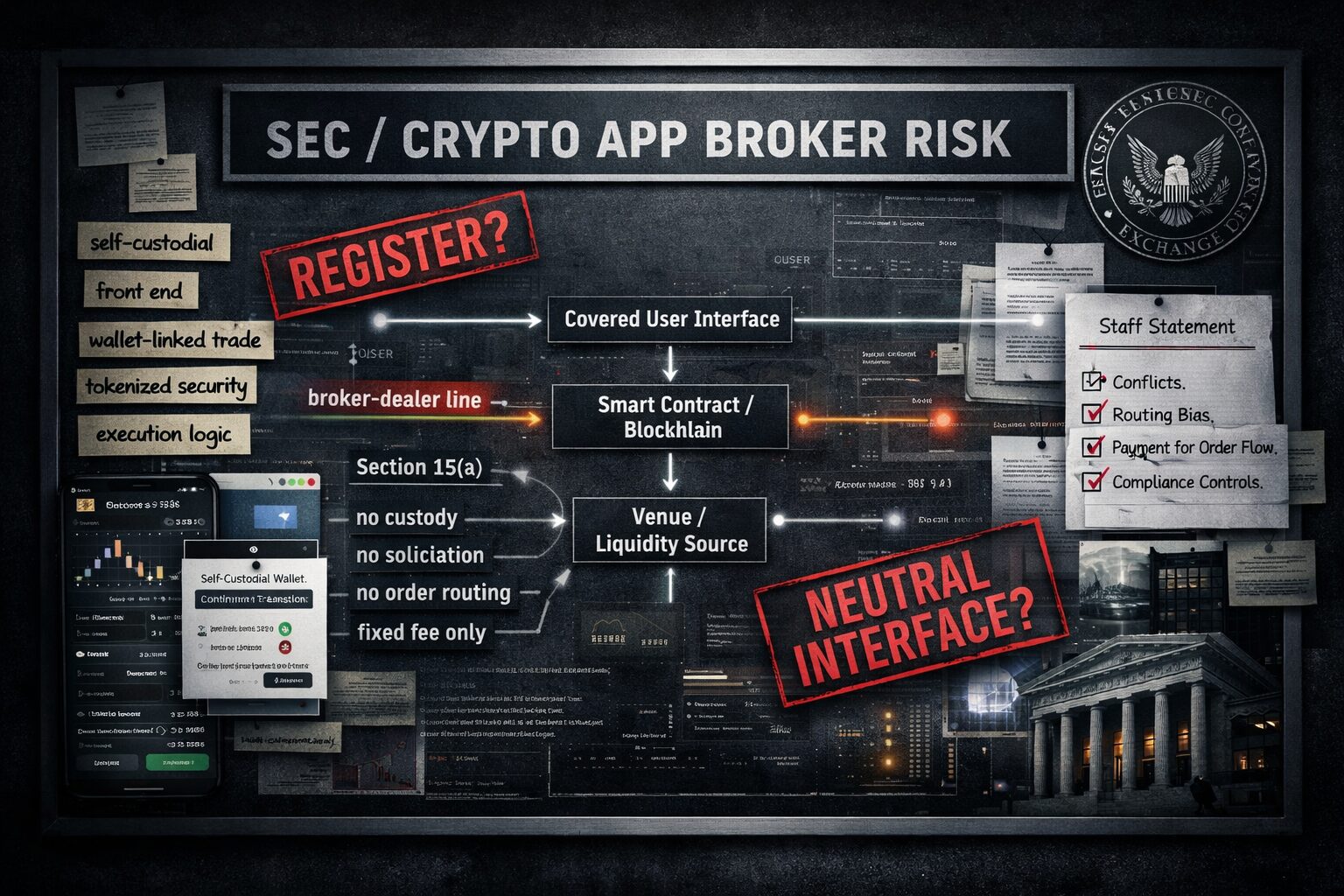
With its April 13, 2026 staff statement, the U.S. SEC’s Division of Trading and Markets has drawn a functional boundary for crypto apps that facilitate transactions in crypto asset securities through self-custodial wallets. The message is clear: a neutral interface may avoid broker-dealer registration, but anything that looks, behaves, or monetizes like an intermediary may still fall into the broker perimeter. For crypto front ends, wallet-linked trading apps, and DeFi-style interfaces, this is not deregulation. It is a conditional warning label.
Key Findings
- The SEC is carving out a narrow non-objection path for certain crypto interfaces. The staff statement applies only to specified “Covered User Interfaces” used by users engaging in self-custodial transactions involving crypto asset securities.
- Neutral tooling is the decisive concept. The SEC staff draws a hard line between passive transaction-enabling software and broker-like conduct involving solicitation, discretion, routing, execution, or custody.
- Compensation structure is now a regulatory signal. Revenue models tied to venues, routes, counterparties, or transaction outcomes may push an interface back into broker-dealer risk territory.
- Disclosure and control expectations are substantial. Even outside registration, app operators are expected to maintain robust disclosures around conflicts, fees, routing logic, cybersecurity, default settings, and use of transaction data.
- The statement is not law and not permanent. It is a staff position with no independent legal force and is scheduled to lapse five years after April 13, 2026 unless the Commission acts otherwise.
- This matters far beyond the U.S. retail crypto scene. The statement offers a useful analytical framework for identifying when “decentralized” or “self-custodial” branding masks a regulated intermediary function.
Why This Matters
The SEC’s latest staff statement is one of the most important recent signals for crypto market structure because it goes directly to the question many platforms have tried to blur: when is an app merely software, and when is it effectively a broker?
For years, crypto operators have relied on a familiar narrative. They claim to be “just an interface,” “just a wallet layer,” or “just a front end” while quietly shaping execution, monetizing order flow, steering users toward preferred venues, or embedding commercial conflicts deep inside their product design. The SEC staff’s April 13, 2026 statement targets exactly this grey zone.
What the staff is saying, in substance, is simple: self-custody alone does not cleanse an intermediary business model.
The SEC’s Core Position
The statement addresses certain crypto apps, browser extensions, websites, and similar interfaces that help users prepare transactions in crypto asset securities using self-custodial wallets. These interfaces may allow users to input transaction details, compare routes, view pricing information, estimate gas, and convert those instructions into data that can be signed and transmitted onchain.
The SEC staff says it will not recommend enforcement action for failure to register as a broker-dealer if the interface provider remains within a tightly defined operational perimeter.
That perimeter is narrow.
The interface must operate as a neutral user tool, not as a transaction intermediary. In other words, it may facilitate user-directed interaction with blockchain-based systems, but it must not influence, structure, monetize, or control the securities transaction in a broker-like way.
The Real Test: Neutral Interface or Disguised Intermediary?
This is where the statement becomes operationally significant.
According to the SEC staff, the non-objection position depends on the provider staying away from conduct traditionally associated with brokerage activity. That includes avoiding:
- soliciting particular transactions,
- recommending specific crypto asset securities,
- negotiating or influencing deal terms,
- routing or taking orders,
- executing or settling transactions,
- handling customer assets,
- arranging financing,
- or otherwise inserting itself into the transactional chain as more than a neutral software layer.
This matters because many crypto businesses do not merely display options. They rank, steer, default, prioritize, and optimize in ways that may materially shape the outcome of the transaction. Once a provider does that with commercial purpose, the “we are just code” defense starts to look weak.
The SEC is effectively saying that the label “self-custodial” does not answer the broker question. Function does.
Follow the Compensation
One of the sharpest points in the staff statement concerns compensation.
The SEC staff indicates that qualifying interfaces should be compensated through fixed, user-facing charges based on objective criteria and applied consistently. Compensation must not depend on the venue selected, the route used, the counterparty involved, or the economic outcome of the trade.
That is a major compliance marker.
Why? Because compensation architecture often reveals what glossy decentralization language hides. If an app earns more when flow goes to a particular venue, liquidity source, or affiliated execution path, then neutrality becomes very hard to defend. The SEC explicitly signals that this framework excludes arrangements akin to payment for order flow.
This is a crucial takeaway for compliance teams: in crypto, broker risk is not only about custody or formal order handling. It is increasingly about how the product is monetized and whether that monetization creates transactional bias.
Disclosure Is Not Optional Governance Theater
The SEC staff also expects significant disclosures from operators seeking to remain outside registration.
These include disclosures around:
- fee structures,
- conflicts of interest,
- routing parameters,
- default settings,
- the use of trading-related data,
- cybersecurity measures,
- integration with venues or distributed ledger systems,
- and transaction-related risks such as MEV exposure.
This is an important signal. Even if the SEC is willing, in limited circumstances, to treat some crypto interfaces as non-brokers, it does not view them as compliance-free software experiments. The staff is demanding governance, transparency, internal discipline, and clearly documented user-facing controls.
In practical terms, the SEC is moving the compliance burden upstream into product design and operational architecture.
What the Statement Does Not Cover
The staff statement is not a blanket pass for crypto apps.
It does not protect platforms that, in substance, do more than help a user prepare and transmit a self-custodied transaction. If the operator:
- exercises discretion,
- influences execution outcomes,
- controls assets,
- manages transaction flow,
- steers users through hidden incentives,
- or embeds commercial conflicts inside routing logic,
then the non-objection position may no longer apply.
This is particularly relevant for hybrid businesses sitting between DeFi and CeFi, including:
- wallet-integrated execution apps,
- protocol front ends with commercial routing logic,
- interfaces connected to affiliated venues,
- token trading apps that market themselves as neutral while optimizing for internal economics,
- and “decentralized” systems with highly centralized product governance.
The SEC has not abolished broker risk for these businesses. It has merely explained where the line may be drawn.
The Bigger Regulatory Context
This statement should be read in the context of the SEC’s broader 2026 effort to impose more coherent structure on the treatment of crypto asset securities and tokenized securities.
It complements the Commission’s wider message that tokenized securities do not cease to be securities merely because they move on blockchain rails. It also reflects a policy shift away from undifferentiated hostility toward a more functional approach: identify what the tool actually does, identify where the intermediary function begins, and assess registration risk accordingly.
That is useful. But it is not safe harbor legislation, not formal rulemaking, and not judicial precedent.
The SEC itself states that the document reflects staff views only, has no legal force or effect, and creates no enforceable rights or obligations. It is also expressly temporary and expected to be withdrawn five years after April 13, 2026 unless the Commission extends or replaces it.
So the market should read this statement for what it is: a current enforcement and interpretive signal—not a permanent immunity shield.
FinTelegram’s Compliance Take
For FinTelegram, the real value of this SEC statement lies not just in U.S. securities law, but in its broader forensic usefulness.
It gives regulators, investigators, compliance officers, and market observers a practical test for crypto interfaces that claim to be neutral technical wrappers while operating as shadow intermediaries.
The key question is no longer whether an app says “non-custodial” on its homepage.
The key questions are:
- Who controls the transactional logic?
- Who benefits from routing outcomes?
- Who shapes the user’s execution path?
- Who monetizes the flow?
- Who manages the defaults?
- Who holds the conflict?
That is where the real broker analysis begins.
In the cyberfinance sector, this matters because the same pattern appears repeatedly: legal risk is disguised as product design, intermediation is disguised as software, and regulated functions are fragmented into technical layers to avoid supervisory classification.
The SEC’s statement does not solve that problem. But it does provide a sharper vocabulary for exposing it.
Conclusion
The SEC has now made one point unmistakably clear: a self-custodial interface may avoid broker-dealer registration only if it remains genuinely neutral. Once an operator solicits, steers, monetizes, controls, or otherwise inserts itself into the transaction chain, the broker question returns with force.
For crypto app operators, this means compliance is no longer a matter of labels. It is a matter of architecture, incentives, disclosure, and operational reality.
For regulators and investigators, the message is equally clear: the next enforcement frontier is likely to focus not only on custody and issuance, but on the hidden intermediary functions embedded inside supposedly neutral user interfaces.
Whistle42 Call to Action
FinTelegram invites whistleblowers, compliance insiders, developers, former employees, payment specialists, and affected users to report regulatory violations, hidden conflicts, custody misrepresentations, undisclosed routing arrangements, and broker-like conduct disguised as “self-custodial” crypto infrastructure. If you have evidence of misconduct in the cyberfinance segment or the crypto scene, submit it securely via the Whistle42 whistleblower platform.