



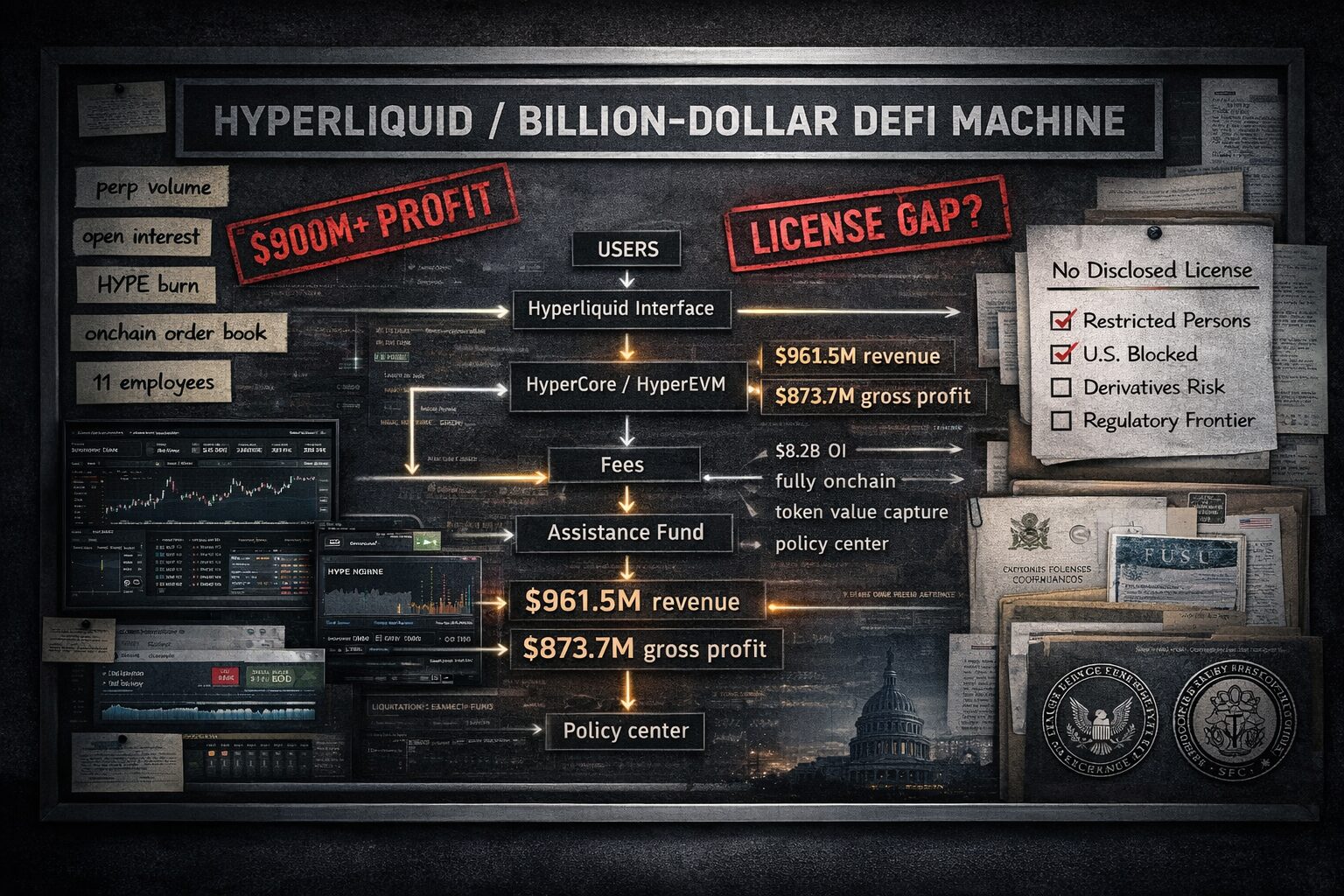
Hyperliquid has become one of the most extraordinary revenue engines in crypto. Public analytics suggest that the protocol generated roughly $961.5 million in gross protocol revenue in 2025 and about $873.7 million in gross profit, while current annualized revenue still sits near $675 million. At the same time, the network is processing roughly $193.9 billion in 30-day perpetual volume, carrying around $8.2 billion in open interest, and supporting a token market cap of about $10.6 billion. But behind the growth story sits a harder compliance question: Hyperliquid’s official materials emphasize self-custody, restricted jurisdictions, and sanctions rules, yet FinTelegram could not identify any publicly disclosed exchange, broker-dealer, or derivatives license attached to the front-end or protocol stack reviewed.
Key Findings
- Hyperliquid is operating at exchange-scale economics. DeFiLlama currently shows about $674.6 million annualized revenue, $758.8 million annualized fees, $193.9 billion in 30-day perp volume, and $8.21 billion in open interest, placing Hyperliquid in the top tier of crypto trading venues by economic output.
- Its 2025 financial performance was exceptional. Based on DeFiLlama’s quarterly income statement, Hyperliquid generated about $961.49 million gross protocol revenue in 2025 and approximately $873.68 million gross profit after cost of revenue.
- The business model is brutally efficient. Hyperliquid has been widely described in recent coverage as an 11-person organization that produced over $900 million in profit in 2025, making it one of the most profitable crypto startups per employee.
- Value capture is unusually direct. Hyperliquid’s docs state that fees are directed to the community, deployers, HLP, and especially the Assistance Fund, which automatically converts fees into HYPE and burns the tokens.
- Commercial traction is now spilling into tradfi-adjacent products. S&P Dow Jones Indices licensed the S&P 500 to Trade[XYZ] for perpetuals on Hyperliquid in March 2026, a milestone showing how seriously the market now takes Hyperliquid’s liquidity layer.
- The regulatory posture remains the weak flank. Hyperliquid’s official interface terms restrict U.S. and other “Restricted Persons,” but the reviewed official materials do not identify a publicly disclosed broker, exchange, or derivatives license for the trading interface or protocol venue.
- That gap matters more, not less, as Hyperliquid gets bigger. Hyperliquid has now funded a Washington policy center focused on building legal pathways for DeFi perps in the U.S., a strong signal that the project itself sees regulation as a strategic frontier rather than a solved issue.
Why This Matters
Hyperliquid is no longer just another crypto protocol with a cult following. It now looks like a serious market infrastructure business masquerading in DeFi clothing: high throughput, deep liquidity, real fee generation, a native L1, an attached EVM environment, and a token that increasingly trades like an equity proxy on future growth. That combination is why many market participants now speak of Hyperliquid not merely as a successful protocol, but as one of the most economically powerful startups to emerge from crypto.
For FinTelegram, however, the story is not just the success narrative. The real issue is whether Hyperliquid is becoming too large, too systemically relevant, and too economically sophisticated to continue relying on the familiar DeFi playbook of self-custody plus geofencing plus legal ambiguity.
The Financial Performance: A DeFi Venue Printing Exchange-Scale Cash Flow
The hard numbers are remarkable. DeFiLlama currently shows Hyperliquid with about $4.99 billion in TVL, $62.2 million revenue over the last 30 days, $55.29 million 30-day protocol revenue, $193.895 billion in 30-day perpetual volume, $7.412 billion in 24-hour perp volume, and $8.21 billion in open interest. On the token side, it shows a $10.626 billion market cap and roughly $42.9 billion fully diluted valuation for HYPE.
The 2025 income statement is even more striking. Using DeFiLlama’s quarterly protocol data, Hyperliquid posted $139.67 million gross protocol revenue in Q1 2025, $180.35 million in Q2, $354.94 million in Q3, and $286.53 million in Q4. That adds up to $961.49 million for full-year 2025. Cost of revenue for those four quarters totaled $87.81 million, implying approximately $873.68 million in gross profit.
Those figures line up with the broader market narrative that Hyperliquid generated roughly $900 million in 2025 profit with an extremely small core team. Recent long-form coverage and institutional commentary have framed Hyperliquid as a rare case of a crypto startup reaching elite-scale profitability without venture capital and with minimal organizational overhead.
This is the core of the Hyperliquid phenomenon: a protocol-native trading venue generating the economics of a major exchange without the cost structure of a traditional financial institution. That is why Hyperliquid is not just outperforming peers; it is forcing the market to rethink what a high-value crypto business looks like.
Why Hyperliquid Has Exceeded Expectations
Hyperliquid’s commercial success is not accidental. Its official documentation describes a purpose-built layer-1 blockchain optimized from first principles, with fully onchain perpetual and spot order books, one-block finality, and throughput currently supporting around 200,000 orders per second. It also combines that trading engine with the HyperEVM, letting builders tap into the same liquidity base from an EVM-compatible environment.
That architecture matters because Hyperliquid has been selling a very specific proposition to the market: CEX-like speed and UX without the conventional exchange stack. The docs explicitly emphasize onchain order books, low fees, transparent execution, and wallet-based onboarding rather than account-heavy intermediated access.
The revenue design is equally important. Hyperliquid’s fee documentation says that on most other protocols the team or insiders are the main beneficiaries of fees, whereas on Hyperliquid fees are directed to the community, HLP, deployers, and the Assistance Fund; that fund then converts trading fees into HYPE and burns the tokens. In other words, the protocol couples venue growth to token scarcity in a way that makes the HYPE token a direct beneficiary of trading activity.
Hyperliquid has also started to push beyond native crypto markets. In March 2026, S&P Dow Jones Indices licensed the S&P 500 to Trade[XYZ] for perpetual contracts on Hyperliquid, giving the chain a tradfi-branded benchmark product. That does not make Hyperliquid regulated finance, but it does show that serious external counterparties now view its market infrastructure as commercially relevant.
The Regulatory Status: Big Platform, Thin License Story
Here the picture changes sharply.
Hyperliquid’s official terms make clear that the interface is not available to “Restricted Persons,” and the snippet surfaced by search explicitly shows that the platform geofences users in prohibited jurisdictions. Independent summaries of the same official terms consistently identify the United States and Ontario among those restricted jurisdictions.
The official onboarding flow also reinforces Hyperliquid’s self-custodial design. Users connect wallets, confirm transactions in their EVM wallet, and are then ready to trade; the official docs focus on wallet connectivity, transfers, staking, API wallets, and developer endpoints rather than centralized customer onboarding or licensed intermediary status.
That distinction is commercially powerful, but it does not answer the regulatory question. After reviewing Hyperliquid’s official website, docs, foundation site, and interface terms, FinTelegram could not identify any publicly disclosed broker-dealer, exchange, multilateral trading facility, crypto-asset service provider, futures commission merchant, or comparable derivatives license associated with the trading venue or front-end access reviewed. The official materials reviewed present Hyperliquid as a blockchain ecosystem with a self-custodial interface and a Cayman-based foundation, not as a conventionally licensed trading intermediary.
That does not prove that no regulated entity touches any part of the broader ecosystem. It does mean that the public-facing regulatory story remains materially thinner than the commercial story. For a venue already operating at multibillion-dollar scale in open interest, that is not a small detail. It is the central legal vulnerability.
The Cayman Foundation Is Not the Same as a Trading License
An SEC filing tied to a proposed HYPE investment product states that the Hyper Foundation is a Cayman Islands registered foundation company formed in October 2024 to oversee growth and governance of the Hyperliquid Network. That is useful corporate context, but it is not the same thing as identifying a market-structure license for a trading venue dealing in leveraged products.
This point is often blurred in crypto. A foundation structure can support governance, grants, ecosystem development, and token administration. It does not by itself answer whether the core trading functionality would satisfy exchange, brokerage, derivatives, conduct-of-business, AML, or investor-protection rules in key jurisdictions if regulators decide to look through the protocol narrative and focus on function.
Hyperliquid Clearly Knows Regulation Is the Next Battlefield
One of the strongest signals that Hyperliquid’s legal position is not settled came in February 2026, when the project backed the Hyperliquid Policy Center in Washington, D.C. Fortune reported that the initiative is focused on helping create legal pathways for decentralized perpetual derivatives in the U.S., backed by a donation valued around $28 million.
That move is strategically rational. If you are already a dominant offshore or extra-jurisdictional liquidity venue, the next value driver is not merely more volume. It is regulatory survivability. Hyperliquid’s policy spend suggests the project understands that its future valuation may depend as much on legal legibility as on throughput, spreads, or token burns.
FinTelegram’s Compliance Take
Hyperliquid deserves the praise it is getting on performance. On publicly available data, it has built one of the most profitable and capital-efficient businesses in crypto. It has deep liquidity, large open interest, powerful token value capture, and a technology stack that the market clearly values. In pure business terms, Hyperliquid has already crossed from interesting DeFi experiment into serious financial infrastructure contender.
But that is exactly why the compliance question becomes unavoidable. The larger Hyperliquid gets, the less plausible it becomes to treat it simply as an innocuous software layer. A venue that processes hundreds of billions in monthly perpetual volume, offers leveraged exposure, develops tradfi-linked products, and supports a native token with multibillion-dollar market value is no longer operating in a regulatory blind spot by default. It is operating in a regulatory waiting room.
The present situation can be summarized in one line: Hyperliquid has already achieved exchange-scale economics without yet presenting exchange-scale licensing disclosure. That mismatch is the key issue for regulators, counterparties, institutional allocators, and serious compliance officers.
Conclusion
Hyperliquid may well be the most impressive financial startup in crypto today if measured by revenue efficiency, profit generation, and market traction. The numbers support the hype. But the next stage of the story will not be decided only by volume, fees, or token price. It will be decided by whether Hyperliquid can convert extraordinary commercial success into a durable regulatory position before supervisors decide to define the platform for themselves.
For now, Hyperliquid looks like a billion-dollar DeFi cash machine with an unresolved license problem. That is both the source of its edge and the source of its risk.
Whistle42 Call to Action
FinTelegram invites whistleblowers, current and former employees, developers, compliance specialists, counterparties, market makers, and affected users to report information on Hyperliquid, offshore derivatives access, geofencing circumvention, sanctions controls, market-structure risks, hidden control points, or any other regulatory violations in the cyberfinance segment and crypto scene.
If you have evidence, report it securely via the Whistle42 whistleblower platform.