
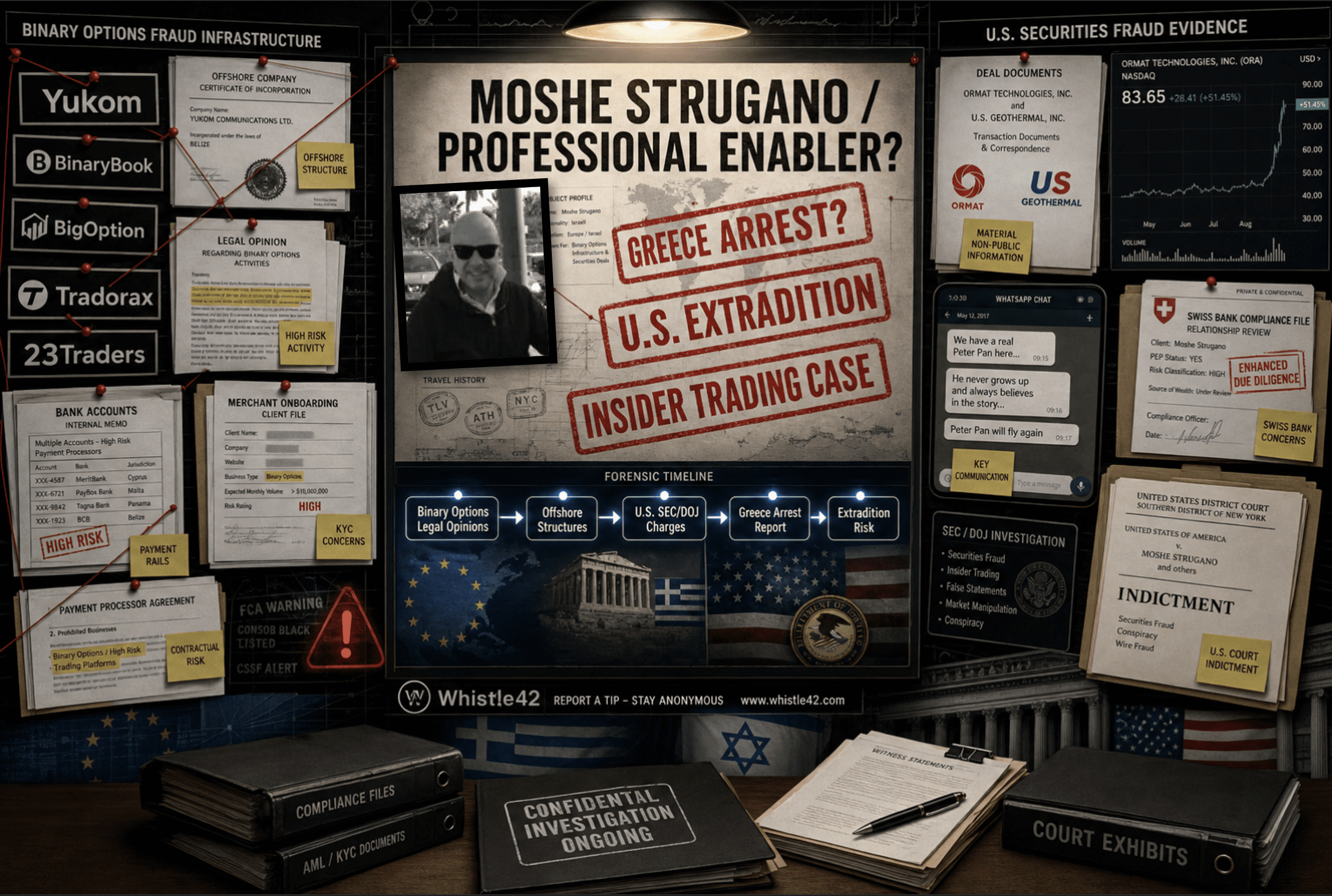
Israeli lawyer Moshe Strugano, long exposed by FinTelegram as one of the legal facilitators of the Israeli binary-options fraud industry, has reportedly been arrested in Greece at the request of U.S. authorities. According to Calcalist, the arrest relates to the U.S. insider-trading case over Ormat’s 2018 acquisition of U.S. Geothermal, in which Strugano allegedly made around $1.2 million in illicit profits. For FinTelegram readers, the case is not a surprise. Strugano’s name has appeared for years in the shadows of offshore companies, boiler-room schemes, legal opinions for scam operators, and now — allegedly — securities fraud.
Key Findings
- Calcalist reports that Moshe Strugano was arrested in Greece at the request of U.S. authorities and later released under restrictive conditions, with a ban on leaving Greece. The Israeli outlet reports that extradition proceedings are expected.
- The U.S. SEC charged Strugano and Rinat Gazit in April 2022 with insider trading ahead of Ormat Technologies’ acquisition of U.S. Geothermal. The SEC alleges that Gazit, then Ormat’s head of M&A, tipped Strugano with material non-public information.
- The alleged profit was approximately $1.2 million. According to the SEC complaint, Strugano bought 740,650 U.S. Geothermal shares between December 2017 and January 2018 and sold them after the merger announcement.
- The DOJ/SDNY charged Strugano criminally with conspiracy to commit securities fraud and securities fraud, describing him as an Israeli lawyer specializing in the creation of offshore companies. The U.S. said in 2022 that it intended to seek his extradition.
- FinTelegram had already identified Strugano as a legal enabler of the binary-options scam industry, including legal-opinion work for the Yukom/BinaryBook ecosystem, Tradorax, GreyMountain Management, and other broker-scam structures.
Report
The Greek Arrest: A Long-Delayed Knock On The Door
According to a new report by Israeli business daily Calcalist, lawyer Moshe Strugano was recently arrested in Greece at the request of U.S. authorities. The report states that he is suspected of insider trading in connection with Ormat Technologies’ 2018 acquisition of U.S. Geothermal, that he has been released under restrictive conditions, and that he may not leave Greece while extradition proceedings unfold.
For ordinary readers, this may sound like a new scandal. For FinTelegram readers, it is merely the latest chapter in a long-running file. Strugano has been on our radar for years — not as a naïve lawyer caught in a misunderstanding, but as one of the professional service providers who helped give legal, corporate, and banking infrastructure to the toxic Israeli binary-options industry.
The irony is almost cinematic: the lawyer who allegedly helped scammers dress fraud in legal clothing now faces a U.S. case alleging that he personally abused privileged information to enrich himself.
To be clear: Strugano is presumed innocent unless and until convicted. But the publicly available U.S. charging documents and the Calcalist report paint a devastating picture.
The Insider-Trading Case: “Peter Pan,” U.S. Geothermal, And A $1.2M Windfall
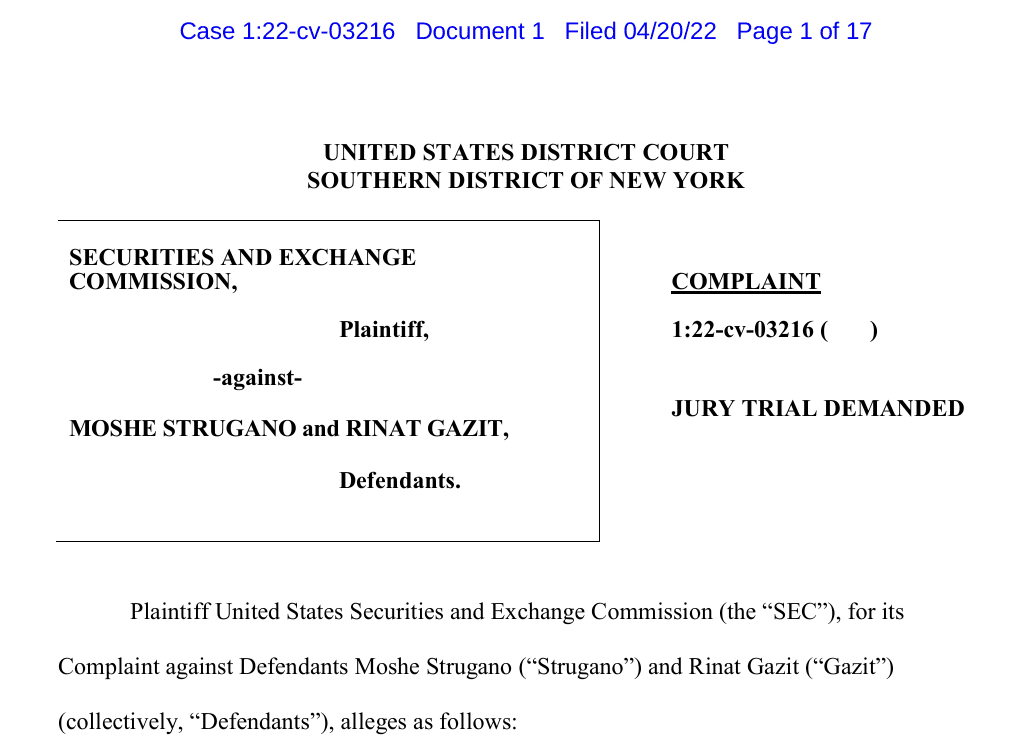
The SEC case is unusually colorful. According to the SEC complaint, Rinat Gazit, then head of mergers and acquisitions at Ormat, had access to confidential information about Ormat’s planned acquisition of U.S. Geothermal. The SEC alleges that Gazit tipped her close friend Strugano before the public announcement.
The alleged signal was almost absurdly theatrical. The SEC complaint claims that after Ormat’s board approved the transaction, Gazit sent Strugano a coded WhatsApp message about a “Peter Pan” show. Less than a minute later, Strugano allegedly tried to contact his broker and then placed orders to buy U.S. Geothermal shares.
Between December 19, 2017 and January 18, 2018, Strugano allegedly accumulated 740,650 shares of U.S. Geothermal. When Ormat announced the transaction on January 24, 2018, U.S. Geothermal’s stock price jumped. Over the following weeks, Strugano allegedly sold the position and made more than $1.2 million in illegal profits.
The SEC also alleges an attempted cover-up. Strugano allegedly told his broker to “delete all messages” concerning the trades, concealed his connection to Gazit when questioned by the Switzerland-based financial institution used for the trading, and later unfriended Gazit on Facebook to distance himself from her.
That is not a compliance footnote. That is the anatomy of alleged insider trading: access, signal, execution, profit, concealment.
The Criminal Case: DOJ Calls Him An Offshore-Company Lawyer
The U.S. Department of Justice unsealed a parallel criminal indictment in April 2022. The DOJ described Strugano as “an Israeli lawyer specializing in the creation of offshore companies” and charged him with conspiracy to commit securities fraud and securities fraud. The DOJ also stated that the United States intended to seek his extradition.
The maximum statutory penalties described by the DOJ are severe: one conspiracy count carrying up to five years in prison and two securities-fraud counts carrying maximum penalties of 20 and 25 years respectively. These are statutory maxima; any actual sentence would be determined by a court if there is a conviction.
This is why the Greek development matters. A U.S. indictment can sit in the background for years when the defendant remains outside U.S. reach. A detention in Greece transforms the case from a paper indictment into a live extradition threat.
FinTelegram’s Earlier Exposure: The Lawyer-To-Go For Binary Options Operators
FinTelegram’s Strugano file did not begin with Ormat or U.S. Geothermal. It began with the global binary-options disaster — the fraud industry that siphoned hundreds of millions from retail victims through fake trading platforms, boiler rooms, offshore companies, and payment processors.
In 2020, FinTelegram reported that Strugano was firmly anchored in the Israeli binary-options scene and had been one of the lawyers connected to the fraudulent Yukom network. Yukom was behind brands such as BinaryBook, BigOption, and BinaryOnline; former Yukom CEO Lee Elbaz was sentenced in the U.S. to 24 years in prison and ordered to pay $28 million in restitution.
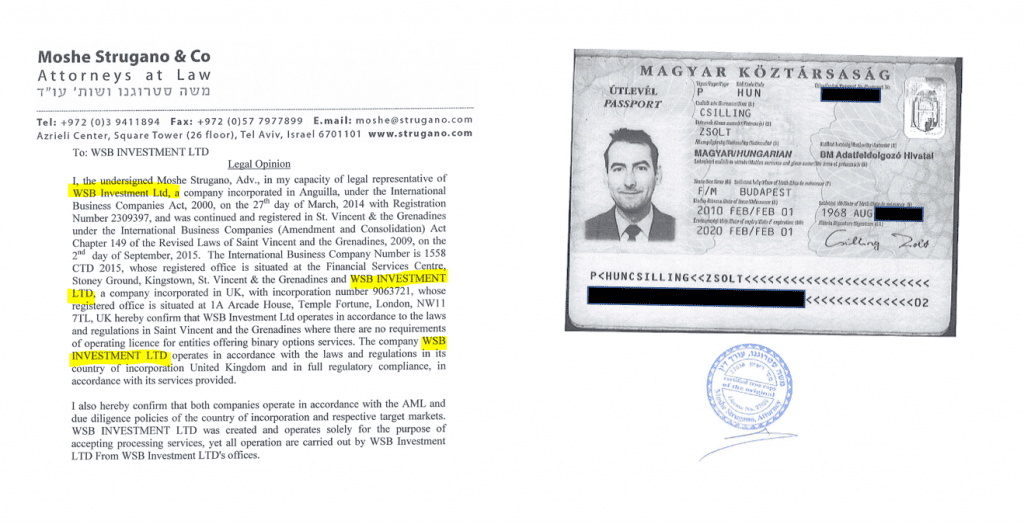
FinTelegram further reported that Strugano had provided “all-in-good-order” legal opinions for binary-options structures — opinions that were allegedly used to open bank accounts, support merchant relationships, and create a compliance façade for scam operators.
In another report, FinTelegram noted that Strugano’s own website advertised services around offshore company formation, overseas bank accounts, online payments, trustee services, clearing, licensing, and ongoing counsel for Forex, Gaming, Binary Options, and Online Trading businesses. FinTelegram described this as precisely the toolbox needed by broker scams.
The key allegation is not that Strugano merely had unpleasant clients. The allegation is that his legal opinions and offshore structuring work helped fraud operators obtain banking, payment, and corporate access that they otherwise might not have received.
The Yukom Connection: Legal Opinions As Fraud Infrastructure
The binary-options fraud model depended on more than boiler-room salespeople. It required a full infrastructure stack:
- offshore companies;
- nominee or front-man structures;
- bank accounts;
- merchant accounts;
- payment processors;
- legal opinions;
- KYC/AML comfort letters;
- and plausible deniability for operators and facilitators.
FinTelegram’s earlier reporting placed Strugano in this infrastructure layer. In the Yukom/BinaryBook context, FinTelegram reported that Strugano provided legal opinions for WSB Investment Ltd, an entity tied to BinaryBook, and that those opinions were used in the broader structure enabling the scheme’s banking and payment channels.
This is why professional enablers matter. Boiler rooms may make the fraudulent phone calls, but lawyers, trustees, company formation agents, payment consultants, and compliance letter-writers often build the rails that allow the scam to scale.
The Strugano case is therefore not only a story about alleged insider trading. It is a story about the recurring role of legal professionals in high-risk financial crime ecosystems.
Pattern Analysis: From Scam Enabler To Alleged Personal Market Abuse
The Strugano pattern, viewed across the FinTelegram archive and U.S. enforcement files, is disturbing.
First, he appears in the binary-options era as a legal-opinion and offshore-structuring figure. Then he appears in the U.S. insider-trading case as a lawyer allegedly using confidential M&A information for personal enrichment. The common denominator is not simply law. It is access: access to structures, access to bank channels, access to financial markets, access to non-public information.
In the binary-options cases, the allegation is that legal opinions helped fraud operators look clean enough for banks and payment processors. In the Ormat/U.S. Geothermal case, the allegation is that confidential deal information was converted into trading profits. Different arena, same compliance smell: the abuse of professional trust.
The SEC complaint’s alleged WhatsApp timeline is especially damaging. The supposed “Peter Pan” message, followed almost immediately by broker contact and stock-buying, reads like a textbook market-abuse case. The alleged instruction to “delete all messages” and the alleged attempt to distance himself from Gazit only deepen the red flags.
Compliance Analysis: Why Banks, PSPs, And Law Firms Should Care
The Strugano file should be required reading for banks, EMIs, PSPs, crypto exchanges, law firms, and compliance officers.
First, legal opinions are not magic shields. A lawyer’s letter does not cleanse a fraudulent business model. If the underlying merchant is a scam, a polished opinion can become part of the fraud infrastructure.
Second, offshore-company specialists are high-risk gatekeepers. When a lawyer markets company formation, trustee structures, overseas accounts, payments, clearing, licensing, and advice for Forex, gaming, binary options, and online trading, compliance teams should treat that profile as high risk — especially where retail-investor money, unregulated platforms, or opaque beneficial ownership are involved.
Third, banks should not treat “client is a lawyer” as a risk mitigant. In the SEC case, the trading reportedly occurred through a Switzerland-based financial institution, and the bank’s compliance questions allegedly triggered false explanations about an “Asian friend” and no Ormat connection.
Fourth, enforcement is increasingly cross-border. The SEC, DOJ, FBI, Israel Securities Authority, and Swiss FINMA were all referenced in connection with the U.S. case. Calcalist’s Greek arrest report now adds another jurisdictional layer: Greece as the potential extradition gateway.
The Bigger Picture: Professional Enablers Are The Real Compliance Problem
The binary-options industry did not grow into a global fraud machine because a few young salespeople lied on the phone. It grew because professional enablers built the roads: lawyers, payment processors, nominee directors, offshore agents, banks, compliance consultants, and call-center managers.
Strugano’s name belongs in that broader professional-enabler discussion. FinTelegram has reported for years that he was not a marginal figure but a recurring provider of legal scaffolding for scam networks. Now, U.S. authorities allege that he crossed the line into direct market abuse for his own account.
That makes the Greek arrest report explosive. It connects the old binary-options file with a fresh enforcement development. It also raises a question regulators should have asked years ago: how many fraud networks were enabled by legal opinions that should never have been accepted by banks, payment processors, or regulators in the first place?
Conclusion
Moshe Strugano’s reported arrest in Greece may become a turning point. For years, FinTelegram has warned that lawyers and other professional enablers were not innocent bystanders in the binary-options plague. They were part of the operating system.
The U.S. insider-trading case now adds a new layer. According to the SEC and DOJ, Strugano was not merely advising high-risk clients; he allegedly used inside information for his own profit, traded through foreign banking channels, and attempted to conceal the misconduct.
The Greek proceedings should be monitored closely. If extradition succeeds, Strugano may finally have to answer in a U.S. courtroom — not only as a lawyer with a controversial client list, but as a criminal defendant accused of securities fraud.
For the victims of the binary-options industry, the case may not deliver direct compensation. But it does send a message: the age of untouchable professional enablers may be ending.
Whistle42 Call For Information
FinTelegram invites former clients, employees, bankers, payment processors, compliance officers, victims, and insiders with information about Moshe Strugano, his law firm, related offshore structures, legal opinions, trustee arrangements, banking relationships, or links to binary-options, Forex, CFD, crypto, or gambling operators to contact us through Whistle42.