

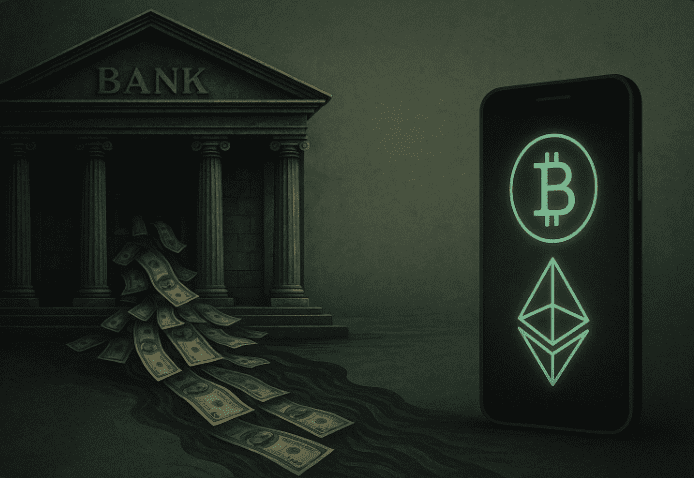
High-profile enforcement actions against Binance, N26 and (most recently) Monzo have created the impression that FinTechs and crypto firms are the drivers of modern money-laundering risk. A review of the past two decades shows the opposite: the scale, sophistication and—crucially—intent demonstrated by major TradeFi institutions such as Deutsche Bank, ING and Austria’s Meinl Bank far exceed the lapses seen so far in the FinTech space. While rapid growth and immature controls explain most FinTech breaches, traditional banks have been caught designing multi-jurisdictional schemes and have largely shielded senior executives from prosecution.
1. Framing the question
Is money-laundering (ML) and cyber-crime facilitation an “invention” of FinTechs and crypto providers?
Public discourse often answers “yes” because enforcement headlines since 2023 have clustered around digital-native players. This report tests that narrative against enforcement data, court filings and regulatory orders.
2. FinTech & crypto: growth pains, not masterminds
| Case | Nature of breach | Penalty / outcome | Key driver |
|---|---|---|---|
| Binance | Allowed illicit funds to flow through exchange; failures in KYC, sanctions screening | US $4.3 bn corporate resolution; ex-CEO Changpeng Zhao jailed four months | Hyper-growth + “move fast, ignore licenses” ethos (Sources: justice.gov,reuters.com,justice.gov) |
| N26 | Late SARs, weak onboarding, transaction monitoring gaps | €4.25 m BaFin fine (2021); growth cap of 50k new customers/month; €9.2 m fine for late SARs (2022) | Rapid customer acquisition outpacing compliance build-out (Sources: bafin.de, fintechfutures.com) |
| Monzo | Opened 34 k high-risk accounts despite prior ban; accepted obviously fake addresses | £21 m FCA fine (2025) | Early-stage control architecture could not scale with user base (Sources: fca.org.uk, thetimes.co.uk) |
Observations:
- Breaches centred on control failure, not elaborate structuring.
- Regulators moved quickly and, in Binance’s case, secured a CEO guilty plea within two years of the investigation start.
3. TradeFi: deliberate, engineered laundering
| Case | Scheme description | Penalty / outcome | Hallmarks |
|---|---|---|---|
| Deutsche Bank | “Mirror-trading” desks in Moscow & London moved $10 bn out of Russia via matching buy-sell orders | $425 m NYDFS (2017) + $630 m global; additional $150 m (2020) over Epstein & Danske correspondent failures | Complex cross-border structuring; bribed desk heads; ran for years (Sources: dfs.ny.gov, dfs.ny.gov, newyorker.com) |
| ING Netherlands | Systemic CDD failures let clients launder hundreds of millions (e.g., Uzbek telecom bribes) 2010-16 | €775 m criminal settlement (2018) | Internal investigations documented deliberate tolerance of risk; yet prosecutors refused to charge ex-CEO Ralph Hamers in 2024 (Sources: ing.com, reuters.com) |
| Meinl / Anglo-Austrian Bank | Provided offshore channels for Odebrecht & Eastern-European laundromats; licence revoked 2019 | Licence withdrawn by ECB; bankruptcy; ex-CEO Peter Weinzierl facing US extradition (2025) | Purpose-built offshore conduits; continued despite repeated warnings (Sources: occrp.org, reuters.com, amlintelligence.com) |
Observations:
- Schemes relied on bespoke offshore vehicles, nested correspondent accounts and professional gatekeepers.
- Political and legal connections slowed or blocked executive accountability (e.g., Hamers, senior Deutsche Bank management).
4. Comparative analysis
| Dimension | FinTech/Crypto | TradeFi |
|---|---|---|
| Primary cause of ML breaches | Control gaps during explosive growth | Deliberate, strategic design of laundering channels |
| Structural complexity | Limited—mostly single-layer platform misuse | Multi-layered offshore SPVs, correspondent networks |
| Regulatory response speed | Rapid (months–few years); personal liability emerging (CZ) | Slow (multi-year probes); executives often untouched |
| Political insulation | Low—new entrants without entrenched lobbying power | High—legacy institutions with deep ties to policymakers, regulators & judiciary |
FinTech may appear riskier because:
- Transparency: blockchain analytics makes illicit flows visible and quantifiable.
- Regulatory novelty: crypto attracts dedicated enforcement units.
- Media focus: “crypto crime” headlines drive clicks.
TradeFi remains the bigger systemic threat: balance-sheet scale, global correspondent reach and the professionalisation of evasion tactics magnify both volume and impact.
5. Answer to the question
Money laundering and cyber-crime facilitation are not inventions of FinTechs or crypto providers. They are longstanding features of legacy banking, perfected over decades and only partially exposed in the post-2000 enforcement wave. FinTechs have amplified risk through speed, but the intentional, large-scale engineering of laundering structures remains rooted in Traditional Finance.
6. Compliance take-aways
- Intent vs. capacity: Assess whether weaknesses stem from capacity limits (FinTech) or strategic intent (TradeFi); remediation tactics differ.
- Executive accountability: Advocate for parity—senior managers at large banks should face the same criminal exposure now applied to crypto founders.
- Political-economy lens: Recognise lobbying and “revolving doors” as residual AML risk factors in TradeFi.
- Holistic monitoring: Combine blockchain analytics with classic correspondent-banking surveillance; illicit actors arbitrage both realms.
- RegTech adoption: Encourage incumbents to learn from FinTech’s tech-first controls (real-time screening, machine-learning SAR triage) while FinTechs adopt robust governance frameworks earlier in their growth curve.
Conclusion
FinTech and crypto have revealed fresh AML vulnerabilities, but they did not invent them. The historical record shows that some of the most audacious, politically shielded money-laundering operations were—and still are—embedded in traditional banks. Future enforcement credibility hinges on regulators applying equal intensity and personal-liability standards across both sectors.