



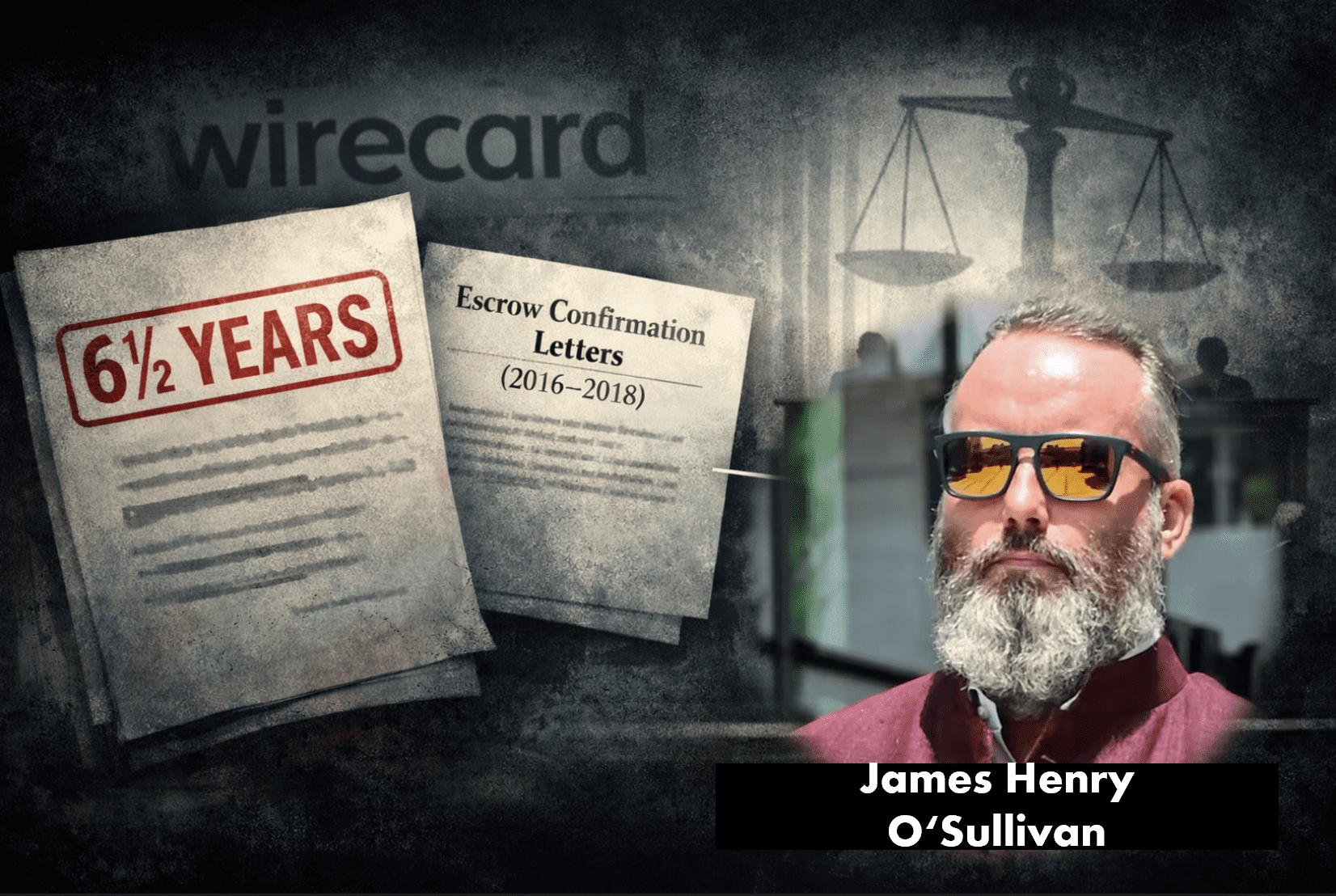
A Singapore court has sentenced British citizen James Henry O’Sullivan to 6½ years in prison for abetting the falsification of Wirecard-linked escrow/balance confirmation letters—paperwork used to convince auditors that hundreds of millions of euros sat safely in escrow accounts. The FinCrime Observer (FCO) brief covered the verdict and defendants. FinTelegram’s angle is different: Singapore is doing what Germany’s watchdogs and parts of its justice system refused to do for years—treat Wirecard’s “Asia cash” narrative as a criminal red-flag, not a PR nuisance.
Key Points
- Singapore sentencing (Jan 6, 2026): O’Sullivan 6½ years; Citadelle director Rajaratnam Shanmugaratnam 10 years (appeals announced) (Source: Reuters, Financial Times).
- Core conduct: falsified confirmations (2016–2018) meant to mislead auditors into believing Wirecard held large sums in Singapore escrow accounts.
- Why this matters for Munich: German prosecutors allege Wirecard’s profits were inflated by invented “third-party acquiring” (TPA) business “especially in Asia,” with group accounts 2015–2018 misstated and the fraud culminating in the €1.9bn hole revealed in June 2020 (Sources: Justiz Bayern).
- Regulatory failure (Germany): BaFin and prosecutors spent key periods targeting journalists and short sellers; BaFin even imposed a Wirecard short-selling ban in Feb 2019.
- Accountability moment: BaFin president Felix Hufeld ultimately left his post after the Wirecard collapse exposed supervisory failure (Source: Reuters).
Short Narrative

Singapore’s verdict reads like a compressed anatomy lesson: fake paper → fake cash → audit comfort → market deception. O’Sullivan and Shanmugaratnam were convicted over letters that “confirmed” escrow balances Wirecard did not have (Source: Reuters).
In Germany, the same “cash-in-Asia” storyline metastasized into one of the biggest post-war corporate frauds. And here is the uncomfortable part: the scandal is not only about Wirecard’s executives—it is also about Germany’s regulators and parts of its justice apparatus choosing the wrong enemy (Source: Reuters).
Extended Analysis
1) What exactly was proven in Singapore
According to Reuters and Financial Times reporting, the Singapore case focused on falsified escrow/balance confirmations used to mislead Wirecard’s auditors (commonly referenced as EY in coverage) about the existence of large Wirecard-linked funds in Singapore.
This is important: Singapore did not “try the whole Wirecard collapse.” It convicted a high-leverage document-fraud mechanism that made a broader fraud believable.
2) Munich: what German prosecutors say (and what the indictment covers)
The Staatsanwaltschaft München I has publicly stated (in its 2022 announcement of the first main indictment) that Wirecard executives and associates allegedly fabricated highly profitable business—“especially in Asia”—and that consolidated accounts 2015–2018 were false because they booked revenue attributed to TPA business.
That framing matters for the Singapore connection: escrow confirmations functioned as “cash proof” for the very Asia-centric partner narrative prosecutors describe.
FinTelegram’s critique remains: even this large indictment window risks being too narrow for a structure that—by multiple public accounts and earlier red flags—shows warning signs before 2015/2016. The public record of “why didn’t anyone stop this earlier?” remains a governance scandal in its own right.
3) How Singapore and Munich are connected
They are connected by the same underlying claim: Wirecard’s “third-party business in Asia” (and the associated cash story) was propped up with manufactured evidence.
- Munich prosecutors allege the group’s financial picture was distorted by fabricated TPA business and misstated accounts.
- Singapore courts have now delivered convictions on a key supporting artifact: forged/falsified confirmations designed to persuade auditors the money was there.
So yes: the Singapore conviction is directly related to the “non-existent third-party business in Asia” and the “missing millions/billions” thesis as advanced by German prosecutors—because it targets the documentary scaffolding that made those numbers auditable and sellable.
4) BaFin + German judiciary: the shameful inversion
Wirecard is now widely described as Germany’s biggest post-war corporate fraud.
Yet in 2019—after Financial Times reporting and short-seller scrutiny—BaFin’s reflex was to shield “market confidence,” not interrogate the issuer:
- BaFin banned short-selling of Wirecard shares in February 2019 (Source: Reuters).
- German prosecutors later dropped the probe into FT journalists; Reuters reported the Munich prosecutor said the FT’s reporting was “fundamentally correct,” and the FT statement called BaFin’s complaint “unfounded” (Source: Reuters).
- Reuters also documented the broader pattern: for years, BaFin and prosecutors focused on investors and journalists who highlighted irregularities (Source: Reuters).
This is why Hufeld’s departure wasn’t “just personnel.” It was a delayed admission that Germany’s supervisory model—and the prosecutorial instincts around Wirecard—failed at a systemic level.
Call for Information
Do you have documentation on Citadelle confirmations, escrow account claims, TPA counterparties, or German supervisory/prosecutorial decision-making pre-2016 (including interactions with BaFin, FREP, prosecutors, or political offices)? Send tips securely via Whistle42.com.