


How a Vienna “World Economic Council” Network Turned Up in the Middle of Secret-Service-Style Ops and Gold Deals
The latest revelations by the Austrian news outlets Krone and News about the “forensic project” run through the law firm of Vienna attorney Stefan Prochaska add a new – and troubling – dimension to the already dramatic Signa/Benko scandal. They also sharpen the focus on the World Economic Council (WEC) network and its key figures, Thomas Limberger, Robert Schimanko, and Moshe Buller, about whom FinTelegram has been reporting for months.
The Latest Exposures
According to internal correspondence and billing records obtained by News and Krone, Prochaska’s firm coordinated a so-called “forensic” project for Signa in 2023, for which around EUR 800,000–1,000,000 in costs accrued – 90% of which were passed on as “third-party services”. These invoices reveal that external security contractors were embedded in the project, including the Estonian-Austrian security firm Seitenberg around Kyrill Lapin.
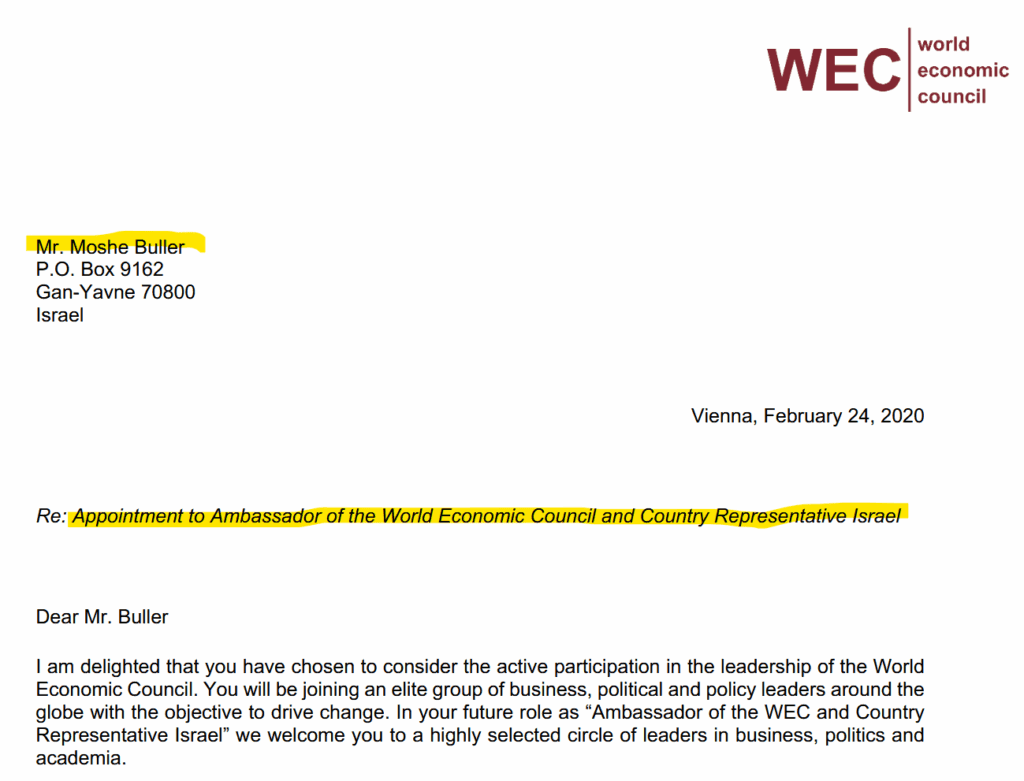
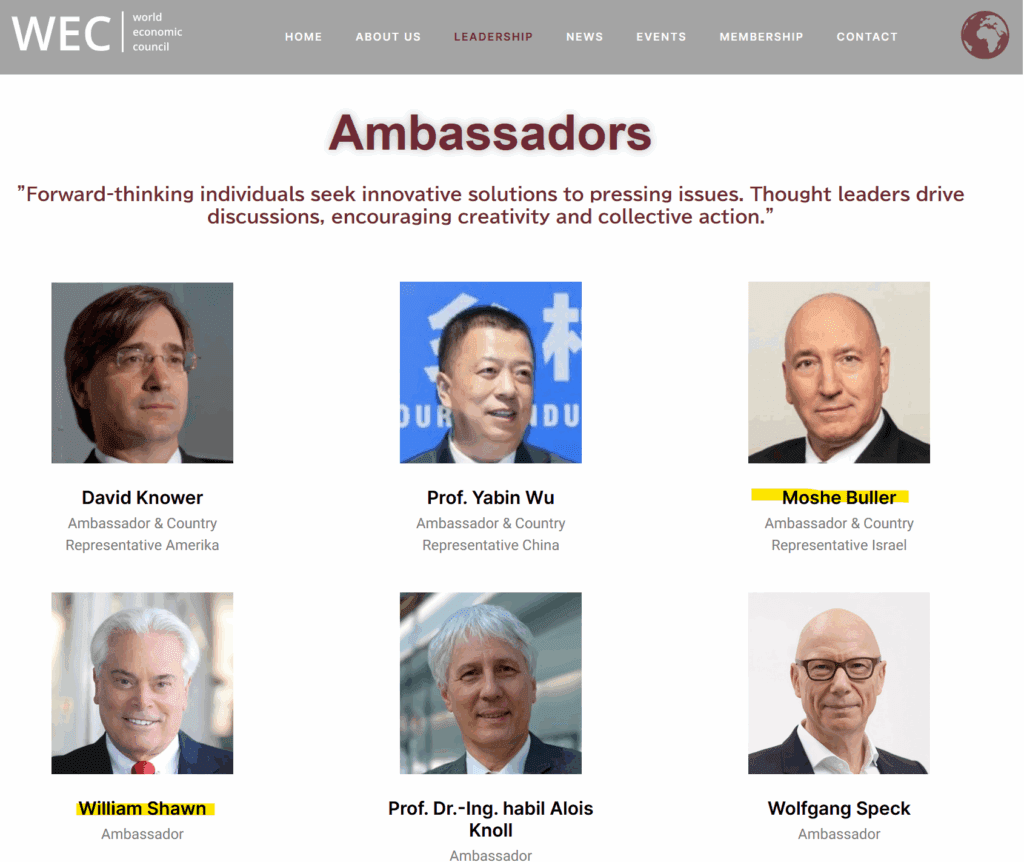
Separately, documents published by News show that the Israeli ex-intelligence officer Moshe Buller and his International Intelligence Agency (IIA) were formally mandated by Signa in February 2023 to “investigate” long-time Benko confidant Dieter Berninghaus – an operation explicitly requested by “two senior Signa managers and a Vienna law firm.” Buller is not just any private operative: he appears as a “WEC Ambassador” on the website of the Vienna-registered World Economic Council GmbH (WEC) and was appointed by WEC in a formal letter in 2020 (read more here).
The WEC has since removed the ambassadors from its website. Apparently, things have gotten a little too heated for people in the Signa/Benko camp.
Download Moshe Buller’s Appointment Letter here.
In parallel, FinTelegram has already documented how WEC leaders Limberger and Schimanko moved into the heart of the Benko foundation structure in late 2024 – just before and after the collapse of Signa – and how the INGBE Foundation in Liechtenstein then sold 360 kilograms of gold worth more than EUR 30 million in March 2025, while Benko was already in pre-trial detention (Sources: Krone, Puls24, FinTelegram).
Taken together, these strands raise a central forensic question:
Was the WEC network – directly or indirectly – part of a coordinated strategy to shield assets and manage intelligence operations for Benko, orchestrated via the law firm Prochaska?
FinTelegram does not assert this as fact, but the pattern of overlaps demands closer scrutiny.
1. Prochaska’s “Forensic Project”: Legal Advice or Covert Operations Hub?
The News article on “Benko-Anwalt Stefan Prochaska: Der Mann fürs Grobe” describes internal emails from Signa’s then CFO Arthur Mühlberger, who complains about the soaring costs of Prochaska’s “forensic” project – nearly EUR 1 million, largely composed of external “Fremdleistungen” (third-party services).
Key points:
- Prochaska’s invoices to Signa contain high five-figure cash expenses and extensive “third-party” positions.
- In the billing details, the name of a staff member of Seitenberg, a security company with offices in Tallinn, Tbilisi and Vienna, appears repeatedly.
- The article notes that Prochaska and Seitenberg’s managing partner Kyrill L. are also linked corporately.
- The services were apparently re-invoiced via the law firm to Signa, with poor internal transparency, prompting Mühlberger to demand detailed breakdowns of all cash expenses and service logs.
In a nutshell:
Prochaska’s firm seems to have functioned as billing and coordination hub for opaque external “forensic” and security operations – a setup that offers both legal privilege and layering of responsibility.
When we place this beside the operations documented for IIA/Moshe Buller, the picture sharpens:
- News shows a confidential IIA report in which Buller confirms that his agency was hired “in February 2023, after a meeting with the client” to investigate Berninghaus – expressly on behalf of Signa and Benko, commissioned by “two senior Signa managers and a law firm in Vienna.” News.at
- The objective was to determine whether Berninghaus was a “risk person” for Signa/Benko – the classic language of internal surveillance and control.
The logical inference – which investigators will now have to test – is that Prochaska’s “forensic” budget may have served as an umbrella for such intelligence contracts, channeled through a legally privileged structure.
2. WEC Enters the Scene: Ambassadors, Foundations, and Gold
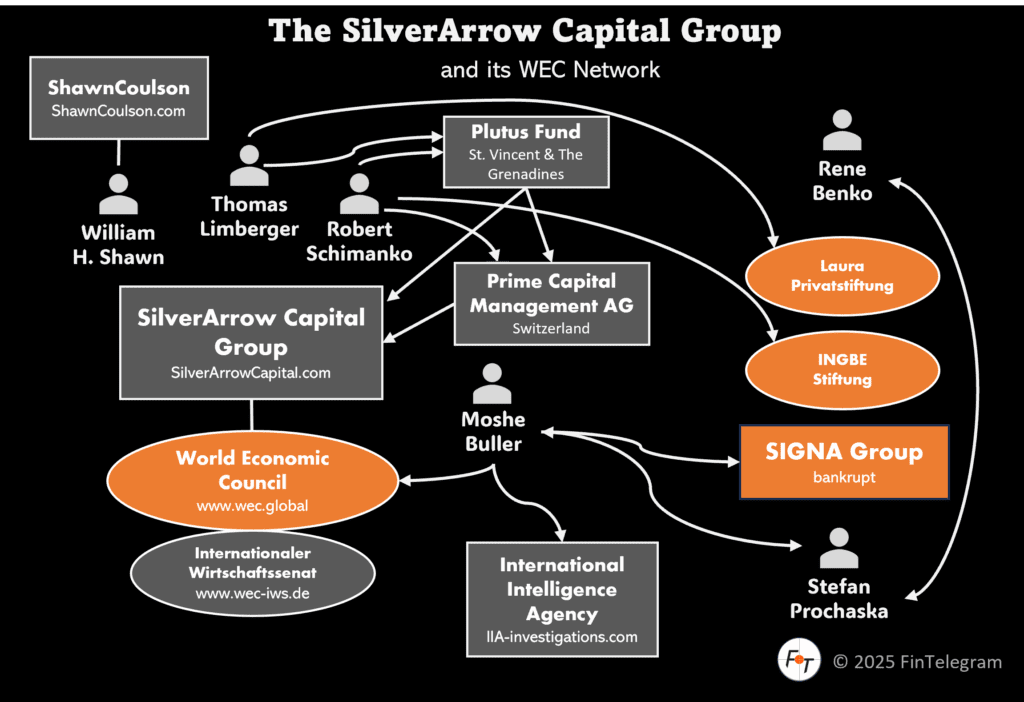
FinTelegram has extensively mapped the World Economic Council (WEC) ecosystem: a for-profit GmbH in Vienna (WEC World Economic Council GmbH) with a deliberately WEF-like brand, tied to the Berlin-based NGO IWS-WEC, and closely interwoven with the SilverArrow Capital Group of bankers Thomas Limberger and Robert Schimanko.
Read our reports on the WEC here.
Some facts already established:
- WEC Board / Partners
- Thomas Limberger – former Oerlikon CEO, co-founder of WEC, SilverArrow partner.
- Robert Schimanko – former banker with past links to the Manhattan Investment Fund and Madoff feeder structures, WEC partner and IWS supervisory board member.
- Peter Nussbaum – WEC partner and chairman of IWS-WEC.
- WEC Ambassadors
- Moshe Buller – Israeli intelligence and cybersecurity specialist; founder of International Intelligence Agency (IIA); formally appointed as WEC Ambassador in 2020 and, according to Austrian media, engaged by Signa to spy on top manager Berninghaus and his family.
- US lawyer William H. Shawn.
- Benko Foundations
- In November 2024, Limberger and Schimanko joined the boards of the two key Benko foundations:
- Laura Privatstiftung (Austria) – Limberger as board member.
- INGBE Stiftung (Liechtenstein) – Schimanko as board member.
- In November 2024, Limberger and Schimanko joined the boards of the two key Benko foundations:
- Gold Sale
- On 11 March 2025, during Benko’s pre-trial detention, the INGBE Stiftung sold more than 360 kg of gold for around EUR 30 million, credited to an account at a Liechtenstein private bank. The sale triggered a suspicious transaction report to the Liechtenstein FIU, which was passed to the Austrian WKStA.
- Historical records show that INGBE held gold worth over EUR 81 million in 2021 and still around EUR 45 million in mid-2022, plus roughly EUR 23 million in cash and currency reserves.
Read more about the Asset Whisperer Schminko here.
The WKStA has described the gold sale as “practical rather than economic”, suggesting an intention to move assets beyond the grasp of European authorities and explicitly citing this as evidence of flight and concealment risk.
It is against this backdrop that the presence of three WEC-linked figures – Limberger, Schimanko, and Buller – in the immediate operational environment of Benko’s asset structures and intelligence operations becomes highly relevant.
3. Hypothesis: Was WEC’s Network Part of a Pre-Collapse “Shielding” Strategy?
FinTelegram emphasizes: At this stage, there is no judicial finding that WEC, its officers, or its ambassadors have committed crimes in the Benko matter. However, based on publicly available information, the following working hypothesis is reasonable and should be examined by investigators:
Hypothesis:
Starting no later than 2023, a network around WEC and its partners – including SilverArrow Capital and the IIA of WEC Ambassador Moshe Buller – was used, via the law firm of Stefan Prochaska, to gather intelligence on internal critics and key partners (e.g. Berninghaus) and to prepare and execute asset protection measures, including foundation restructuring and the monetisation/transfer of gold and other assets.
This hypothesis is supported by:
- Temporal Sequence
- 2023: Prochaska’s “forensic project” with high external security costs; IIA/Buller mandated to surveil Berninghaus on behalf of Signa/Benko and a Viennese law firm.
- 2024: WEC partners Limberger and Schimanko move into two core Benko foundations.
- March 2025: INGBE (with Schimanko on board) sells 360 kg of gold for EUR 30+ million during Benko’s detention, triggering a money-laundering alert.
- Functional Roles
- Prochaska as legal coordinator and billing node for covert “forensic” and intelligence services.
- Buller/IIA as covert intelligence operator, officially mandated to monitor a key insider.
- Seitenberg as another security contractor integrated into the same cost structure.
- Limberger & Schimanko as post-collapse foundation controllers, overseeing structures that held significant hidden assets (gold and art).
- Organisational Overlay: WEC
- WEC is not an NGO but a private GmbH in Vienna, positioning itself – in its own marketing – as an elite economic council and global network.
- Its ambassador system (including Buller and US lawyer William H. Shawn) provides a ready-made international platform for intelligence, lobbying, and financial structuring around high-risk clients.
From a forensic perspective, such a network has all the hallmarks of a dual-use structure:
- Outwardly: a high-end business and policy network.
- Inwardly: potentially a toolbox for crisis management, including information control, surveillance, and asset migration.
Whether this toolbox was used to help locate missing investor money or to shield Benko’s private wealth from creditors is precisely the question prosecutors now need to resolve.
4. Key Questions for Prosecutors and Regulators
FinTelegram believes the following questions are central and demand answers:
- Mandates & Money Flows
- Which exact mandates did the law firm of Stefan Prochaska sign in relation to “forensic” or security services for Signa?
- Did these mandates explicitly cover IIA/Moshe Buller, Seitenberg, or other WEC-linked persons or entities?
- Were WEC or SilverArrow-related entities directly or indirectly compensated from Signa, its subsidiaries, or Benko-controlled foundations?
- Role of WEC in Foundation Governance
- What was the concrete decision-making role of Limberger and Schimanko in the Laura and INGBE foundations, particularly in:
- the sale of 360 kg of gold,
- the movement of art and other high-value assets,
- any restructuring or change of beneficiaries?
- Did they approve or facilitate transactions that weakened creditor positions?
- What was the concrete decision-making role of Limberger and Schimanko in the Laura and INGBE foundations, particularly in:
- Intelligence & Surveillance
- To what extent did IIA and other security contractors target journalists, former insiders, or critical business partners – and on whose legal instruction?
- Were these operations primarily for risk management – or to intimidate and silence potential witnesses and whistleblowers?
- WEC’s Governance & Discovery Duties
- Did WEC introduce internal policies to prevent its platform from being used in connection with controversial or criminal activities?
- Once the Signa situation escalated, were any steps taken within WEC or IWS-WEC to distance the organisation from Benko and his structures – or did integration deepen?
5. Call to Whistleblowers: Help Clarify WEC’s True Role
FinTelegram and its German-language network platform Wiener Zocker see the emerging WEC–Benko–Prochaska–Buller constellation as a high-risk nexus at the intersection of:
- elite business networking,
- opaque foundation and offshore structures,
- and private intelligence operations targeting insiders and critics.
We stress again: We are not accusing WEC, SilverArrow, or the individuals named of proven illegal conduct. We are, however, stating that the convergence of roles, timelines, and money flows raises serious and legitimate questions in one of Europe’s largest white-collar crime cases. To get to the bottom of this, we need insiders:
Use our whistleblower platform Whistle42. The gold trail, the “forensic” invoices, and the WEC network are no longer just background noise – they may be central elements in understanding how assets and information were managed around René Benko and Signa.
We will continue to follow the money. And with your help, we will also follow the truth.