

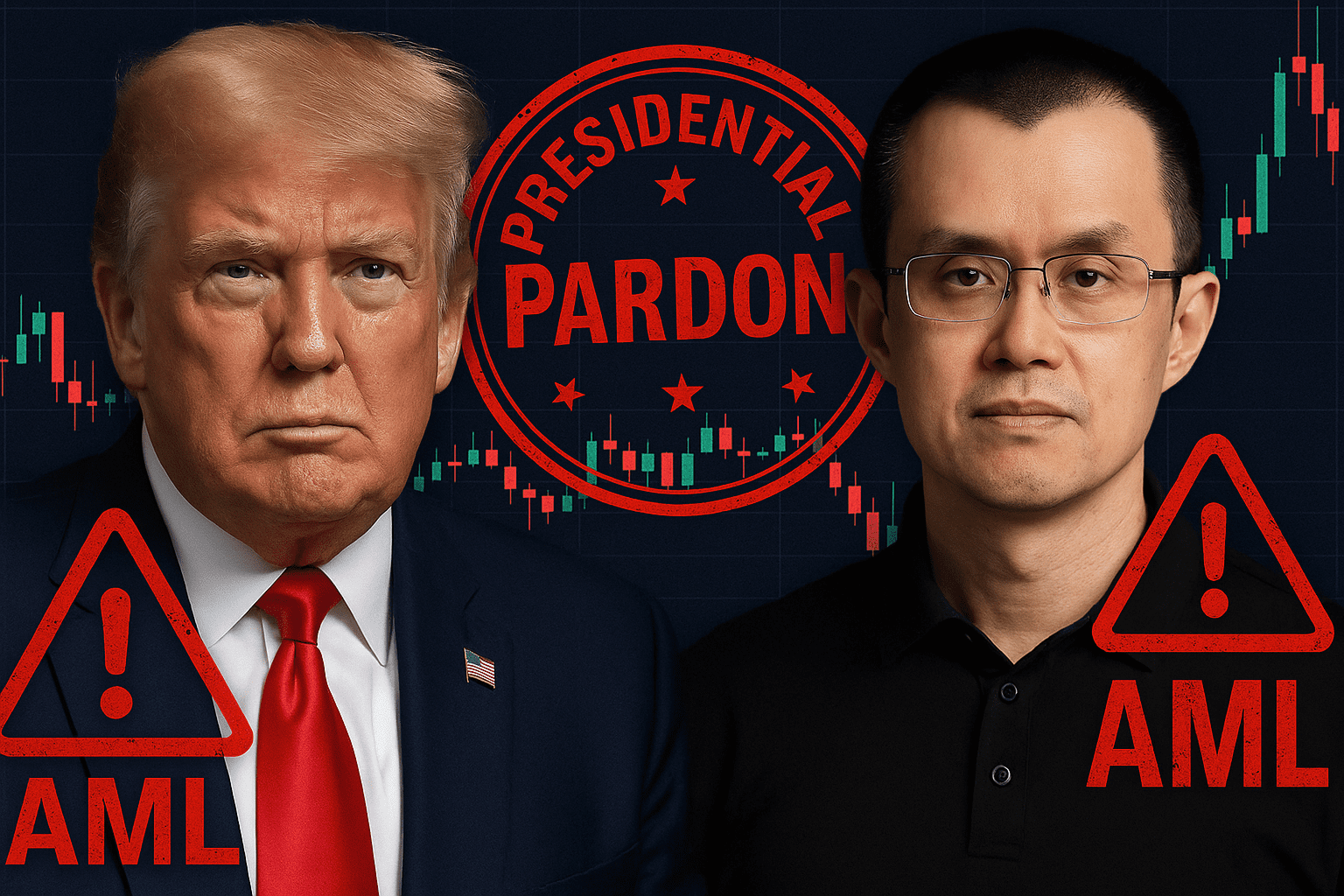
Donald Trump has pardoned Changpeng “CZ” Zhao, the former Binance CEO who admitted to criminal anti–money laundering failures that helped move funds for terrorists, cyber-criminals, and child abusers. Now, in a surreal twist, Trump claims on 60 Minutes he “doesn’t know” the billionaire he just rescued – even as Binance is financially entangled with his family’s own crypto venture.
Key Points
- The conviction: In November 2023, CZ pleaded guilty to violating the U.S. Bank Secrecy Act by willfully failing to implement an effective AML program at Binance, which enabled illicit flows through the platform (Source: justice.gov).
- Systemic AML failures: U.S. authorities found Binance allowed billions in transactions from sanctioned jurisdictions and high-risk customers, including links to terrorist groups and child abuse material. The platform failed to report over 100,000 suspicious transactions (Source: nypost.com).
- Record penalties: Binance agreed to pay over $4.3 billion in criminal and regulatory penalties; CZ paid a $50 million fine and stepped down as CEO (Source: justice.gov).
- The pardon: On 23 October 2025, Trump granted CZ a full and unconditional presidential pardon, effectively erasing the federal conviction while leaving his admissions and the Binance monitorship intact (Source: Wikipedia)
- Conflict-of-interest alarm: The pardon came after Binance entered a multi-billion-dollar deal around USD1, the stablecoin of World Liberty Financial, a crypto venture tied to Trump’s sons and allies, raising “pay-for-play” concerns (Source: TIME).
- “I don’t know who he is”: In a 60 Minutes interview, highlighted by CNBC and others, Trump claimed he has “no idea” who CZ is, insisting he relied on recommendations and dismissing the prosecution as a Biden “witch-hunt” (Sources: CNBC, The Daily Beast).
- Pattern of clemency: CZ joins a growing list of white-collar and crypto offenders benefiting from Trump’s aggressive use of clemency in his second term, including Ross Ulbricht and Trevor Milton.
Short Narrative
On paper, the case of United States v. Changpeng Zhao was a landmark in crypto enforcement. The DOJ, Treasury, FinCEN, OFAC, and the CFTC coordinated a global action against Binance, accusing it of building the world’s largest crypto exchange by simply switching compliance off: no effective KYC, no real sanctions screening, and a deliberate focus on volume and profit over the rules (Source: thelaundrynews.com).
Prosecutors said the result was predictable: Binance processed flows from sanctioned regimes and high-risk actors, including terrorist organizations and dark-web markets, and failed to report massive volumes of suspicious transactions. Treasury officials openly accused Binance of having “turned a blind eye” to its obligations, allowing money to flow to terrorists, cyber-criminals, and child abusers (Source: nypost.com).
CZ took a plea, accepted a four-month prison sentence, and watched Binance agree to more than $4 billion in penalties and a multi-year independent monitorship plus an exit from the U.S. market. For global AML enforcement, it looked like a watershed moment: no one is too big to prosecute (Source: thelaundrynews.com)
Then Trump signed the pardon – and blew a hole through that narrative.
The pardon landed just as Binance deepened its financial links to World Liberty Financial, the Trump-family-aligned crypto project behind the USD1 stablecoin. A Senate letter and investigative reporting underline how Zhao’s pardon campaign ran in parallel to Binance’s role in boosting World Liberty’s capitalization.
Days later, on 60 Minutes, Trump shrugged at the uproar and told Norah O’Donnell – and, via CNBC and others, the world – that he had “no idea” who CZ is and that he simply heard the case was a Biden “witch hunt.”
Extended Analysis – Compliance View
From a compliance and rule-of-law perspective, the CZ pardon is a live-fire stress test of U.S. AML credibility.
- Signal to the market: enforcement is negotiable.
CZ did not plead guilty to a technical reporting error. The DOJ and Treasury framed Binance’s behavior as a deliberate commercial strategy that enabled sanctions breaches and serious crime. Turning around and pardoning the architect of that strategy – while his company partners with the president’s family – tells every offshore exchange: If you’re big enough and politically useful enough, there’s an escape hatch. - Potential textbook case of “pay-for-play” optics.
The timeline is toxic:- 2023–2024: guilty pleas, record fines, monitorship. Early 2025: Binance and World Liberty Financial announce a multi-billion-dollar USD1 deal that supercharges the Trump family’s crypto brand. October 2025: Trump signs the full pardon.
- The “I don’t know him” defense undermines governance.
Trump’s claim on 60 Minutes that he doesn’t know CZ and relied on others’ advice is not exculpatory – it’s damning. It suggests the U.S. president is willing to override a multi-agency enforcement action without understanding the underlying conduct, the monitorship, or the national-security implications. - Knock-on effect: regulatory backlash elsewhere.
For EU and UK regulators pushing MiCA-style and FSMA-style regimes, this pardon will be cited as proof that U.S. enforcement can be neutralized politically. Expect more insistence on local licensing, ring-fenced compliance, and reduced reliance on U.S. precedents in crypto cases. - For Binance, this is reputational, not legal, relief.
The pardon does not erase Binance’s guilty plea, the monitorship, or the factual record in DOJ and Treasury documents. Civil suits, private litigation (including terror-finance claims), and regulatory supervision all continue. But politically, Zhao can now present himself as “cleared” – a narrative many retail users and promoters will happily adopt.
Actionable Insight (for Regulators, Banks, and Investors)
- Treat Binance and any Trump-family-aligned crypto ventures as a combined high-risk cluster. Political proximity does not mitigate AML risk – it amplifies it.
- Do not downgrade risk ratings based on the pardon. For sanctions/AML purposes, rely on the original DOJ/Treasury record and ongoing monitorship, not on the political clemency.
- Enhance PEP and conflict-of-interest screening for any counterparties linked to World Liberty Financial, USD1, or similar vehicles that benefit from this pardon.
- Document your rationale. Supervisors will ask why your institution continued or discontinued relationships in light of the CZ pardon. Build that paper trail now.
Call for Information
Do you have information about violations of compliance or financial laws? Then share it with us via our whistleblower system, Whistle42.